Saturday, 23 July 2016

Plas Newydd

I am often asked the question "Scone Blogger, what inspires you to visit one National Trust property over another? Why a flour mill in Hebden Bridge over a dovecote near Biggleswade?" The answer is that there are many factors. I obviously look for scone potential. I like a dollop of historical scandal. A priest hole is always a bonus, as is a cat.

But when it comes to Plas Newydd on Anglesey, I had one reason and one reason alone for wanting to visit. Here it is: 


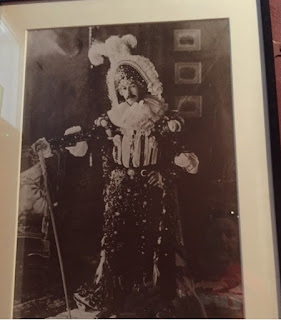
This, my friends, is a picture of Henry Cyril Paget, the 5th Marquess of Anglesey. You're probably shaking your head right now, thinking "that Freddie Mercury has a lot to answer for" but Henry Cyril DIED IN 1905! This picture was taken before 1905! My mind was blown.


But there's a lot more to Plas Newydd than Henry Cyril and his prediction of glam rock a full 70 years before it happened. Let's start at the very beginning: 


Plas Newydd


1. It's near a village called Llanfairpwllgwyngyll
Llanfairpwllgwyngyll has the longest single word place name in Europe, and the second longest in the world, apparently. I'm so glad that this is a written project AND that copy and paste exists. 

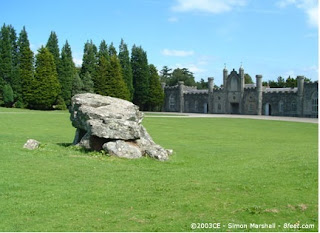
2. Plas Newydd has a 5000 year-old burial place! 
A long, long, long, long time ago, someone took the trouble to push five big boulders together to create a burial chamber (or cromlech) for a Neolithic chieftain - and it's still there today! Anglesey was a stronghold of the Celtic Ordovices tribe and its Druid leaders apparently - the Romans referred to Anglesey as Mona but failed to conquer it until 79AD, when they massacred everyone.


Cromlech Plas Newydd

3. Plas Newydd in Tudor times!  
In the 15th century, Plas Newydd belonged to the Griffiths family, passing to the Bagenals through marriage and then, in the early 17th century, to the Baylys, also through marriage. 

4. Then came the Pagets! 
In 1737, Sir Nicholas Bayly married Caroline Paget. Her great-great-great-great grandad, William, had been made 1st Baron Paget following a successful career in the courts of Henry VIII and Edward I. When the 8th Baron Paget died, Caroline and Nicholas's son Henry was next in line, so he changed his name and took the Paget title to Plas Newydd. 

5. Henry built a new Plas Newydd! 
Henry rebuilt Plas Newydd in a hybrid Neo-classical-Gothick style, which is the house we see today.

6. 'One Leg' Henry delivers the scandal! 
Henry's son, also Henry, was a very interesting character. He made a name for himself through his military escapades during the Napoleonic Wars, before scandalising society by leaving his wife and eloping with the Duke of Wellington's sister-in-law. 

Henry and the Duke were presumably friends again by 1815 when they fought together at Waterloo. The guide book describes the moment Henry lost his leg; "By God, sir, I've lost my leg!" he is claimed to have said to Wellington, who replied "By God, sir, so you have!" Henry then had what was left of his leg amputated with no anaesthetic. He was made 1st Marquess of Anglesey for his efforts and his prosthetic leg is on display in the house. 

7. Then came Henry Cyril! 
Henry 'One Leg' actually did very little to Plas Newydd, and nor did his son or eldest grandson. His second grandson, the 5th Marquess, was the Henry Cyril mentioned above. There was always gossip about whether his real father was actually a French actor, and Henry's love of acting and jewellery did little to dispel those rumours. 

He built a theatre at Plas Newydd by converting the chapel into the 'Gaiety Theatre'. The first production was Aladdin, in which he had a starring role. He also did his solo Butterfly Dance, after which he handed out photographs of himself to a baffled audience. 

But it all ended badly, with debts of £544,000 and bankruptcy in 1904, followed by his untimely death aged 30 in a hotel in Monte Carlo a year later. Poor old Henry Cyril - they even sold his pet dogs, complete with their little silk jackets embroidered with his coat of arms. Where did it all go wrong. 

8. Rex Whistler did the dining room mural! 
The 6th Marquess was Henry's cousin Charles. He sorted out the debts and turned Plas Newydd into a comfortable country house - many of the rooms are presented as he and his wife, Marjorie, had them, with 1930s style bathrooms and bedrooms. 

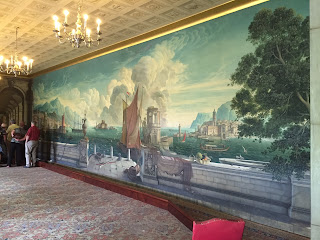
Charles and Marje were also great friends and supporters of Rex Whistler, and he painted an enormous mural for their dining room. It takes a few liberties with reality - he painted the mountains of Snowdonia behind a harbour scene featuring a Venetian gondola and some baroque buildings he had seen in Austria - but what's wrong with that? He put himself in it too, pushing a broom.


Rex Whistler mural

9. The NT took charge in 1976! 
Lady Marjorie must have been one very relieved woman when she gave birth to twins in 1922 and one of them was a boy - she'd already had four girls. In 1976, however, the 7th Marquess gave Plas Newydd to the National Trust, although he continued to live there until he died.  

10. The views are stunning!
The house is in the most fantastic location - overlooking the Menai Straits and the Menai Bridge (as you can see below) while also facing the mountains of Snowdonia. It's a stunning spot and I highly recommend you spend a day there.


Plas Newydd Menai Straits

The Plas Newydd scone
But let's move on to the scones. I had already had a very disappointing scone experience by the time I got to Plas Newydd and so my expectations were low. 
We did make the same mistake of going into the first tea room that we saw - there's another one nearer to the house - but this time it didn't matter at all; the scone was absolutely delicious. It was fresh as anything, light but substantial, and very tasty. 

Plas Newydd scone

But let's end with another picture of Henry Cyril (or Toppy as he was known to his chums). What a legend. 


Henry Cyril Paget


Plas Newydd: 5 out of 5
Scone: 5 out of 5 
Henry Cyril "Toppy" Paget, God bless him: 5 out of 5 

Other properties we've been to in Wales: Aberdulais Tin Works, Bodnant Garden, Chirk Castle, Dyffryn Gardens, Erddig, Penrhyn Castle, Powis Castle, Tredegar House

Penrhyn Castle

What would you do if you received a call one day saying that Alan Sugar had died leaving everything to you in his will? All of his businesses (even that plastic surgery one) and a huge sprawling estate with a house on it? The only drawback being that the estate is in North Wales and you live miles away and have never even been to North Wales?

This is sort of what happened to a man called George Hay Dawkins in 1808. His distant cousin, Richard Pennant, was the owner of sugar plantations in Jamaica as well as slate quarries in Wales. When he died childless, he left everything to George.

I don't know what you would do - I don't even know what I would do - but George decided to spend 20 years and an estimated £100 million in today's money building Penrhyn Castle:


Penrhyn Castle

Yes, this ancient-looking fortress might look a thousand years old but it was actually built less than 200 years ago. George didn't want to build a Georgian house - with its location high on a hill near to Caernarfon Castle and Conwy Castle, he wanted something spectacular. 20 years and a king's ransom later, he got it. 

But if you think the exterior is impressive, you should see the inside. It is quite literally STUPENDOUS and probably the most amazing interior I have ever seen at the NT. 

And I wasn't alone in thinking this. The Scone Sidekick is a builder and when I am wandering around NT properties admiring scones and cats and pictures of scandalous adulterers, he is looking at door hinges and examining flooring. At the end of today's visit he said simply "I am speechless". Which says it all. 

This is the Library - the elaborate ceilings and carved wooden door and window frames give you a tiny bit of insight into what the place is like - but you really have to see it to believe it:


Penrhyn Library

Let's go back and take in a bit of early Penrhyn history:

  • The Penrhyn estate was founded by Gwilym ap Gruffydd in the 14th century 
  • It remained in the Griffiths family until 1617, when Rhys Griffiths had to forfeit the place - he was apparently a pirate who ended up being put in the Fleet prison by his own father-in-law
  • It was bought by a John Williams who became Archbishop of York - the guidebook quotes a biographer on how John fell from a wall as a child and "the fall was on so critical a part as ever to secure him from all reproaches of unchastity". Eek!
  • The Penrhyn estate was broken into chunks as it was passed down through the Williams family
  • In 1765, Richard Pennant married an heiress who owned a portion of Penrhyn - his father and uncle bought up the rest of it and it eventually all belonged to Richard
  • Richard took over all of the slate quarries in the Penrhyn area and reformed production, turning it into a very successful industry
  • He also modified the house, adding Gothic style turrets
When Richard died, George decided to replace the house that Richard had created and work started on his 'fairy castle'. It was built using local oak, slate, marble and a workforce that had been laid off from the quarries during difficult times for the industry.

It is very sobering to look at Penrhyn knowing that it was built on the profits of slavery - our friend George opposed the electoral reform that led to the emancipation of slaves in 1833, and he was paid almost £15,000 for the 764 slaves that were freed from his estates. 

The views from the castle are also spectacular, taking in the mountains of Snowdonia and the Menai Strait:

Views from Penrhyn

The Penrhyn scone
Let's move on to the scones. I'm not going to go into detail about the whole saga, because things go wrong for all of us sometimes and the poor service was probably just unfortunate. 

However, the fact remains that the scone tasted stale, I took it back, and the staff refused to accept it - they insisted they'd been baked that morning. I was really disappointed about this, because:

  • I've eaten scones at 130 NT properties 
  • I've only ever sent 1 of them back for being stale - I've scoffed the other 129 without complaint
  • We had travelled 200 miles to Penrhyn Castle
  • We were very, very hungry
  • I don't like complaining

But the staff didn't know any of that - presumably they just thought that I was making it up or being difficult or trying to get something for nothing. I don't know. We were just left with two scones that we couldn't eat.

Penrhyn Castle scone

Anyway - the beauty of this scone project is that if the scones don't work out, the property usually makes up for it and that's exactly what happened today. I can't recommend Penrhyn Castle highly enough - it's stupendous and well worth a visit.

Penrhyn Castle: 5* out of 5 - amazing place
Scone: 0 out of 5

Other properties we've been to in Wales: Aberdulais Tin Works, Bodnant Garden, Chirk Castle, Dyffryn Gardens, Erddig, Plas Newydd, Powis Castle, Tredegar House

Monday, 4 July 2016

BIG NEWS! Around England in 50 Scones book coming soon!

Here's a story for you. When I was 6 or 7, someone bought me a book from The Garden Gang series. You may remember these books if you came of reading age in the early 1980s - Roger Radish and Simon Swede etc. 

Anyway, when I discovered that the author, Jayne Fisher, was 9 YEARS OLD I nearly had a cat. I decided right then and there that I would beat her and have my name on a book EVEN YOUNGER. I may even have started writing that very afternoon - no word of a lie, my opus was called The Coin Gang and starred a 10p called Terry and a 5p whose name I mercifully can't remember. Freddy probably.

Anyway. I probably don't need to tell you that I did not become the youngest ever author of a Ladybird book and the world remains untroubled by the Coin Gang. 

BUT!!!!!!! Never give up on your dreams, kids, because 36 years later, I am about to contribute to an actual book! Yes, the National Trust will be publishing a tome called Around England in 50 Scones, featuring scone recipes from National Trust chefs around the country with some commentary from yours truly!

And as if this wasn't exciting enough, I also recently got to meet Clive Goudercourt, the Development Chef at the NT. For some reason I always want to call him Sir Clive Goudercourt - I think he has the perfect name for a knighthood, plus as King of the Scones at the NT a summons to the palace can only be a matter of time, but for now I better stick with 'Clive'.

Anyway, Clive showed me how to bake fruit scones and cheese scones in the lovely kitchens at Grey's Court. A massive thank you to Clive, Tessa, Emily and everyone else that made that possible - it was fantastic and I got answers to a gazillion questions about scones and the NT.

Here are a couple of pictures - I'm boringly and probably unnecessarily remaining incognito for now, just in case a chef spots me and refuses to let me in to his/her tearoom when I still have 120 properties to visit.

National Trust Images/Emily Roe 

National Trust Images/Emily Roe 
I'll keep you posted on when the book is out - it'll be sometime in the Spring!

NB: It's out! You can find it in most NT shops, on the NT website, or on Amazon!


Saturday, 2 July 2016

Dyrham Park

If I were in charge of the finances of a National Trust property, my favourite words in the world would probably be 'coach party' or, maybe a bit more ambitiously, 'billionaire Mark Zuckerberg discovers his ancestors built National Trust estate'.

But my most hated words would definitely be 'roof repairs'. It must be GALLING to have to replace the roof on a stately home. It must cost MILLIONS OF POUNDS for something that nobody can really see. If someone offers to sell me a raffle ticket to restore a fishpond currently containing an old shopping trolley and a mattress, I'm all over it. A summer house with no glass that needs repairing? Delighted to help. But a roof? Are you sure you can't just put a tarpaulin over it?

Dyrham Park near Bath replaced its roof last year. It cost - pass the smelling salts, mother - £3.8 MILLION POUNDS. 


It's also very disruptive to replace a roof. The whole house was covered in scaffolding while the work went on, which must have put a lot of visitors off. It certainly put me off. But the staff at Dyrham did a brilliant thing; they made a feature of it. You could actually go up on the roof and see the replacement works going on. I think that's such a brave and clever thing to do - much better than just claiming everything is business as usual, even though 90% of the rooms are shut so disgruntled visitors pile onto TripAdvisor to complain.

ANYWAY. The scaffolding is down, so I got to see the outside of the house properly. And it's a beautiful house - you can either walk from the visitor centre or you can catch the shuttle bus, but in either case you get a lovely view as you come over the hill and look down into the valley.

So here's some history about Dyrham:
  • In 1571, a man called George Wynter and his brother William bought Dyrham manor and park
  • George helped to finance Sir Francis Drake's voyage around the world, which nearly ruined him - but that's a whole other story
  • Dyrham eventually passed to his great-grand-daughter, Mary Wynter
  • Mary married William Blathwayt, a very successful civil servant who had risen to become Secretary at War for James II. We can only wonder what first attracted him to the rich, estate-owning Mary Wynter. 
  • Over 13 years William transformed Dyrham - he used local supplies as was normal for the time, but he also used his colonial network to bring timber from Virginia and materials from other parts of the world
  • He survived quite a few twists and turns in his career - he was booted out of his job after the removal of James II, but William of Orange realised that he needed a man who could speak Dutch, so back came our William Blathwayt
  • His ancestors were pretty happy with a quiet country life and the house continued to be passed down through the family
  • It was leased out, but when that ended in 1946 the future looked bleak - sheep were even found wandering through the house at one stage
  • Dyrham was passed to the National Trust in 1961
In another INGENIOUS move, Dyrham staff also serve up FREE HOT CHOCOLATE in the orangery. It was lovely - a little bit spicy. Here's the recipe if you're ever in the mood for a 17th century hot chcolate:


Dyrham chocolate recipe

The Dyrham Park scone
But on to the 21st century scones. I recently had the privilege of spending a morning baking scones with Clive Goudercourt, the Development Chef at the National Trust. He showed me how the perfect scone should have a 'mouth' - ie, as it rises, the scone should split slightly so that it can be divided easily by hand without a knife. 

So when I looked at my Dyrham scone I shook my head sadly at the Scone Sidekick. "There's no mouth on this one, Sidekick," I said. "I've got insider information on this now. This one won't pass muster." He looked slightly baffled and tucked into his scone as I bit into mine. "Actually, it's not bad," I said. Another bite. "It's actually really good." Last mouthful. "Top marks, I'd say." He gave me a slightly tired look that said 'do you actually even know what you're talking about?' But bravo to the Dyrham scone baker.


Dyrham Park scones

So I really take my hat off to Dyrham. They're trying very hard to keep the place going during the ongoing conservation works and that can't be easy, plus top class scones and hot chocolate to boot.

Dyrham Park: 4 out of 5
Scones: 5 out of 5
Whoever suggested the hot chocolate idea: 5 out of 5

Saturday, 11 June 2016

Rufford Old Hall

I am not a huge fan of topiary. I went to an NT property last year and there was a hedge that looked like Bart Simpson in a cannon. Even the guide book wasn't sure what it was meant to be. 

But the topiary is one of the highlights of the garden at Rufford Old Hall near Preston. 


Rufford Old Hall squirrel

(Please note: I really need you to admire this picture of a topiary squirrel for longer than usual, because there was no guide book and no photographs were allowed in the house*, so this post is going to be a bit on the short side.)

So let me tell you what I know about Rufford Old Hall.


Rufford Old Hall

  • Rufford Old Hall was built in 1530 by Sir Robert Hesketh, the lord of the manor
  • The Great Hall is the only remaining room from that time - there are conservation works going on at the moment so it's a bit messy but it's a stunning room with a remarkable free-standing wooden carved screen that dates from 1530-1540
  • A brick section was added to the house in 1661 and another wing was added in the 1820s
  • There is evidence that William Shakespeare came to Rufford and performed with the Hesketh Company of Players in 1585 but nobody is certain
Rufford Old Hall scone
Rufford is the winner of Most Expensive Cream Tea on the National Trust Scone Odyssey so far: £6. It was a generous helping of two scones though and they were very tasty. The tea room is waitress service and the waitresses were excellent - it was very pleasant. 


Rufford Old Hall scones

Rufford also wins the MC Hammer Award for having the most You Can't Touch This signs. I suppose it is a relatively small house and visitors probably need to be reminded not to reach out and touch the carvings on a 16th century cabinet or whatever, but so many signs on every surface got a bit wearing after a while if I'm honest. 

Rufford Old Hall: 3 out of 5 (no guide book, confusing photography rules, and loads of 'don't touch this' signs don't really make for a nice experience)
Scones: 4.5 out of 5 
Nice gardens that were pretty even in pouring rain: 5 out of 5

* When I got home I realised that although photographs were not allowed in the house, they were allowed in the Great Hall, which I thought was in the house. The National Trust make things very complicated sometimes.

Sunday, 5 June 2016

Houghton Mill Revisited

I had a head-melting hangover the first time I came to Houghton Mill. The night before, I had attended the 40th birthday party of my first school-friend to turn 40 - say no more.

The next day, however, I was due to take my sister on her very first National Trust scone mission. She had not exactly been exuberant in her support of my blog when I first explained it to her - "You're doing what? Why?" - and she wasn't hugely enthusiastic about driving to Huntingdon to look at a mill. 

And so I found myself in the car with her that day, chirping away about absolutely nothing, desperately hoping that chirping away would stop me from being sick. 

But this story has a happy, non-vomitous ending: I wasn't sick and she absolutely loved Houghton Mill. She has since voluntarily accompanied me on visits to Wimpole, Anglesey Abbey, Stoneywell, and Woolsthorpe Manor. 

The Scone Blogger's sister at Houghton Mill
I was still amazed this week, though, when she asked if we could go back to Houghton Mill on a return scone mission. I still have about 100 NT cafes to visit on this scone odyssey of mine, so I don't often do revisits. But they can be fascinating, as they give a good insight into how the NT is always trying to improve. For example, Chartwell had upgraded its tea room in between my first and second visit and it was genuinely interesting to see how it had been done. 

Houghton has also improved things - there are new exhibits that allow you to pour grain into a model and then turn handles to see it moving through the milling process. 

Our old favourites, the rotary quern and the quern, were still there. Imagine having to grind flour for a batch of scones using a quern - it would take HOURS *shudders*:


Quern at Houghton

The hangover scone had scored 5 out of 5 back in 2013 and today's specimen didn't disappoint - very tasty:


Houghton Mill scone


There are no points for revisits, but Houghton remains a firm favourite - read about its history in my original Houghton blog post.

Saturday, 28 May 2016

Calke Abbey

I am not generally a fan of abbeys. I have had two bad abbey experiences; I visited Whitby Abbey about 6 years ago and am still paying off the entrance fee. And Westminster Abbey was guarded by the rudest doormen I have ever encountered, and I have been to some very questionable nightclubs in my time.

But I made an exception for Calke Abbey in Derbyshire for two reasons:
1. It's the 12th most popular National Trust property, with 314,000 visitors last year
2. It came in for some very high praise by Bill Bryson in his book, The Road to Little Dribbling. 


Calke Abbey

And from what I saw of Calke, it deserves the plaudits. However, I had a bit of a disastrous day and I didn't see much of it at all - more of that later. 

First, let me tell you what I learned about the slightly bonkers history of Calke Abbey: 

1. It was never actually an abbey
Calke was an Augustinian priory, founded sometime between 1115-1120 - the word abbey was only added in 1808 as a bit of vanity. The priory was dissolved in 1538 during the Dissolution of the Monasteries.  

2. It was owned by the same family for 360 years
The Harpur-Crewes owned Calke from 1622 until 1985, when it was given to the National Trust. It was Sir John Harpur, the 4th baronet, who built the house we see today between 1701-4.

3. It got a bit weird after 1789
From 1622 to 1789, the Harpurs sound like your usual well-to-do types - bit of politics, marrying into other local wealthy families, surviving the odd religious skirmish/being on the wrong side in the Civil War etc. 

But then Sir Henry came along. He was slightly odd, in that he hated having to communicate with other people and went to great lengths to avoid it - he wrote letters to his own staff, for example, and built a tunnel in the garden so he could go for a walk without having to see his gardeners. He didn't cut himself off entirely - it was he who added the 'Crewe' to the family name in a bid to get a peerage, and he managed to start a relationship with a lady's maid called Nanette, who he eventually married, to the outrage of everyone.

4. The "congenital unsociability" continued until 1981
Sir Henry was killed in 1819 in an accident. His son George was more sociable, but then his son, John, was "averse to public life" and rarely seen outside of Calke. And then came Vauncey who was even worse, often communicating with his own children by letter. His grandson, Charles, continued the theme and from 1949 to 1981 Calke was pretty much closed to the outside world.

5. The Trust has a policy of preservation, not restoration
As well as being unsociable, a lot of the Harpur-Crewes did very little to improve and maintain the house. Vauncey, for example, preferred to spend his money collecting stuffed birds and filled the house with them. When the Trust took over, they cleverly decided to maintain Calke as "an unstately home", showing what a decaying house looked like in the middle of the 20th century. 

This means that the Trust is preserving everything, without actually restoring it - nothing should decay any further, but it's not being polished and restored to its original brilliance. This dog is a good example of what 'preservation, not restoration' means. Apparently it was initially sent off to be fixed, but then the Trust changed their minds and decided to stick with the matchbox for a foot arrangement:


Calke Abbey dog

So what went wrong with my visit today? First, I made the mistake of trying to visit Calke using public transport. This turned out to be like Mission Impossible, if you replaced Tom Cruise on a high speed motorbike with a man called Ron driving an Arriva bus. My carefully crafted plans fell to pieces and I ended up having just 1.5 hours at Calke. Calke has 58 rooms. This was not going to work. 

And it breaks my heart to admit this, having ridiculed other people for the same mistake, but I also got the opening times wrong. In my defence, the website said 11am but I didn't read the small print, which explains that from 11-12.30 only 3 rooms are open. So that's all I saw. 

The day was saved though by Peter the guide. I think I was his first customer of the day, and he very enthusiastically offered to explain the conservation of metal to me. I'll be honest; my heart sank. I only had 45 minutes and I have very limited (ie no) interest in metal conservation. Plus the other guide rather ominously said "don't keep her long, Peter" in a way that suggested other visitors had been led away and only released 3 weeks later, dazed and requiring medical attention.

BUT! Peter was great. He showed me to the kitchen - a huge, damp cavern of a room - and pointed out a small metal pot that the NT has divided into sections and treated with different methods (eg wax and a buff, wax and no buff) so they can work out how to preserve everything. It was really interesting, and he was very amusing. 

And so onto the Calke Abbey scones.

I was feeling a bit harassed by the time I got to the cafeteria, but one glance cheered me up immensely; two big piles of generously sized scones awaited me. "Fruit or plain?" the woman asked. If I had taken just ONE second longer, I would have seen that the plain ones were bigger and more photogenic. "Fruit please," I said, and she handed me a plate containing the smallest, most misshapen scone in Derbyshire. 

I wanted to lift up my glasses and say "It is I! The National Trust Scone Blogger!" But I didn't do that, because a) she wouldn't have known what I was talking about and b) I wasn't wearing any glasses. 

So instead I carried my little scone to a table and cut into it. It looked dry. At this point, I felt like throwing the whole thing onto the floor. But I persevered and was amazed to discover that it was an excellent scone - crisp, tasty, perfectly baked. I am going to deduct half a point for its diminutive size though - at £5.20 for a cream tea, you have to expect a decent size scone. If Tom had been there, he'd have sorted it out.


Calke Abbey scone

So I'll be heading back to Calke Abbey for another look - it's a fascinating property and definitely worth a proper visit.  

Calke Abbey: 4 out of 5 this time - I'll be back though! 
Scone: 4.5 out of 5