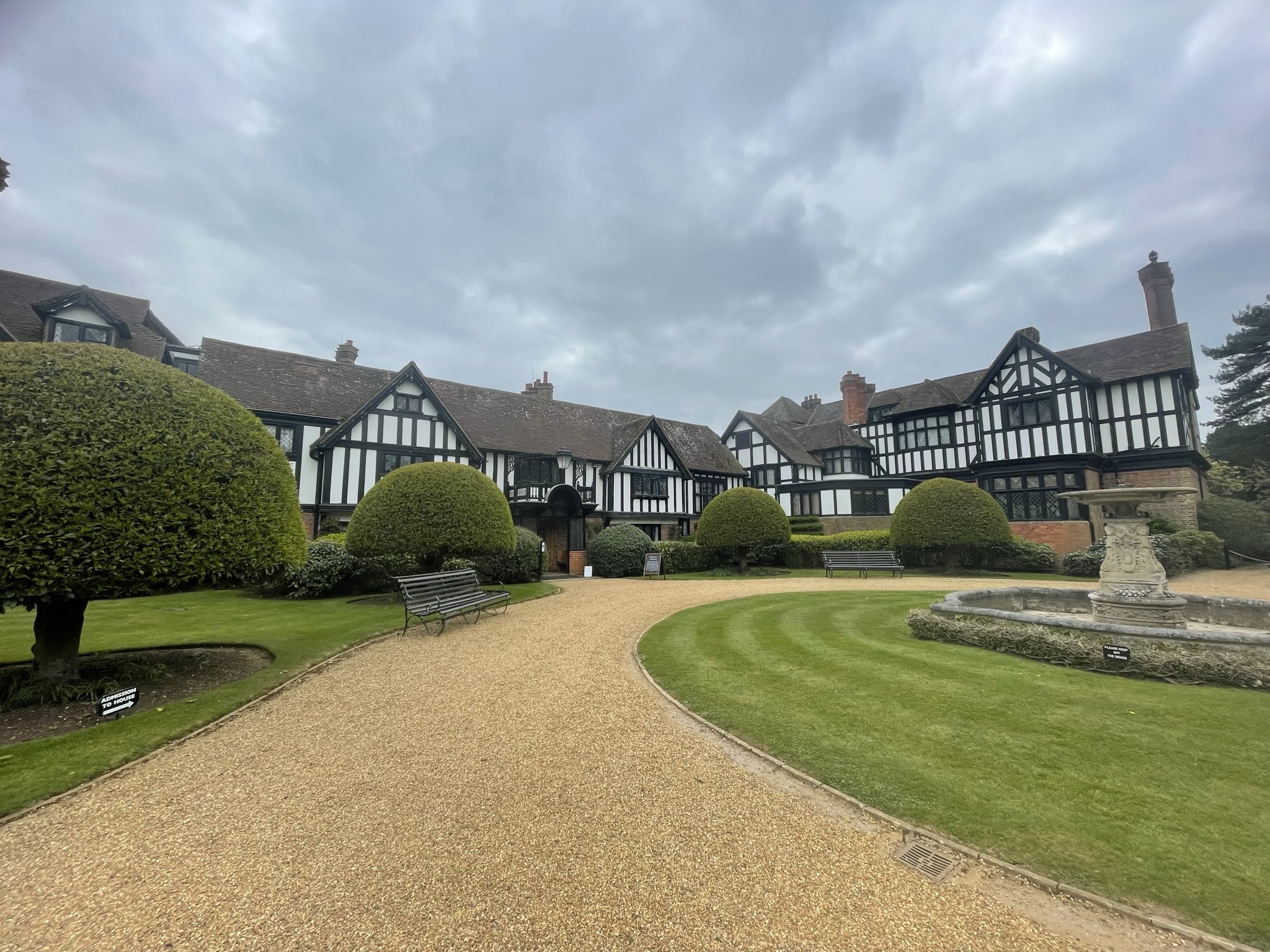
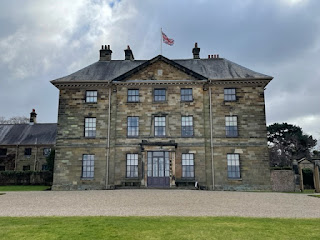
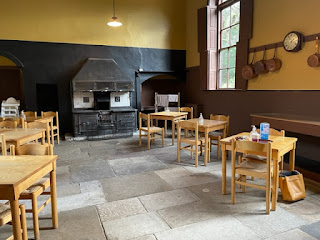
- In 1873, Lionel de Rothschild (grandson of Mayer Amschel Rothschild, the man who started the famous European banking dynasty) bought a farm at Ascott for his son, Leopold. The architects took the original farmhouse and turned it into a hunting lodge and then a fashionable country house that Leopold could use for entertaining guests. He also had a successful stud nearby.
- Leopold's sister Evelina was the wife of Ferdinand de Rothschild, the creator of Waddesdon Manor
- In 1947 the house and some of its contents were given to the National Trust.
- Sir Evelyn de Rothschild and his family still use the house on occasions and it is only open to the public at certain times, so be sure to book before you visit.
A blog dedicated to finding the best National Trust scones by visiting every single property with a tea room.
Friday, 29 April 2022
Ascott
Friday, 15 April 2022
Brean Down
The most important piece of advice I can give anyone is simply this: never trust a bus timetable. There have been a few occasions during this National Trust Scone Odyssey when I have required the services of a bus and I can honestly say, hand on heart and without exception, that I have always been completely stunned when the bus actually turned up. And to be fair, they've turned up more often than they haven't. But I'm still always really surprised when they do.
And I will add to this, because there is one particular day of the year when you must NEVER trust a bus timetable and that is Good Friday. At least on Christmas Day you can be certain that there won't be a bus. But Good Friday? Just don't go there.
Anyway, today I went there, despite knowing the above. I checked the timetable for the bus service that goes to Brean Down from Weston-super-Mare and it clearly showed a service for public holidays. But there was no bus. Luckily, I knew the Brean Down Way provided an 8-mile walk from Brean to Weston. I'd been deliberating whether to attempt it, so the bus shortage made my mind up, while a taxi took me out there.
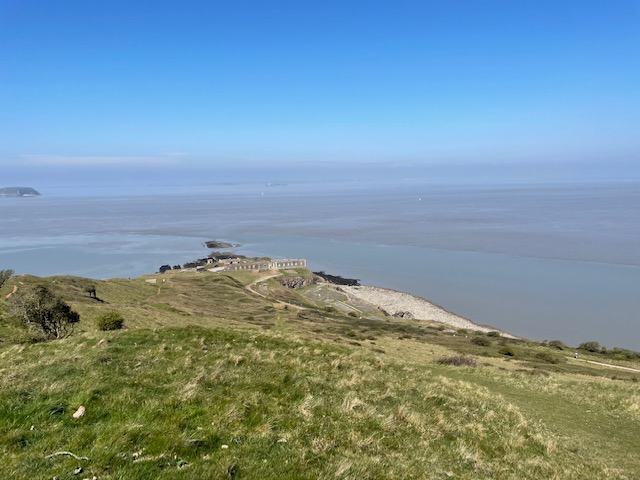
The slight snag with doing an 8 mile walk after a visit to Brean Down is that Brean Down itself requires a bit of effort. A nice amble on the beach it is not. As I dragged myself up the steps to reach the top of the promontory, I found myself thinking "is this fun? I'm not sure this is fun", before I reached the summit and was treated to the amazing views that make a climb worthwhile.
Let me tell you a little bit about Brean Down:
- Brean Down is a promontory stretching 1.2 miles into the Bristol Channel
- People have used Brean Down for thousands of years - a possible long barrow mound suggests Neolithic occupation, while remains of an Iron Age hill fort and Roman temple have also been found
- In the 19th century, plans were drawn up to turn Brean Down into a harbour that could act as a transatlantic port. The project was beset with problems and it didn't materialise.
- Brean Fort was built at the far end of Brean Down between 1865-1872 as part of a chain of forts designed to protect against the French.
- The main building we see today (below) was the barracks for 50 men
- The fort was refortified in 1941 during World War II
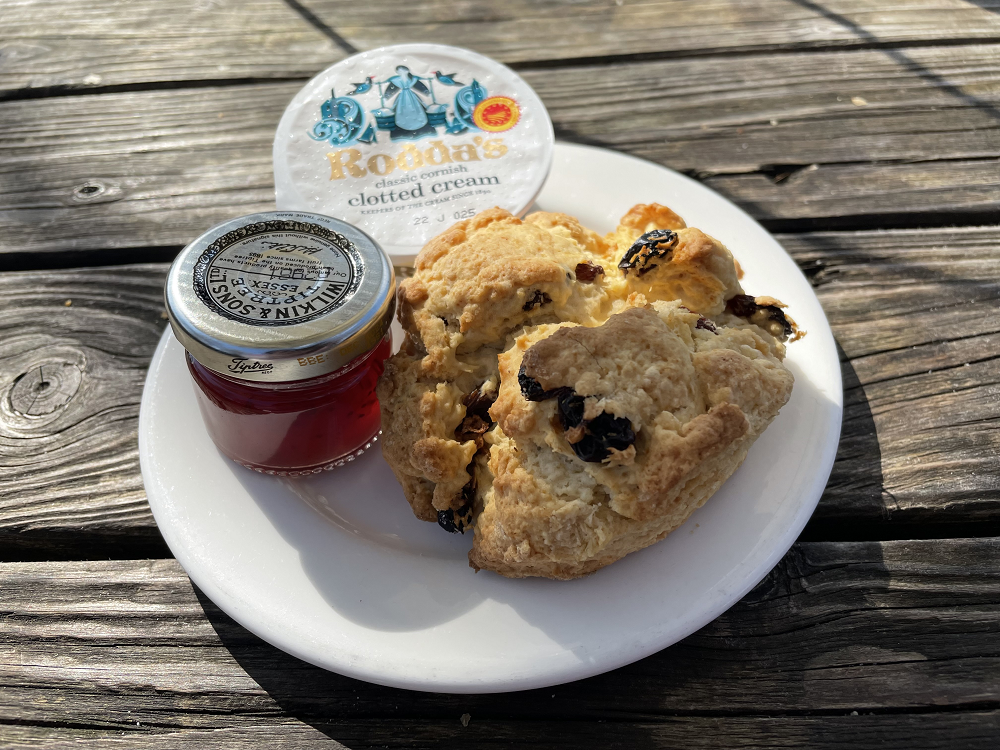
The Brean Down Scone
Scone: 5 out of 5
Walking the Brean Down Way path to Weston-super-Mare: 5 out of 5
Saturday, 26 March 2022
Aira Force and Ullswater
William Wordsworth even wrote a poem about Airey-Force Valley (as he called it):
—Not a breath of air
Ruffles the bosom of this leafy glen.
From the brook's margin, wide around, the trees
Are stedfast as the rocks; the brook itself,
Old as the hills that feed it from afar,
Doth rather deepen than disturb the calm
Where all things else are still and motionless.
And yet, even now, a little breeze, perchance
Escaped from boisterous winds that rage without,
Has entered, by the sturdy oaks unfelt,
But to its gentle touch how sensitive
Is the light ash! that, pendent from the brow
Of yon dim cave, in seeming silence makes
A soft eye-music of slow-waving boughs,
Powerful almost as vocal harmony
To stay the wanderer's steps and soothe his thoughts.
The Aira Force Scone
Claife Viewing Station
The Claife Scone
![]() |
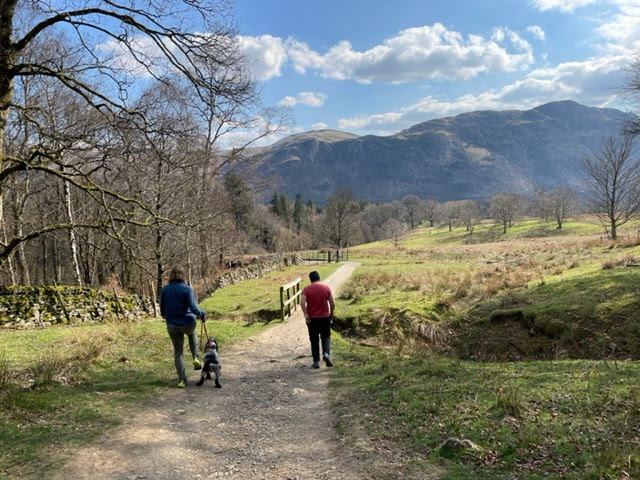
| SJ, Steph and Cooper - if you also ever decide to visit 240 National Trust properties, I can recommend them as an exemplary support team. |
Friday, 25 March 2022
Beatles' Childhood Homes
I'll cut to the chase here: there aren't any scones at the Beatles' Childhood Homes. But seeing as Paul McCartney and John Lennon gave us the most influential pop band of all time, as well as 180-odd Beatles songs, as well as all the other music they did, I'm going to let them off.
There are two properties that you get to visit as part of your pre-booked tour:
- 20 Forthlin Road in Allerton in Liverpool, where Paul McCartney lived from the age of 13 until his dad had to move when Paul became too famous
- Mendips on Menlove Avenue in the nearby Woolton area of Liverpool, where John Lennon lived with his Aunt Mimi from the age of 5
Pre-booking is essential and you meet your driver at a designated pick-up point (in our case, Liverpool South Parkway station). They then drive you to the first property, drop you off, and then pick you up and drop you off again. The reason for this becomes very clear: both houses are on normal residential streets. Even the most tolerant of neighbours probably have a limit on how many people and how much traffic they're willing to put up with.
Our first stop was Mendips. I had heard that John had grown up with his aunt and uncle in quite well-to-do surroundings, after it became clear that his parents weren't able to look after him. It wasn't quite the case - his Uncle George died very suddenly when John was 14 and Mimi took in student lodgers to make ends meet.
Beatles' Childhood Homes: 5 out of 5, 8 days a week
Scones: there weren't any but we knew that
Tour guides: 5 out of 5
Saturday, 5 March 2022
Ormesby Hall
Ormesby - owned by the Pennyman family
The 'Wicked' Pennyman bankrupts the place
Jim and Ruth - the final Pennyman residents
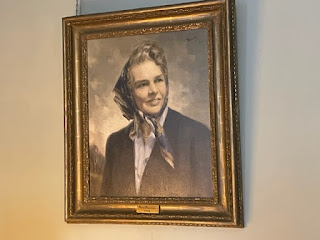
How many women would choose to sit for a portrait in a head scarf and blazer? She was obviously brilliant. I knew she was the kind of woman who got things done and I wasn't wrong - there were notices everywhere explaining how the couple had very different interests and political viewpoints but together they had set up schemes for unemployed miners. She was also very fond of the arts - visitors to the house included everyone from Sybil Thorndike to Ewan MacColl.
The Ormesby Model Railway
The Ormesby Hall Scone
Saturday, 19 February 2022
East Riddlesden Hall
I think East Riddlesden Hall will go down in scone blog history as the hardest-fought scone of all time. I've had my travel battles before but this one took the biscuit, thanks to Storm Eunice.
I have to tell you that I don't normally ignore travel advice. I'm usually the batten-down-the-hatches type, but I knew that if I timed it right I could get ahead of the bad weather and batten my hatches down in West Yorkshire.
I won't go into it, except to say my journey took nine hours instead of four.
Instead, let's get straight into the history of East Riddlesden Hall, which is located just a mile from Keighley station!
- There have been inhabitants on the site since the 7th century
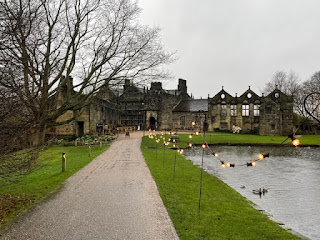
- In the early 14th century a hall was constructed on the site where the facade on the right in the picture below now stands:
- In 1638, a rich wool merchant called James Murgatroyd bought the estate and built most of the house you see on the left in the above picture
- This included a Great Hall that sits between both wings but he died before it could be finished
- A man called Edmund Starkie completed the acquisition of the estate in 1708. He built the Starkie Wing, although all that's left of that is the facade, as it was demolished in 1905.
- The estate was eventually inherited by Starkie daughters who had married Suffolk men - they became absentee landlords and pieces of the estate were sold off
- The Brigg brothers saved the house from demolition in 1933 and gave it to the National Trust
East Riddlesden reminded me of Cotehele in that it was a) very dark and b) one of those labyrinthine houses where you can never quite work out where you are or why there are so many rooms in a relatively small building. Or at least I couldn't.
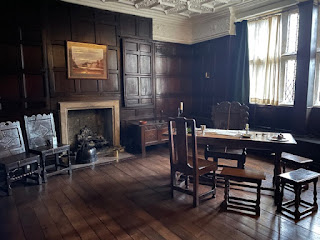
| The Drawing Room, known as 'His Own Parlour' in James Murgatroyd's time |
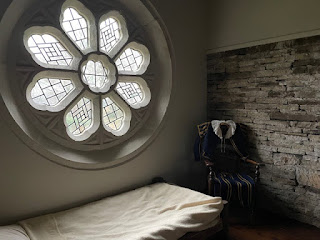
The interior of the house was chopped up and remodelled several times during its history, as different tenants moved in and out. As a result, it has some oddities, like this very tiny bedroom with an enormous rose window:
| Surely the most incongruous bedroom window in Britain |
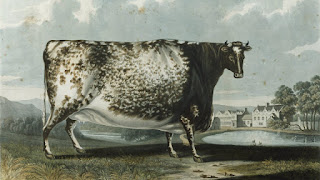
The Airedale Heifer
My favourite line in the guidebook was without doubt this one: "During the 1820s East Riddlesden enjoyed the reflected glory of the celebrated Airedale Heifer" who was apparently "fattened on the estate". I was instantly fascinated by this Airedale Heifer and did some more research: "It was said to have been 3.5 metres (over 11 feet) long and weighed more than a ton and became a much-visited local animal celebrity until its slaughter following a serious injury in 1830."
I'm not sure I've encountered a "local animal celebrity" before. I was quite sad that she wasn't mentioned in the house (although I just checked the book and there's a picture of her in the kitchen that I must have missed). There wasn't any Heifer merchandise in the shop either. I'd have paid good money for a "I got fattened at East Riddlesden Hall!" mug or fridge magnet.
| The impressively huge Airedale Heifer with the Hall in the background - she was 170 years too early for 'Pets Win Prizes' |
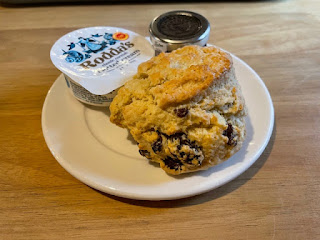
The East Riddlesden Scone
I don't want to worry any of the remaining places on my list, but I seem to have become the angel of doom for National Trust properties. An hour after I left East Riddlesden, they closed the place early because of snow. Ilam Park also closed early, an hour after I had eaten my scone there in January.
Or maybe I'm the National Trust scone ninja, using great skill and agility to grab my scone in the very nick of time before the weather catches me. To be honest, it's all quite stressful whichever way you look at it. But such is life for us hardy National Trust members venturing out before Easter.
Anyway. The tea room at East Riddlesden was really lovely. I was the only person in there, presumably because a) it was the first day of their season and b) it had literally opened about 20 minutes earlier. This in itself carries risk - is it fair to judge the first scone of a property's entire season?
This was National Trust scone #194. As you can imagine, I've learned a few things from the previous 193 specimens. One of those things is that a perfect scone often dances on the precipice of disaster. Take the East Riddlesden scone today: it was still warm, which is always an encouraging sign (although not entirely surprising at 11am). However, fresh and warm can sometimes suggest that a scone is under-baked and I had to deliberate a lot on this today before adjudicating that it was, in fact, perfectly done.
I've also had to establish a Crumbleometer. According to me, if a scone disintegrates into more than six pieces during preparation or consumption, then it must be marked down. The East Riddlesden scone tottered on the edge today but remained intact enough for a top five star rating. Bravo!
Haworth and the Brontë Parsonage Museum
By now, you have probably realised that I am ruthlessly single-minded in my pursuit of a National Trust scone. I don't really like distractions. I can count on the fingers of...well, three fingers the number of occasions when I've combined my scone missions with a visit to another heritage location.
(For the record, they are: Tintagel Castle when I visited Tintagel Old Post Office; Hever Castle when I went back to Knole; and finally York Minster and the York City Walls when I went to Treasurers House for the third time and decided I needed to add a bit of 'value', so I wrote The Christmas Pudding Scone Tour of York.)
But I decided to make an exception on this trip, because just five miles down the road from East Riddlesden Hall is a village that I have wanted to visit for a long, long time.
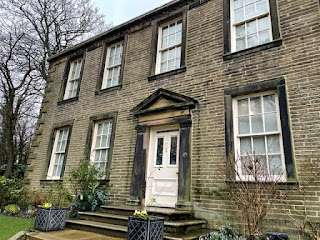
Haworth was home to the Brontë sisters, and their former residence is now a museum dedicated to their lives:
The museum was about to close for the day by the time I turned up, bedraggled and cold like a true Brontë heroine, although I'm not sure Brontë heroines typically wore a Brentford FC bobble hat that was, in retrospect, an unwise decision in Leeds United territory. Anyway, my lateness is the reason for the poor quality photographs. However, it was absolutely worth nine hours of train pain.
Below is the room where the sisters wrote their celebrated novels, Jane Eyre, Wuthering Heights and The Tenant of Wildfell Hall. If you've seen To Walk Invisible, the excellent BBC film about the family, you'll recognise it - although the parsonage is much smaller in real life than it seemed to be in the film.
I then headed to the Old White Lion pub/hotel where I was staying and watched the Michael Fassbender version of Jane Eyre while Storm Eunice raged outside. (There have been 24 films of Jane Eyre! 24! And that doesn't even include the TV versions! I recommend the Fassbender one. Let me know which one you prefer, in the Comments.)
Keighley & Worth Valley Railway
East Riddlesden Hall: 5 out of 5
Scone: 5 out of 5
Brontë Bonus: 5 out of 5 - I'd give it more if I could