Showing posts with label Warwickshire. Show all posts

Friday, 11 December 2015

Packwood

I've wanted to visit Packwood for a while. Back in June we went to Baddesley Clinton, which is just down the road. The taxi driver that picked us up after our visit to Baddesley asked if we'd also been to Packwood. I said no. "Oh it's LOVELY!" he said. "We've got ten minutes before your train, I'll take you down there and show you." And so like one of those gameshow contestants that has to look at the speedboat they didn't win, we ended up driving past Packwood so we could see it.
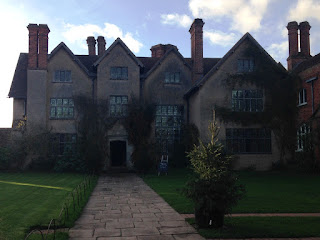

Packwood House

Today I had the choice of either buying Christmas gifts for my loved ones or fitting in one last scone before the end of the year. Naturally, I chose the scone. And I'm very glad I did, because Packwood is lovely and I would happily take it off the Trust's hands tomorrow if they wanted to sell it to me for £50. Here are some of the t
hings I learned today: 

1. It's a brilliant idea to call your son Baron
Packwood was given to the National Trust by Graham Baron Ash, whose family had owned the place since 1904. He preferred to use his middle name, so everyone called him Baron Ash, even though he was no more an actual baron than I am. A rogue comma was also inserted on one occasion, so it became Graham, Baron Ash. This is ingenious. If Mr Sugar had called his son Lord instead of Alan, he could have saved him the bother of flogging all those computers. 

2. Baron persuaded his dad to buy Packwood 
The story goes that Baron asked his parents to buy Packwood - so they did. He was only 15 at the time, which is a bit odd - if you consulted most 15 year olds on where they wanted to live, "as far away from you as possible, while still accessing your laundry and cooking services" would most likely be their reply, over "a Tudor manor house I can restore". They were rich, though - the family had made its money from zinc, although Baron never referred to this in later life, preferring to see himself as a country gentleman. 


Entrance Hall at Packwood

3. Baron insisted that the house must not be changed
It sounds like Bazza was a fastidious type - if you turned up one minute after your expected arrival time, there was a good chance you'd would be turned away. He gave the house to the National Trust in 1941 on the condition that it must be kept exactly as he had it, contents and all. The owner of Treasurer's House did the same thing, although I believe he actually threatened to come back and haunt the NT if they so much as moved a table forward an inch. Presumably the NT representative laughed nervously and then looked up 'exorcist' in the Yellow Pages.


Interesting factoid: Baron eventually fell out with the National Trust. After he handed Packwood over, he went to live in a castle in Suffolk. Although he remained friendly with the Packwood gardener, he didn't agree with how it was being run and when he died in 1980 he left none of his £3 million estate to the Trust. His niece, however, gave them a generous bequest that enabled the purchase of nearby Baddesley Clinton.

4. If you go to the National Trust on a weekday, you get a personal tour guide
It's taken me a staggering two years to work this out, but National Trust properties can get quite busy at weekends. And I've noticed that the best room guides often hang out in the smallest rooms on Saturdays, so you'll turn into Lord Morris's chess room and one guide is surrounded by 40 visitors, all squashed in and hanging on her every word, until one visitor says "my great-grandmother was a Morris - I wonder if I'm related?" and then looks expectantly at the guide, as if she is going to pull out a family tree and say "Yes! Here, take all these antique chess sets, they are rightfully yours". 

ANYWAY. I went to Packwood on a Friday, which meant that it was relatively quiet. A lovely tour guide called Jean walked me through a few of the rooms. She explained the history and showed me some pictures - it really made my visit. She would definitely win BBC Scone Personality of the Year, if the BBC hadn't rejected the idea as "borderline insane - please stop emailing us" (their loss).


5. It's really very important to read up on a property before you go 
I decided to go to Packwood on a bit of a whim, which meant that I hadn't read up on it beforehand. This is my excuse for why I didn't see the Yew Garden. The yews first appear on a plan from 1723, and 16 of them supposedly represent the four evangelists and the apostles.You can see them here: www.ntprints.com/image/354371/the-yew-garden-known-as-the-sermon-on-the-mount-at-packwood-house. 

I read the guidebook afterwards though and discovered that:
  • The house was originally built in 1570-ish by William Fetherstone
  • The Fetherstones and their descendants continued to own the house until 1869, when it was sold to a solicitor
  • The Ash family bought in at auction in 1904
6. Packwood scones are very nice
The restaurant at Packwood is a thing of beauty. It looked very new and it was full of people who had clearly come for lunch, which is a good sign. 

The scone was warm and soft and full of fruit. It might have been a bit too soft, to be honest, but it was tasty.


On a final note, I had not realised until today that the National Trust has a website for ordering posters and pictures from its collection! So that's my Christmas shopping sorted after all! 'Monkey Barbers' for everyone!

Packwood House: 5 out of 5
Scone: 4.5 out of 5
Jean, the lovely tour guide: 5 out of 5


Saturday, 22 August 2015

Coughton Court

Here's an interesting factoid about Coughton Court: when it was handed over to the National Trust in 1948, the owners negotiated a 300-year lease for themselves, the longest in NT history. 

I don't know what a normal lease looks like, but to get the National Trust to take on your massive house AND let your family remain in residence until 2248 is impressive. Where are they going to put the flying cars?

In fact, the Throckmortons win the award of Family I Would Least Like To Get Into Bother With. On top of their ferocious negotiation skills, they also spent hundreds of years being Catholic when it was a seriously dangerous business. They were involved in the Gunpowder Plot. Let's just say I don't think they scare easily.

Coughton Court

In fact, I'm going to begin with their Gunpowder Plot connections, because they are AMAZING.

1. Coughton and the Gunpowder Plotters
Consider this: there were 13 conspirators involved in the Gunpowder Plot. Of those 13, a whopping SEVEN were either Throckmorton descendants or they were married to Throckmortons. Here's a quick summary:

  • Robert Catesby = son of Anne Throckmorton
  • Thomas and Robert Wintour = grandsons of Catherine Throckmorton
  • Francis Tresham = son of Muriel Throckmorton (of Lyveden New Bield fame)
  • John Grant = another grandson of Catherine Throckmorton
  • Henry Morgan = married to grand-daughter of Catherine Throckmorton
  • Thomas Percy = father of the grand-daughter-in-law of Anne Throckmorton

It's frankly a wonder that James I didn't go all Herod-like after the plot was discovered and order the extermination of anyone with Throckmorton blood or connections. 

2. Coughton During the Aftermath of the Plot
The story of the Gunpowder Plot is very well-known, but I'll do a recap for anyone else who covered this part of history with a bit of clapping and singing at infant school, but whose subsequent history teachers didn't bother with it.

Basically, Robert Catesby and his cohorts intended to blow up the Houses of Parliament during its opening on 5th November 1605. King James I would be attending the opening, so the explosion would take out pretty much the entire power-base of England, leading to an uprising and the restoration of a Catholic-friendly monarchy. But the plot was foiled, Guy Fawkes was famously caught red-handed, and the other plotters were soon rounded up and killed, or tried and executed. 

Coughton itself was involved in the drama. The wife of one of the plotters, Sir Everard Digby, was staying there, along with two Jesuit priests and Nicholas Owen, the priest-hole builder. Another plotter, Thomas Bates, was sent to tell her that the plot had failed - Thomas probably wasn't able to tell her that she'd never see her husband again, as he would be soon find himself being dragged on a hurdle through the streets of London before being hung, drawn and quartered in front of the crowds that had gathered to see this charming spectacle. 

Anyway, the Jesuit priests, who apparently had not been told of the plot, were incriminated in the plotters' confessions - those confessions having been acquired through slightly different means to a police officer banging quite hard on a table and shouting "tell me the truth, Gunpowder Plotter!" One of the priests did manage to escape to Rome disguised as the captain of a boat carrying pigs, but Father Garnet and Nicholas Owen were eventually discovered at Hindlip Hall - Owen died during torture, while Fr Garnet was executed.

3. Other Throckmorton Adventures
If that wasn't enough excitement for you, here's a quick round-up of other Throckmorton history:

  • The main gatehouse at Coughton was begun by Sir Robert Throckmorton in the early 1500s - he also built the church next door which is well worth a look
  • His son, Sir George, was very vocal in his opposition to Henry VIII's marriage to Anne Boleyn and ended up in prison for it. He and his wife had an astounding 19 children and 112 grandchildren.
  • George's grandson, Thomas, rented Coughton to Sir Everard Digby, with interesting consequences (see above)
  • What then followed were 11 more Throckmorton baronets, most of them battling Catholic repression throughout the ages
  • Sir William Throckmorton, who inherited in 1860, restored Coughton and wanted to hand it over to his nephew, Courtenay
  • But Courtenay was killed in Mesopotamia during WWI, leaving a 7-year old son, Robert
  • It was Robert's mother, Lady Lilian Throckmorton, who arranged for the freehold of the house to be handed to the National Trust
  • Her grand-daughter, Clare McLaren-Throckmorton, and family still live in the house

4. The House 
I know I said that I didn't want to get on the wrong side of the Throckmortons, but I have to admit that I came away from the house today feeling that I didn't really understand it. It was only through reading the guidebook afterwards that I realised the nightdress in a glass case had belonged to Mary, Queen of Scots. The guidebook also mentioned a famous coat that was produced in a single day by workers on the estate, from shearing the sheep to stitching the cloth, but I didn't see it. I kept thinking how useful an audio guide would have been to help point these things out, but some of the rooms are quite small and it's a very busy property, so maybe that wouldn't work.

I very much liked the views from the top of the tower though:


Coughton view from tower

5. The Coughton scones
My heart sank a bit when I picked this scone up. The reason: squidginess. In my experience - and this was my 94th National Trust scone, so I think I can rightfully claim to have some - a squidgy scone often equals a been-in-a-microwave-scone. But I bravely tucked into it anyway and was very pleasantly surprised to find that it was delicious. Even the Scone Sidekick agreed that it deserved top marks.


Coughton Court scone

Until now, I've been loudly proclaiming that Suffolk and York represent National Trust scone nirvana. However, it seems that Warwickshire has been quietly gathering its honours without me really noticing. First Charlecote Park, then Upton House, and now Coughton Court. Put Warwickshire on your maps, scone fans.

Coughton Court: 3.5 out of 5
Scones: 5 out of 5
Gunpowder, treason and plot connections: 5 out of 5

Saturday, 13 June 2015

Baddesley Clinton

I spent the first eighteen years of my life in Northamptonshire where there was a church called the St Nicholas Owen. It says a lot about me that I never once wondered who St Nicholas Owen was. But then in my defence there were an AWFUL lot of saints and I didn't have access to Wikipedia at the time. 

Anyway, I now know that Nicholas Owen was a courageous little man who built priest holes in Catholic houses during the time of Elizabeth I and James I. Baddesley Clinton, a lovely moated manor house in Warwickshire, was one of those houses.


Baddesley Clinton

In fact, Nick built priest holes all over the place. He was arrested in 1594 and was tortured, but refused to reveal any details about his work. In 1606 he was arrested again and taken to the Tower of London, where he was tortured again on the rack. It killed him and he was canonised in 1970.

You can still see the priest holes at Baddesley Clinton. I loved the way the fantastic guides all said "there are three that we know of", as if Nicholas was so cunning that some of his hidey holes are still hidey today, even after hundreds of years of renovation works and general poking about. This is the one in the kitchen:


But Baddesley Clinton's amazing history began before the Reformation and the need for priest holes. Let me give you a quick run-down of some of its inhabitants:

1. John Brome - murdered!
There has been a manor house at Baddesley since before the Norman Conquest. In 1438, it was bought by a lawyer called John Brome. He was murdered in a church doorway in London by a man called John Herthill during a quarrel over property.

2. Nicholas Brome - murderer! Twice! 
John's son, Nicholas, avenged his dad and murdered John Herthill in 1471. He then killed AGAIN - one day he found the local priest flirting with Mrs Brome, so he murdered him. To make up for his crimes, Nicholas built the tower at the nearby church.

3. Henry Ferrers - friend of Catholics!
The Ferrers family took ownership of Baddesley in 1517, through the marriage of Sir Edward Ferrers to Constance Brome. In the 1560s, their grandson, Henry, inherited. He was known as The Antiquary because of his love of history, but what is most interesting about him is that he leased Baddesley out to the Vaux sisters, two fervent Catholics who used the place to harbour Jesuit priests. This was a treasonable offence at the time and the punishment for treason was to be hung, drawn and quartered, which was not very pleasant. Not only that, Henry also leased a place in London to Thomas Percy, one of the Gunpowder crew, who actually stored the gang's gunpowder there! Henry must have had friends in high places to have got away with this, but he did and he died aged 84. 

4. Marmion, Rebecca, Georgiana and Edward - the Quartet!
Marmion Ferrers inherited in the 1830s but he and his wife Rebecca were not well off at all. In 1869, Rebecca's aunt Georgiana and her husband, Edward Dering, came to live at Baddesley and it was their money that was used to keep the place going. The four became known as 'the Quartet', until Georgiana and then Marmion died, and then Rebecca married Edward.

5. Greycat!
When I heard about "the legend of Greycat", I was expecting him to have solved a murder case, or to have saved the lives of 15 priests. In fact, his claim to fame involved him accompanying Mr Ferrers-Walker on his walks. And he lived to be 21. Which is admittedly quite impressive.

The Baddesley scone
And so we come to the difficult bit. Before I tell you what happened with the scone, I need to clarify two things:

1. I'm one of those people that never complains in restaurants. I have sat there on numerous occasions boring my companion to death about the substandard food and yet when the waiter came to say "everything ok?" I've said "YES! FANTASTIC! THANK YOU!" Maybe it's because I am British. Or maybe it's because I am an idiot. 

2. This was my 82nd National Trust scone and I've never even thought of rejecting one before now.

So when I say that I couldn't eat the scone because it was stale, I hope you know that I had very good reason and I'm not just trying to be controversial.  


Baddesley Clinton scone

The staff, however, were LOVELY about it and hastily got some replacements. They'd been microwaved, which makes scones soft and squidgy, but they tasted a lot better. 

I am going to finish by telling you how much it troubles me that it took 364 years for Nicholas Owen to be made a saint. 364 years! WHY? Surely a miraculous deed is a miraculous deed! There is currently no patron saint of scones and I will be a shoe-in for the role once I have completed my National Trust scone odyssey. I've still got around 150 scones to go but clearly I should get my application in. 

Baddesley Clinton: 5 out of 5
Scones: 3 out of 5 for the replacement scone
Priest holes: 5 out of 5

Sunday, 8 March 2015

Upton House and Gardens

I keep getting Upton House mixed up with Upton Park. They are not the same thing at all. Upton House is a stately home near Banbury. Upton Park is a football stadium in East London. 
Upton House

I will tell you now that I LOVED Upton House. There are many reasons for this. It has an impressive art collection, complete with fascinating stories about where those artworks came from and where they were hidden during the war (in a quarry in Wales). 

The house itself also has a very interesting history; in 1927 it was bought by Walter Samuel, Lord Bearsted. He had a lot to contend with during his years at Upton - apparently Hitler had two lists of people that were to be rounded up immediately after an invasion of the UK and Lord Bearsted was on both of them, as the chairman of an international business - his father had founded the Shell oil company - and as a prominent member of the Jewish community. 

However, I wouldn't have known any of this if we hadn't joined a tour. I'm a MASSIVE fan of audio tours but I normally avoid being led about by a human - mainly because I don't want to wait an hour and a half for the next one, or go careering around the place trying to catch up with the one "that just left two minutes ago".

After today, however, I will try harder to join a tour if one is available. It was full of fascinating facts and it really helped to bring the place to life.

The art tour basically showed us round the gallery area of the house. There are plenty of impressive works. This one, painted by El Greco in 1579, was one of my favourites. Poor old 'El' had his fee cut apparently, because he painted the heads of the crowd higher than that of Christ, which didn't go down very well in 16th century Spain: 


El Greco at Upton House


Once the art tour was over, we wandered around the rest of the house. It was built in the 17th century and had many owners, before the Bearsteds bought it as a weekend country bolt-hole. 

I think it's the only National Trust property I've seen with a swimming pool in the back garden. It didn't look all that inviting today, in the drizzle:


Upton House swimming pool


The Bearsteds have remained connected to Upton. The daughter of the 3rd Viscount, Felicity Waley-Cohen, is the mother of the jockey Sam Waley-Cohen and they still own a nearby stud farm called Upton Viva. So there is a sporting connection after all.

The Upton House scone
Let's be honest though - there was only really one work of art I was looking for today and that was a show-stopping SCONE. It hasn't been a good year for me and my scone odyssey so far. In 2013 and 2014, I managed a total of 20 top-scoring National Trust scones, giving me an average of 1.18 top class scones per month. This year, the Scone d'Or has been gathering dust and it's the 8th of March already. 

The tea room at Upton House was lovely - it's big and welcoming and without doubt one of the nicest I've seen. It was early, though, and I had serious concerns about that. Going into a tea room at 11.30am and asking for a scone - you might as well say "I know you're more concerned with preparing lunches at the moment, so please just give me one of last Thursday's scones and I'll get out of your way". I know this probably doesn't happen, but I fear it all the same. 

But there was no reason for concern because the Upton scone was A TRIUMPH. It was warm, fresh, and literally melt-in-the-mouth, which is really all I ever ask of a scone. Even the scone sidekick agreed and he's normally saying things like "I'd give it a two".


Upton House National Trust Scone

I did learn one other thing today, and I hope the National Trust forgives me for this. I sometimes think that I've gone a bit native with the NT - I so rarely find anything to complain about, and I've even started feeling more positively inclined to gardens, which was UNHEARD of two years ago. BUT today I came to the firm conclusion that even if I live to be 104, I will never, ever be interested in porcelain. But if porcelain IS your thing, then there's plenty of it at Upton. 

Upton House: 4.5 out of 5
Scone: 5 out of 5! Get IN!
Artwork tour: 5 out of 5
Porcelain: 0 out of 5 for me, 5 out of 5 if porcelain is your bag

Sunday, 20 July 2014

Charlecote Park

If I had a pound for every time someone recommended Charlecote Park near Stratford-upon-Avon to me, I'd have...why, I'd have £3. But a journalist friend once told me that once is an accident, twice is a coincidence, and three is a story, so off we went.


Charlecote Park

I'd been reading a good book about Charlecote: Mistress of Charlecote, The Memoirs of Mary Elizabeth Lucy. On page one, it tells the story of a local tanner's son caught stealing a deer from the park. Sir Thomas Lucy, owner of Charlecote at the time, was a justice of the peace, so the poacher decided it was time to move on and try his luck in the London theatre, his name being William Shakespeare. 

The Shakespeare connection has been very important to Charlecote over the years, although some miserabilist party-poopers have now cast doubt on it. The National Trust took the property on in 1946 partly because of the link (or so I'm told), and since the 1700s the great and the good have come to Charlecote to see where The Bard started a short-lived criminal career.

But Charlecote has a fascinating history with or without Shakespeare:
  • The Lucy family has lived on the estate since the 1100s
  • The present house was built in the 1550s
  • Much of the house was refitted in the 1800s, in Elizabethan Revival style
  • The current baronet, Sir Edmund Fairfax-Lucy, still lives in the house
  • The father and grandfather of Dame Judi Dench both worked at Charlecote
The Elizabethan Revival style can be seen in the Great Hall, where the supposedly wooden ceiling is actually made of plaster. I've now seen so many Great Halls at National Trust properties that I've decided I want one of my own. I don't know about you, but our hall was the smallest, coldest room in our house - we only ever went in there to open the front door or to collect a semi-frozen coat. Yet in medieval and Tudor times, the Great Hall was the most important room in the house, with people coming and going and servants and dogs running around. If you ever see an episode of Grand Designs with Kevin McCloud saying "what she's planning is quite literally ridiculous - a medieval Great Hall where servants and dogs can run around, even though she hasn't got any servants and she's scared of dogs. I just can't see it working," - you'll know it's me. 


Anyway, back to the book. What makes Mistress of Charlecote so readable is its author, Mary Elizabeth Lucy. She wrote her memoirs specifically for her grandchildren, yet she happily tells them that she was forced to marry their grandad in 1823, even though she cried her eyes out and begged and pleaded with her father not to make her do it. It makes you realise that Jane Austen wasn't inventing it all. 

I also have Jane Austen to thank for my Surprising Moment of Self-Discovery of the Week. We came out of the house and saw a sign for 'Carriages', which made my heart sink, as I have absolutely sub-zero interest in transport history.

But I was shocked to find that I was FASCINATED by the display of carriages. I am almost tempted to give up my job, find a PhD course on How People Got About Before Cars and write books on the subject. For all you other Jane Austen fans, below on the left you can see a barouche, with its four seats, two facing two, as used by those pompous old bats Lady Catherine de Bourgh and the Dowager Viscountess Lady Dalrymple.

On the right is a brougham, which was invented a bit later and is enclosed, making one think mainly of murders on foggy November nights in Whitechapel.


Barouche and Brougham Charlecote

And this is a phaeton or "an owner-driven carriage suitable for a sportsman who enjoyed driving himself with groom sitting behind". So now you know. I'll let you know when my book is published.


Charlecote phaeton

The Charlecote Scone
But let me stick to my true area of expertise: scones. In the history of the National Trust Scone Blog, I've never had top-scoring scones on three consecutive missions. Two weeks ago Claremont Landscape Garden was awarded five out of five for their flufftastic scones. A week later, Bateman's took top honours for their any-fresher-and-they-were-flour scones. Surely, the scone blogger wasn't going to score a hat-trick?

Readers, she did score a hat-trick. The scone at Charlecote Park was scone perfection. There was a choice of plain or fruit, a choice of jam, a sprinkle of icing sugar and the freshest scone since...well, last week. It had that tiny hint of warmth that provides the alibi of freshness, without interfering with your digestion. The Orangery was a lovely restaurant as well - welcoming with friendly staff. Marvellous.


National Trust scones at Charlecote

Charlecote Park: 5 out of 5
Scone: 5 out of 5
Surprisingly fascinating carriages: 5 out of 5