Showing posts with label Cumbria. Show all posts

Saturday, 26 March 2022

Aira Force and Ullswater

Maybe it's the law that every waterfall has to be described as 'dramatic' and 'thundering' but I will be very, very honest with you, viewers: having read a bit about the place in advance, I was expecting Aira Force to be a bit more of a force? 

Aira Force waterfall

Due to a fallen tree, you can't access the viewing platform so you have to admire the falls from afar and then walk over them. This does diminish the impact a bit. BUT. It is very beautiful and the walks around the area are absolutely lovely.
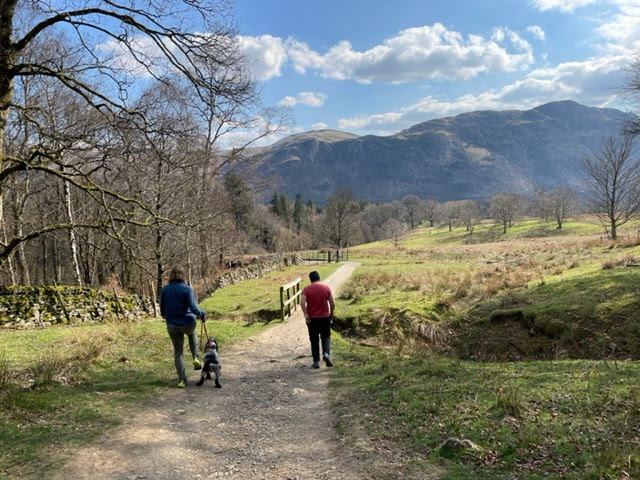
  
Ullswater

William Wordsworth even wrote a poem about Airey-Force Valley (as he called it): 

—Not a breath of air
Ruffles the bosom of this leafy glen.
From the brook's margin, wide around, the trees
Are stedfast as the rocks; the brook itself,
Old as the hills that feed it from afar,
Doth rather deepen than disturb the calm
Where all things else are still and motionless.
And yet, even now, a little breeze, perchance
Escaped from boisterous winds that rage without,
Has entered, by the sturdy oaks unfelt,
But to its gentle touch how sensitive
Is the light ash! that, pendent from the brow
Of yon dim cave, in seeming silence makes
A soft eye-music of slow-waving boughs,
Powerful almost as vocal harmony
To stay the wanderer's steps and soothe his thoughts.

The Aira Force Scone

I certainly needed to soothe my thoughts as I approached the cafeteria at Aira Force. I have to tell you that I could write a very lengthy thesis on the art and science of purchasing National Trust scones. People think it is easy. It is not. 

The Aira Force scone is a great example of this. It was my second scone of the day, as we'd already stopped off at Claife Viewing Station. This means that two completely opposing things occurred at the same time: on the one hand, my stress levels were reduced because one scone was already safely in the bag, so the trip wasn't going to be a complete disaster. 

But! Because it was the second stop of the day, it was LATER in the day. I was now veering into mid-afternoon territory and that's a scary place for a Scone Blogger. It was also the warmest day of the year so far and the place was packed.

I joined the queue with a sense of foreboding and did a quick, subtle recce of the scone situation. In normal circumstances, the person with me is usually oblivious that we have now entered the critical moments of the scone mission. My friend Steph, however, is a very, very observant person. Within 3.5 seconds she had clocked the situation and turned to me and said "There are only two scones left".  

The queue was long. The person at the front asked for a cream tea. Steph looked at me. The next person in the queue was querying out loud whether she whether wanted a cream tea or not....did she? Didn't she? She did. Steph looked at me.

We finally made it to the front. "Two cream teas please!" I chirped confidently, as if by not even acknowledging that no scones was possible, I could stop it happening. "You're lucky," said the very nice man. "These are the last two."
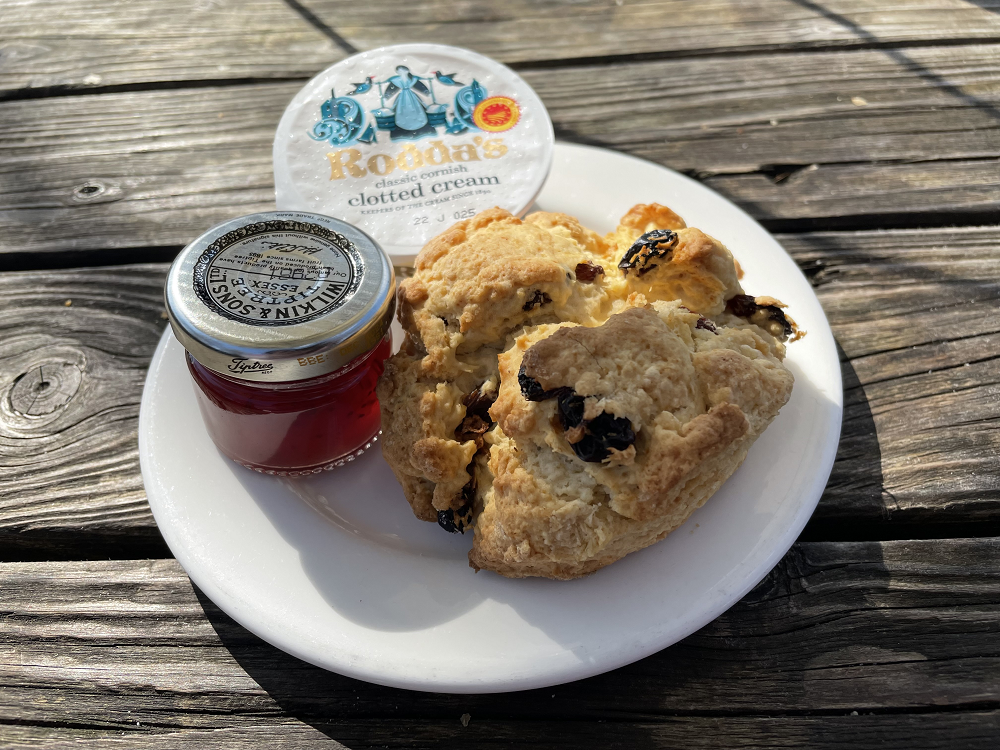
Aira Force Scone

(I'd like to point out that Steph doesn't eat scones and there was no other food left so while I was gambolling triumphantly off across the patio with my baked items, she was making do with coffee. I probably wasn't empathetic enough about that, so sorry Steph.)

Anyway. It was a delicious scone and well worthy of 5 stars.

Aira Force and Ullswater: 5 out of 5
Scone: 5 out of 5
Food that wasn't a scone: 0 out of 5 (it was a very busy day)

Claife Viewing Station

Nobody can ever accuse the National Trust of turning Claife Viewing Station into a tourist attraction, because it always was a tourist attraction. It was built in the 1790s to wow visitors when they came to Lake Windermere in the Lake District, a two storey octagonal tower that looked like a mini castle. 

Claife Viewing Station

It's hard to believe now, but until the 18th century the Lake District wasn't troubled by tourists. It was largely was seen as an unattractive wilderness. This changed for a number of reasons: firstly the Picturesque movement encouraged people to appreciate landscapes, while the French Revolution and Napoleonic Wars made it harder for people to travel on the continent. The Lake District became a destination and - as 19 million annual visitors can now confirm - it never looked back.

It was one Reverend William Braithwaite who commissioned the original summer house, which was built in a Greek/Roman style. It was then extended by John Curwen after he purchased it in 1801, giving it a more Gothic look. By the 19th century it was hosting dinners and other events, with visitors often arriving by boat and making their way through a landscape garden to the big reveal of the spectacular views over Windermere.

The building also used coloured glass to provide filters on the views - yellow gave the visitor a summer perspective, for example, while light green was used to provide a spring theme and so on. There's still a hint of this in the building today:

Claife windows

By the end of the 19th century, Claife Viewing Station had fallen out of favour and into disrepair. It eventually passed to the National Trust in 1962.

The Claife Scone

To be honest, I wasn't sure if the cafe at Claife was actually run by the National Trust. As per the Rules of the National Trust Scone Project, I don't need to include properties with tenanted or 'NT approved' scone facilities. 

However, I decided to go for two reasons. Firstly, at this late stage of the scone quest I am taking absolutely no chances of missing one out. Secondly, my very brilliant friend SJ had seen my map of remaining properties and had sorted out the itinerary for the day to help me get two more places covered. I have had a lot of help with this project over the years but SJ and Steph have gone above and beyond - they've done about 450 miles with me and Steph doesn't even eat scones.

The triangular shape of the fruit scones finally convinced me that the place wasn't NT run, but frankly it didn't matter because it was an absolute barnstormer. There was no jam or cream but SJ and I agreed they weren't needed. Fresh, warm, fluffy and full of fruit - it might not strictly qualify as a National Trust scone but I'm including it anyway. 


Our luck was also in: one of my fellow scone fans visited Claife the following day and reported that there were no scones at all.  

SJ, Steph and Cooper - if you also ever decide to visit 240 National Trust properties,
I can recommend them as an exemplary support team.

Claife Viewing Station: 5 out of 5
Scone: 5 out of 5

Saturday, 31 August 2019

Sticklebarn and The Langdales

I suggested recently that if anyone wanted to start their own National Trust blog you could do worse than to choose National Trust Beaches. Well, here's an even better idea for you: National Trust Pubs. It turns out that there are around 40 of them, Sticklebarn in the Lake District being one. What a pub crawl that would be.

Anyway. Sticklebarn and The Langdales might sound like the band at Worzel Gummidge's wedding but it's actually a pub and a very scenic area:
  • Great Landgale is a U-shaped valley containing the Langdale Pikes (a group of mountains) and two villages. It was the centre of the Lake District's slate industry and there are still slate works there today.
  • Little Langdale is a valley containing a hamlet, as well as two tarns (mountain lakes created by glaciers); Little Langdale Tarn and Blea Tarn
  • Sticklebarn is a pub (a place serving alcohol), providing food and drinks to weary walkers
Sticklebarn - a National Trust pub
I'm not sure why I took a picture featuring a drain-pipe, rather than the cosy interior
of the pub. You'll just have to imagine that part. 
You really do need a special dictionary in the Lake District - I only just discovered that a stickle is "a hill with a prominent rocky top." What with ghylls, fells, tarns, forces, thwaites, and meres, you really do need to pay attention to what you're agreeing to.


The Stickle Tarn Trail

Anyway. If you like walking, cycling, and camping then you'll love this beautiful area of the country. There's a real buzz - people setting off on walks, or returning from walks, or walking into the pub having completed a walk.
Blea Tarn in Little Langdale
Blea Tarn - surely one of the world's most beautiful spots
The Sticklebarn scone
But let's move on to the scone. This was the third (yes, third) scone of the day (after Fell Foot and Wray Castle) and it was still only 2pm. We decided to go crazy and have some lunch as well, so what with sausage rolls and baked potatoes thrown in to the mix it was all turning into a highly unusual scone mission. 

The scone itself was a lot smaller than the Fell Foot and Wray Castle ones, which wasn't necessarily a bad thing - if most people drop in to Sticklebarn for hearty meals to get them up the fells, then a scone-as-dessert might be appropriate. And it was definitely fresher than the one we'd just had at Wray. It just wasn't quite up to the standards of the legendary scone we'd had at Fell Foot.

Sticklebarn National Trust scone

Sticklebarn was my second National Trust pub, as I had been to The George Inn in Southwark in my previous life as a London pub expert*. If you'd like to see the list of all NT hostelries, you can find it here.

*I wasn't a certified or qualified London pub expert. I just went to a lot of London pubs.

Sticklebarn: 5 out of 5
Scone: 4 out of 5
Ticking second National Trust pub off the list: 5 out of 5

Other National Trust properties we've visited in the Lake District: Acorn Bank, Allan Bank, Fell Foot, Hill Top, Sizergh Castle, Wordsworth House, Wray Castle

Wray Castle

If I went to IKEA tomorrow and bought a flat-packed fortress, it would probably look just like Wray Castle. Or it would do if I got someone else to build it for me, as my efforts at flat-pack unfortunately tend to look like Dennis the Menace's tree house until they just fall apart completely.


Wray Castle

Anyway. Wray is not an ancient castle. It was built in 1840 as a Gothic Revival place, so the turrets and arrow slits were never actually used for firing projectiles at Roundheads or invaders during a siege. It's also a very squat building when you see it up close, but the exterior is very impressive nonetheless.

It's very different inside. I mean this with the greatest of affection, but it reminded me of a cross between a town hall and the set of Why Don't You?, that iconic 80s TV show that was presented entirely by kids making Rice Krispie cakes and marauding around the place like a televisual Lord of the Flies.
Wray Castle Interior
Someone messaged me to say it reminded her of Byker Grove
rather than Why Don't You. She's right.
But before we get further into that, here's a bit of history for you:
  • Wray Castle was built in 1840 for James and Margaret Dawson from Liverpool - he was a retired surgeon and she came from a wealthy background.
  • Hardwicke Rawnsley, one of the founders of the National Trust, came to visit his cousin Edward who had inherited Wray Castle from the Dawsons. Hardwicke loved the place and became vicar in Wray church.
  • In 1882, Hardwicke bumped into a young Beatrix Potter in the grounds at Wray Castle - her parents had rented the place for the summer and she and Hardwicke became good friends. She went on to buy nearby Hill Top.
  • The castle was left to the National Trust in 1929 and had many uses subsequently.
  • It was originally a youth hostel and then from 1931 it contained the offices of the Freshwater Biological Association. You probably won't be surprised to hear that the FBA is concerned with freshwater science and research.
  • Bizarrely, Wray Castle was classified as a ship from 1958 and 1998. RMS Wray Castle was a training ship for radio officers. There was even a student bar in the room that had been used as an eel reservoir by the FBA.
  • In 2011 it was opened to the public - apparently the National Trust had looked at other options for its use but it attracted so many visitors that they decided to keep it as a tourist destination.
And that's the thing about Wray; its location in the Lake District makes it a hugely attractive attraction for families. We arrived on a wet Saturday lunchtime and the very cheerful receptionist said "we have LOTS of children in today" in a way that left it very much open to our own interpretation. We could either take that piece of information and run a mile, or we could return to our people carrier and unleash 8 kids of our own into the melee.

As it was, we just stuck to having an enjoyable time wandering around the place. There's no original furniture in any of the rooms, which does make it ideal for children who want to run around a bit. However, for the first time in the six year history of my National Trust membership I did find myself questioning whether there's enough at Wray to really justify the £11 entry fee (or £27.50 for a family). It's undoubtedly a great property with a huge amount of potential, so hopefully they'll persevere with their events and continue to find good use for the space.

The estate includes lovely shoreline onto Lake Windermere:
Wray Castle on Windermere

And the view of the fells from the castle are beautiful, especially with a bit of sunshine:
Wray Castle view across the fells

The Wray Castle scone
But on to the scone. I was very impressed by the size of the Wray Castle scone but I think its size may have worked against it. It was very dry and it didn't taste very fresh. It had also followed hot on the heels of a sublime scone that we'd had earlier at Fell Foot - although each scone is taken on its own merits, it was a bit like when someone on Strictly does a show-stopping, jaw-dropping jive as the penultimate dance of the night and then the final couple have to come on and do a waltz to Three Times a Lady - it's just an extra challenge that they could have done without.

Wray Castle scone

But Wray Castle is well worth a visit if you're already an NT member - it's impressive with very friendly staff.

Wray Castle: 4 out of 5
Scone: 3.5 out of 5
Surely the only room in the whole of the National Trust that was used as an eel reservoir and then turned into a student bar: 5 out of 5

Other National Trust properties we've visited in the Lake District: Acorn Bank, Allan Bank, Fell Foot, Hill Top, Sizergh Castle, Sticklebarn, Wordsworth House

Fell Foot

I ate A LOT of National Trust scones in August 2019. I had managed to visit 8 properties between January and July, but it wasn't enough. I had committed to finishing this project by December 2020 and 1.14 scones a month was not going to get me over the finish line.

I thought about hiring a personal scone trainer/scone coach to help me get closer to my goal, but unfortunately they don't exist. So I just went on a scone rampage. In the first 30 days of August I managed to visit 23 National Trust properties across Devon, the Midlands, and Northern Ireland, racking up a total of 19 scones. 

By August 30th I was fatter, covered in scone crumbs, and smelling faintly of jam when my phone pinged. I struggled out from under a pile of National Trust maps and guidebooks to find a text from my friend Sarah-Jane saying she was looking forward to seeing me for the weekend and that she was planning to drive us to the Lake District - but would I be able to manage three scones in one day?

WAS I ABLE TO EAT THREE SCONES IN ONE DAY? Did she know who I was?? Like Godzilla, I raised myself up from the depths of a scone-induced torpor and headed for Euston station.

And this is how, one rainy August Saturday morning, we found ourselves at Fell Foot, a shoreline park at the bottom of Lake Windermere in Cumbria.

The Lakeside and Haverthwaite Railway adding
a bit of Victorian glamour in the background
Fell Foot was once the site of a large lakeside villa. A man called Jeremiah Dixon from Leeds enlarged the original farmhouse after 1784, before selling up to a Francis Astley who in turn sold the place to Colonel George Ridehalgh in 1859. 

It was Colonel George who created the piers and the five Gothic-style boathouses that still survive today. To really see the boathouses, you can catch the Fell Foot Ferry from nearby Lakeside and approach from the water.


The Gothic boathouses -
a bit incongruous against the modern-day cruiser
The estate was then sold to an Oswald Hedley, who demolished the house and started work on a new neo-Jacobean mansion. But his wife died and he lost interest in Fell Foot. The property was given to the National Trust after he died.

Interestingly, the place was initially tenanted out to a man who ran it as a caravan park with holiday chalets. They're gone now but it's fascinating to think that the Lake Distrct has always balanced recreation facilities with the natural beauty of the area.


There used to be a large house on this site - it's not there now (obviously)
The Fell Foot Scone
Let's move on to the scone. I'd never been to Fell Foot before but it still seemed strangely quiet as we made our way along the path. We soon worked out why; everyone was in the tea room. It was packed.

This was the first of our three scheduled scones and after a couple of bites SJ looked momentarily troubled; "I think we might have peaked early - this is a great scone." She was right - it was sublime; slightly warm, extremely fresh, and very, very tasty indeed.

Fell Foot Scone
The Fell Foot scone - one of the best
ever encountered on the National Trust Scone Odyssey
She then proved once and for all that she is an exceptional human being with the words "and I haven't even eaten the top half yet and everyone knows that's the best part of a scone." There have been several occasions during the making of this scone blog when friends and family have proven themselves beyond all measure - this was one of those moments. 
Scone aficionado at work
The only disappointment was that anyone let Oswald demolish the house, but it didn't really matter. Fell Foot is now all about the lake and the paddleboarding and other activities that you can do before you enjoy one of the best National Trust scones that you'll ever eat.

Fell Foot: 4 out of 5 - I had to deduct a point for the missing house
Scone: 5 out of 5 (I'd give it more if I could)
Fitting another three scones in to August when I thought I was done: 5 out of 5

Other National Trust properties we've visited in the Lake District: Acorn Bank, Allan Bank, Hill Top, Sizergh Castle, Sticklebarn, Wordsworth House, Wray Castle

Friday, 18 March 2016

Allan Bank and Grasmere

I have a tricky relationship with TripAdvisor. It sometimes makes me laugh - I recently read a comment from someone asking if there would be any fog at an NT property.

It also routinely makes me despair. I absolutely loved Beatrix Potter's former home at Hill Top in the Lake District and yet someone had spent valuable minutes of their life rating it Terrible and offering to bulldoze it. I am not of the same species as that person. 

However - and I NEVER thought I would say this - if you want to learn about Allan Bank in Grasmere, you should definitely read the TripAdvisor reviews. 


Allan Bank

They really give a very accurate representation of the house and how it works. Bizarrely, the Allan Bank page on the NT website doesn't tell you much about the place at all, considering its history.

But I did a bit of extra reading and here's what I managed to find out:

  • The house was built by John Gregory Crump in 1805
  • William Wordworth lived across the valley at Dove Cottage at the time and he was outraged by Allan Bank - it spoiled his view and he called it "a temple of abomination" 
  • However, in 1808 he moved in to his temple of abomination with his wife, children, sister Dorothy, sisters-in-law, plus their many regular guests, which included the Coleridge family
  • The house wasn't easy to live in - the fires were very smoky and everyone was cold and covered in soot 
  • In 1811 they moved down the hill to the Parsonage, but that was damp - it all ended sadly when two little Wordsworths died while they were living there
But the history of Allan Bank didn't end there. It later became the home of Canon Hardwicke Rawnsley, the man who founded the National Trust, when he retired in 1917. 

He left it to the Trust and it was tenanted for many years. In 2011, it was gutted by fire - once it was restored, the Trust took the opportunity to open it to the public.

But what makes the house at Allan Bank very unusual is that it isn't 'finished'. It's undecorated and full of bits of furniture that you can sit on. 

And that's what the TripAdvisor reviewers seem to love - the informality of the whole place, where you can pour yourself a cup of tea in the kitchen and take it into another room to sit and marvel at the views.

In fact, it's probably just as well that I live 300 miles away from Allan Bank, because if I lived nearby I'd be in there every single day - a book and a flask of tea and I'd be happy as Larry plonked in one of these armchairs:


Allan Bank room

There's a kitchen cafe where you can make yourself a cup of tea and buy a piece of cake. There were no scones but I didn't mind about that - how can you complain when you're drinking your tea with this view:


Allan Bank tea room view

In fact, it's the views that make Allan Bank really special. I was very lucky with the weather:


Allan Bank view

Grasmere was described by Wordsworth as "the loveliest spot that man hath ever found" and I'd go along with that. An absolute must see. 

Allan Bank and Grasmere: 5 out of 5
Scones: there weren't any but there was cake and views

Other National Trust properties we've visited in the Lake District: Acorn Bank, Fell Foot, Hill Top, Sizergh Castle, Sticklebarn, Wordsworth House, Wray Castle

Thursday, 17 March 2016

Acorn Bank

If I ever get invited on Desert Island Discs, I know exactly what my luxury item will be: a National Trust mill enthusiast.

The people that restore and run water mills for the National Trust are not like you and me. I have been to four National Trust mills now and the story is often the same: the mills have been there for 800 years and there's nothing much left, except some barely standing timber and a mill-stone covered in lichen. 

Yet the National Trust mill enthusiasts get stuck in and soon have the whole thing up and running and rattling away to produce actual flour that is actually consumable. That's why I want one on my island: give them a pebble and a coconut and we'd soon have a Boeing 747 to get us home. 

And before anyone points out that the luxury item on DID has to be inanimate and must not facilitate escape - I know. I don't think I really need to worry about it.

Acorn Bank

ANYWAY. Today I went to Acorn Bank near Penrith, which has a watermill. Here are my five highlights:

1. The house tour
I very rarely join tours at NT properties, but thank God I did at Acorn Bank. There was no guide book and if I had wandered around on my own, I'd have come away slightly baffled by it all. There's very little furniture and a lot of doors are locked.

But the tour guide was excellent - she gave us a bit of history:
  • The estate was once owned by the Knights Templar, who used it as a safe haven for pilgrims and other travellers in the 13th century
  • In 1543, it was acquired by the Dalston family and it remained with their descendants until the 1930s  
  • The house we see today was largely built in the 16th and 17th centuries
  • In 1934, the estate was acquired by Dorothy Una Ratcliffe and her husband Noel McGrigor Phillips
  • She gave it to the National Trust in 1950 - they supported her efforts to stop a munitions dump near the estate and she promised the house to them
  • Dorothy sounds like a real character - when James Lees Milne went to negotiate the terms of her leaving the house to the Trust, he left his notes behind. She read them and all the uncomplimentary things he had said about her (in his diary, he described her husband as "a grubby, red-visaged, hirsute old teddy bear"). She took offence and although she left them the house as planned, she took everything out of it - hence the lack of furniture.  

2. The watermill
There wasn't much to see at the mill, to be very honest - I'm not sure if they open more of it up at weekends - but there was a brilliant exhibition explaining its history. I learned more about the Acorn Bank mill in five minutes than I've learned from hours at other properties. There's also a really lovely mill blog.

3. The fairy houses
Today I finally understood the point of putting fairy houses in trees; when I saw this little green door and jetty, complete with miniature boat, I realised that children walking round Acorn Bank must go absolutely nuts with excitement. I was quite excited and I'm 42.


Fairy door at Acorn Bank

4. The newts
The woman on reception told me excitedly that there were some newts in the pond. I tried to look interested, but I am no wildlife expert and I wouldn't have recognised a newt if it fell on me. But I wandered around for a look and I was amazed - there were loads of them. They also have very weird feet. I can't share any pictures - there were a lot of gardeners around and I knew that me + pond + attempting to take photos of small things would end up with me being fished out by people trying not to laugh.

5. The Acorn Bank scones
Acorn Bank was the fourth stop on the Scone Blogger's Spring Tour 2016 (t-shirts and other merchandise available). Wordsworth House had delivered a barnstormer of a scone on Tuesday. Sizergh Castle had followed up with an outstanding specimen on Wednesday. Hill Top doesn't do scones, but it was fabulous anyway. Could Acorn Bank score the hat-trick? 

There wasn't a scone to be seen when I got to the Acorn Bank tea room and my heart sank. But the very nice man confirmed that they had some - in fact he offered a choice of plain or fruit, which is very rare.

I then went and sat in the sunny courtyard, where they brought out the freshest scone I've had in ages - it had definitely seen an oven within the past hour - and it was AMAZING. I ate every crumb.


Acorn Bank scone

So hurrah for the Lake District - three properties so far and three 5-star scones.

Acorn Bank: 4 out of 5
Scone: 5 out of 5
Sunbathing newts: 5 out of 5

Other National Trust properties we've visited in the Lake District: Allan Bank, Fell Foot, Hill Top, Sizergh Castle, Sticklebarn, Wordsworth House, Wray Castle

Wednesday, 16 March 2016

Hill Top

I loved reading when I was little. But for some reason my local library only had one Beatrix Potter book and that was The Tale of Ginger and Pickles. It's about a cat and a dog who run a shop but keep giving credit to their customers, so they go out of business. I'm sure it was a big favourite in George Osborne's house, but even at the age of five I knew capitalist propaganda when I saw it and I didn't like it. 

Maybe this is why I've never really had any major affection for Beatrix Potter. And when I discovered that her former home at Hill Top has no tea room or scones, I very nearly gave it a miss.

Hill Top

But thank God I didn't give it a miss, because it's now one of my favourite National Trust properties and I urge you all to go.

It's a relatively small and very understated place - it's a farmhouse, basically - but the minute I walked into it, I completely understood why she loved it so much. It has a really warm and cosy feel to it and it contains a whole treasure trove of objects that meant a lot to her.

Here's the background:
  • Beatrix Potter was born in London in 1866 
  • She was 16 when her family started holidaying in the Lake District
  • When she was 30, the Potters stayed near the village of Near Sawrey and Beatrix completely fell in love with the place
  • She got engaged to Norman Warne, her editor, when she was 39 but he died a month later
  • That same year, she bought Hill Top - a 34 acre working farm in Near Sawrey, using an inheritance and her royalties from her books
  • She continued to live in London, looking after her parents, but returned to Hill Top whenever she could
  • She wrote 13 of her books at Hill Top, including The Tale of Jemima Puddle-Duck and my old nemesis, Ginger & Pickles
  • There are pictures from her books dotted all round the house, showing how the house and furniture appeared in her stories 
  • I didn't realise this at the time but the shop in the village is the very shop that appears in Ginger & Pickles!
  • She married a local solicitor, William Heelis, in 1913 and they moved down the road but she kept Hill Top
I'm ashamed to say that I had always assumed that Beatrix Potter was a little bit twee. In fact, she was way ahead of her time: 
  • She was a keen conservationist and worked closely with the National Trust to protect the Lake District from development
  • The founder of the Trust, Canon Hardwicke Rawnsley, became a friend of the Potters when they started holidaying in the Lakes
  • In 1930, she bought a 4000 acre estate to save it from development, giving the Trust more time to raise the money needed
  • Beatrix eventually owned 15 farms and pieces of land in the Lake District
  • She died in 1943, leaving everything to her husband - when he died all the farms, land, manuscripts, illustrations and drawings went to the Trust
  • The Trust headquarters were named Heelis in her honour
The ONLY bad thing about Hill Top is that they don't allow you to take photos inside. I was very sad about that, because the Entrance Hall is particularly lovely and her library was stunning, with four giant landscape paintings done by her brother, Bertram. Mind you, I am supremely bad at taking pictures so you're probably better off just going to see it all for yourself.

Lastly, I was delighted to meet a cat at Hill Top. Sadly, he wasn't wearing a jacket and he didn't appear to be running a shop. And he pointedly refused to pose for me. 


Cat at Hill Top

But never mind! Hill Top is absolutely marvellous and I highly, highly recommend it.

Hill Top: 5 out of 5
Scones: there weren't any, but I knew that
Cat not really playing ball with the whole Beatrix Potter thing: 0 out of 5

Other National Trust properties we've visited in the Lake District: Acorn Bank, Allan Bank, Fell Foot, Sizergh Castle, Sticklebarn, Wordsworth House, Wray Castle

Sizergh Castle

I'm going to admit something now that will probably result in the National Trust cancelling my membership; I didn't really like that Michael Buerk ITV programme, Inside the National Trust.

It wasn't the actual NT properties that I didn't like - I first saw Sizergh Castle on there and it went straight onto my wishlist.


Sizergh Castle

No, what I disliked is the thing that gets on my nerves with any TV programme these days - the way it introduces you to the subject ("Jim works at Boggins Castle, which was built by William The Conquerer and was the wedding venue for Wayne Rooney") before moving on to something else and then coming back to repeat everything ("Back at Boggins Castle, which was built by William the Conquerer and was the wedding venue for Wayne Rooney...") until you want to kick the TV in and scream "I KNOW! I WAS WATCHING 3 AND A HALF MINUTES AGO WHEN YOU LAST TOLD ME!"

But let us not kick the TV in. Let us instead be calm and grateful to Mr Buerk for enlightening us about Sizergh Castle.

Here are my five favourite things about Sizergh: 

1. Nearly 800 YEARS with the same family! 
Sizergh has been connected to the Strickland family since 1239. That's astounding. I'm proud of myself for having maintained a mortgage for 5 years without anybody sending the bailiffs round. But 800 years!

It's impressive because the family didn't have it easy. They were Catholic and Royalist and basically always seemed to be on the wrong side of things. But they were also very clever and somehow managed to retain control of Sizergh. 

However, I am not even going to TRY to summarise the full 800 years of Stricklands, particularly as they all seem to be called Walter or Thomas and it's all very confusing. But some basics: 
  • The tower at Sizergh dates from the mid-1300s, when it was constructed to display the Stricklands' power and authority
  • Walter Strickland transformed the house into an Elizabethan residence
  • Modernisations were made in 1897-1902 by Gerald Strickland
  • The house was given to the Trust in 1950
  • The family still live there
I was surprised at how relatively small the cafeteria was - I couldn't imagine it coping with hundreds of visitors on a Saturday. But Sizergh Castle itself isn't open at weekends, as the family don't allow it. 

This normally drives me bonkers, but I will say this: one thing that Sizergh has in spades is homeliness. I've visited many NT properties with a no photography rule "because it's a family home" and you look around at all the priceless objects and furniture and think "REALLY? People ACTUALLY live in here? I don't think so." Sizergh isn't like that - you can genuinely imagine people traipsing in and shouting "What's for tea?" It's the homeliest castle I've ever seen. 

2. Lots of Jacobite history
In the same way that I knew very little about Charles II until I went to Moseley Old Hall last year, I knew pretty much nothing about the Jacobite Rebellion until I went to Sizergh.

James II came to the throne in 1685, following his brother, Charles II, who had no legitimate heirs. James was Catholic and there had been efforts to stop him becoming king, which had failed. 

The Stricklands were fans of James - Lady Strickland was under-governess to the Prince of Wales - and so they went into exile in France with him in 1688 when he was deposed and replaced by William and Mary. Sir Thomas left Sizergh in trust with two family servants so it couldn't be seized by the new monarchy. 

The Stricklands eventually returned to England, but remained loyal to the Jacobite cause when James III moved to Rome. Strickland cousins were part of Bonnie Prince Charlie's army when it marched through nearby Kendal.

3. The house guides
I always love properties with excellent room guides and at Sizergh they have Betty. She was brilliant. "Have you been here before?" she asked. "Would you like a potted history?" and without any further messing about she gave us the background.

4. Incongruous artefacts 
Sizergh wins the award for Most Unexpected Item on Display at the National Trust Ever. I can't remember which room this was in, but there it was: a Wham! double album. I spent the rest of the day thinking of suitable Wham! scone tracks (Club Sconeicana, I'm Your Scone, Bad Scones being my three favourites). I really wanted to rifle through the pile and see if there was any Johnny Hates Jazz, but I restrained myself.


5. The Sizergh scones

This was my 113th National Trust scone and my expectations were low. I very rarely get two excellent scones on the trot and the Wordsworth House scone yesterday had been spectacular.

But the Sizergh scone was excellent too. It was freshly baked and tasty and gets top marks. 


Sizergh scone

It's only a matter of time before the BBC calls me up and ask me to front a major documentary on scones of the National Trust - I promise I won't allow them to keep repeating the facts.

Sizergh Castle: 4.5 out of 5 

Scone: 5 out of 5
Musical taste of the Stricklands: 5 out of 5

Other National Trust properties we've visited in the Lake District: Acorn Bank, Allan Bank, Fell Foot, Hill Top, Sticklebarn, Wordsworth House, Wray Castle

Tuesday, 15 March 2016

Wordsworth House and Garden

"I wandered lonely as a cloud" is the only thing I knew about William Wordsworth until my visit to Wordsworth House and Garden today.

And when I say the only thing - I mean it. I didn't know the second line of that poem, nor the third line, nor any other lines. I knew the word 'daffodils' was in there somewhere but that was it.

This is BAD. I studied English Literature at university. I even did a WHOLE TERM on the Romantic Poets. It's embarrassing.


Wordsworth House

Anyway. I tried to make up for my failings by reading a very good book about Wordsworth by Hunter Davies before I set off for the Lake District - I can recommend it.

I also did a bit of research and discovered three things about Wordsworth House that greatly appealed to me: 


1. Wordsworth House was badly flooded in December - here's a video about it. The water was three feet deep and yet the staff still managed to open last week as planned.


2. They have a scarecrow called Fletch, who is a spectacular failure at keeping the birds away, but he does have his own blog. 

3. When the Tour of Britain cycle race started in Cumbria, the baker at Wordsworth House made these bike-shaped scones, which are the greatest thing I have ever seen:


And I'm happy to report that Wordsworth House did not disappoint. Here are some factoids:
  • The house was built between 1670 and 1690
  • John Wordsworth, dad of William, moved there in 1765 - it came rent-free as part of his job as agent for Sir James Lowther
  • William was the third child born to John and his wife Ann - he arrived in 1770, followed by his sister Dorothy in 1771
  • Ann Wordsworth died in 1778 - this had a big impact on the family, with Dorothy being packed off to relatives in Halifax
  • John died just five years later in 1783 when William was 13. The house was given back to John's employer and the boys were sent to live with relatives
  • In his great autobiographical poem, The Prelude, William talks about his happy childhood growing up by the River Derwent, which runs behind the house:
Wordsworth House river


I must admit: I expected Wordsworth to have grown up in a tiny cottage somewhere, and not in a sizeable house on a main street in Cockermouth. But the house is great: you get a real sense of what life would have been like.

The Wordsworth House scone
February was not a good month for this blog. First, I discovered that all National Trust properties now follow the same recipe to bake their scones. I'm not one to overreact but when I heard this news, I threw myself face down onto my bed like Scarlett O'Hara and announced "THE BLOG IS DEAD!" - the Scone Sidekick had to talk me round. 

And then the day after that shocking news, I travelled miles and miles for two subpar scones and went into a bit of a sulk.

Luckily, I had already booked the Scone Blogger's Spring Tour 2016, and so I was forced back onto the road in March.

And thank the Lord for that, because the Wordsworth House scone was DIVINE. Every single constituent part of the cream tea was perfect - fresh scone, delicious jam, great cream, fantastic tea. 


Wordsworth House scone

It was so good, that I decided to compose this poem in its honour:

Golden scone! With your curranty treasure,
How happy you make me is beyond measure
With jam and cream and tea in a cup
You really cheered the Scone Blogger up

On the off-chance that you're now muttering "that's rubbish" to yourself, I'm going to leave you with a poem by Wordsworth himself. I read it in Hunter Davies' book and was astonished; "I recognise the first line of this one as well! And it's a REALLY GOOD POEM! How can I not have understood this at university? I must have been a real div."

It's not about the Lake District, or scones for that matter, but I'm a city girl at heart:

Upon Westminster Bridge

Earth has not anything to show more fair:
Dull would he be of soul who could pass by
A sight so touching in its majesty:
This City now doth, like a garment, wear

The beauty of the morning: silent, bare,
Ships, towers, domes, theatres, and temples lie
Open unto the fields, and to the sky;
All bright and glittering in the smokeless air.

Never did sun more beautifully steep
In his first splendour, valley, rock, or hill;
Ne'er saw I, never felt, a calm so deep!

The river glideth at his own sweet will:
Dear God! the very houses seem asleep;

And all that mighty heart is lying still!

Wordsworth House and Garden: 5 out of 5
Scone: 5 out of 5
Ability to take all that Mother Nature can throw at you and still manage to open on time: 5 out of 5

Other National Trust properties we've visited in the Lake District: Acorn Bank, Allan Bank, Fell Foot, Hill Top, Sizergh Castle, Sticklebarn, Wray Castle