Showing posts with label Shropshire. Show all posts

Monday, 5 August 2019

Dudmaston

If this National Trust Scone Blog project has taught me anything, it is to be less grumpy. This will come as surprising news to my family, and it will be disputed with good reason by the woman who scanned my NT pass in a property recently and let me walk all the way round to the house before I was sent all the way back to her again to get a house tour ticket. But it is true.

Dudmaston, near Bridgnorth in Shropshire, was a perfect example. Six years ago when I started this National Trust Scone Quest I expected the NT to be very formal, very quiet, with everyone focused on porcelain and architecture. 


Dudmaston

When I got to Dudmaston on a Monday afternoon, the first thing I saw were about 15 children sat on spinning wheels, all intently focused on their work. I wondered if I'd walked into the garden of a workhouse in 1893 or discovered a child slavery racket responsible for producing all those car rugs you see in National Trust shops.

But no. It was a wand workshop. Each kid was chiselling a piece of wood to make a wand. I haven't seen such focus in a long time.

And then in the grounds I saw a little boy run up to his big brother. "Kyle, they have goals!" No response was forthcoming. "Goals WITH NETS." That was enough for Kyle - both hightailed it for a game of football.

I know a lot of National Trust members will be unhappy with this but I love it. I love the fact that families can rely on the NT to provide space and activities during the summer holidays and that kids grow up thinking 'yay Dudmaston' rather than 'Dudmaston boring'.


Dudmaston Big Pool

But I wasn't very interested in wands or footie, and thanks to the handy guide book I can share some history:
  • The estate at Dudmaston is very old - a man called Helgor of Holgate was granted a manor at Dodemannestone in 1127
  • In 1403 one of the family married a William Wolryche and people named Wolryche remained at Dudmaston until very recently
  • By the time Sir Francis Wolryche died in 1614, the family were on the up, thanks to his marriage to Margaret who brought many useful connections
  • It was Sir Thomas who started building the house we see today in the late 17th century
  • He died young from tuberculosis and his son was a gambler - he drowned on his way home from the Chelmarsh races in 1723
  • The estate then ended up with the Whitmores, who gave their son William the extra name Wolryche for continuity
  • The Wolryche-Whitmores also died out but when Reverend Francis Henry Laing inherited he adopted the name
  • When Geoffrey Wolryche-Whitmore died in 1962, his niece Rachel inherited with the understanding that the National Trust would take over
  • Rachel was married to George Labouchere, a diplomat. They travelled all over the world and retired to Dudmaston in 1966.
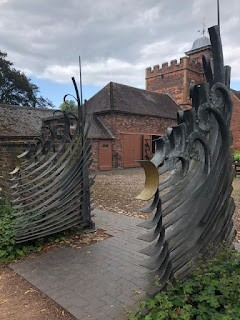
  • George was a big collector of modern art and the impressive gates you see below were installed for the couple's ruby wedding anniversary in 1983
Dudmaston gates

The Dudmaston scone
But let's move on to something that I definitely did have in common with all of the younger visitors: an interest in the cafeteria. I had already had a scone at Kinver Edge and I won't lie to you; being hungry can affect my perception of scone quality. If I'm starving, then a scone tends to taste better and I have to carry out a rigorous inspection of myself to ensure that all scones enjoy a level playing field. 

Happily it didn't matter a jot at Dudmaston because the scone was indisputably fantastic. It was light, fresh, and fluffy and a very good size. The entire wasp community of the West Midlands had clearly followed me up the A458 from Kinver and was ready for part two of their jam fest. I didn't disappoint them and the old jam-pot-on-the-adjacent-table trick distracted them from bothering me (the adjacent table was empty by the way, just in case you were worried that I had sent the wasp brigade to bother a group of defenceless toddlers).


So there you have it - a lovely house with an interesting history, a top-notch scone, and goals WITH NETS.

Dudmaston: 4 out of 5
Scone: 5 out of 5
Easily distracted wasp community: 5 out of 5

Other visits I have made in the West Midlands: Kinver Edge, Moseley Old Hall, Wightwick Manor. 

Saturday, 16 January 2016

Sunnycroft

I had a Ladybird book when I was little that featured a picture of a giant tree in America that you could drive through. It was amazing. I desperately wanted to see that tree and drive through it, possibly reversing and driving through it again.

And last year we did it. We actually went to Yosemite National Park and saw that tree. Unfortunately there was no driving through it because it fell over in 1969. This was extremely disappointing - I was born in 1974, so the tree had toppled over long before I arrived on the planet. People sue each other for less than this in America, although who do I sue? Ladybird books? My parents? The tree?


Anyway. What has this got to do with Sunnycroft in Shropshire? 


Sunnycroft

Well, my sad experience with the Fallen Tunnel Tree has not put me off giant redwoods, or sequoiadendron giganteum, and Sunnycroft has an avenue of them that was planted in 1899! The Scone Sidekick and I were overjoyed to see them today and we relived our time in Yosemite, with the added bonus that no massive bear was likely to come lumbering out of a hedge and take my face off with a swipe of her paw.


Sunnycroft redwoods

It took us almost as long to get to Sunnycroft today as it did to get to California*. There had been a frost during the night so naturally all the trains had stopped working. But we persevered and it was well worth it. Here's a bit of history: 

  • Sunnycroft is a Victorian villa, built by John Wackrill in 1880
  • Wackrill was a successful brewery owner and, like many prosperous professionals of the time, he wanted a nice mini country estate in the suburbs to show off his success
  • Mary-Jane Slaney bought Sunnycroft when Wackrill died - she extended it and furnished it with fashionable, good quality materials 
  • She too shuffled off this mortal coil and Sunnycroft was bought by her brother-in-law, JVT Lander, in 1910
  • He owned an iron foundry and was thrifty at work and at home - he was a lot slower to introduce any innovations to the house 
  • His daughter Joan moved to London and became a successful embroiderer - she worked on the Queen's Coronation robe! Amazing. 
  • Joan returned to Sunnycroft to look after her sick parents and stayed on after their deaths
  • She gave Sunnycroft to the National Trust in 1997
A couple of my highlights from today's trip: 

The house
I had read the guidebook before I went to Sunnycroft and have to say that it didn't exactly oversell the place; "Sunnycroft makes no claims to great architecture and is rather solid and conservative in style" is a sample line. 

But I absolutely LOVED the place. It joins Hughenden, Packwood, and Avebury Manor on the list of NT properties that I would happily move into tomorrow. 

The staircase hall is particularly beautiful:


Sunnycroft staircase hall

And the rooms were big but homely too, like the Drawing Room:


Joan Lander and her diaries
I've decided that Joan Lander is my hero. Today she put my mind at rest on a matter that has troubled me for years; the difference between mine and other people's diaries.

For example, political diaries when they are published always seem to sound something like: "Tuesday 4 October. Peter put both hands on the table and said "Mike, fiscal adjustment that targets deficit and debt reduction does not necessarily prevent fiscal instability." He was shaking with rage, his knuckles were white and his eyes had an unusual green-ish tinge to them."


My entry for Tuesday 4 October on the other hand reads "Spoke to mum. Had chips." And today Joan proved that I am not alone. Her entries - "We were going to have tennis, but it was much too wet, so Heath, Mary Leake and I played ping-pong, Daddy and Mr Leake billiards" - prove that people can keep simple diaries that end up being useful and interesting to other people. Alright, maybe not mine.


The Sunnycroft scone

The Scone Sidekick kept asking very helpful questions on our lengthy journey today, such as "what are you going to do if there are no scones? What if we've come all this way and there are no scones?" I was therefore VERY relieved to see a pile of scones on display when we reached the tea room.

Sunnycroft scone

I have to say that it tasted a lot better than it looked. I'm not sure why, but shop-bought scones always remind me of someone that has been a little bit too fond of their sunbed. It was also a bit dry and metallic-tasting. But I enjoyed it and so did the Sidekick. They had other cake options too, and the tea room was fabulous - it's inside the house, so very much part of the Victorian house experience. 

I'm going to end with a tip for the National Trust: find the lovely, lovely girl that was working in the tea room at Sunnycroft today and give her a job sharing her customer conversation skills with other staff and volunteers. She's a diamond.

Sunnycroft: 4 out of 5
Scone: 3.5 out of 5
Lovely friendly tea room assistant: 5 out of 5

*this may be a slight exaggeration

Tuesday, 29 December 2015

Carding Mill Valley

This year I discovered a great new hobby; reading negative TripAdvisor reviews of National Trust properties. 

I have come to the conclusion that 50% of the Terrible or Poor reviews of NT places are connected in some way to the reviewer getting the opening times wrong. We've all done it - the Scone Blogger's own sister once delayed us so much that the mansion we were visiting was shut by the time we got there. Did I go on TripAdvisor and blame the property? No I did not. Did I save £80 on Christmas and birthday presents for my sister that year? Yes I did. 

Another 20% of the Terrrible or Poor reviews complain about the parking, while 20% report that the place itself was fine, but it rained. 5% are annoyed that their dog wasn't allowed in. 

Carding Mill Valley in Shropshire falls into the final category - the 5% who complain that a place was too busy. Of course, saying somewhere was too busy is like giving it a five-star rating. 'It must be GREAT if it's that popular! And I'm not like all these misanthropic misery-gutses on TripAdvisor - I love my fellow man! Even when he waits in the food queue for 20 minutes and then starts asking the 17 members of his family what they want to eat. Yes, I love the general public.'


Carding Mill Valley


I obviously wanted Carding to be busy, because I decided to visit on a gloriously sunny day during Christmas week, when all the kids were off school. I knew it was a risk. The ever-present pessimist in me warned that the dreaded day might finally have come, the day when the tea room would be full and I would be forced to sit on a doorstep gnawing at a dry scone. 

But it didn't happen. Carding was busy but the cafe is one of those brilliant National Trust tea rooms that knows exactly what it's doing: serving a lot of people, as quickly as possible. It also offered one of the finest arrays of cakes I have ever seen at the National Trust. I had to force myself to choose the scone. 


Chalet Pavilion Carding Mill
The lovely tea room at Carding Mill Valley.
It was imported from Scandinavia, apparently.
The scone itself was very nice - it looked the part and it tasted good. And I got to eat it listening to Christmas carols next to a Christmas tree, which doesn't happen very often for obvious reasons. 


Carding Mill Valley Scone

Anyway. Having eaten my scone, I set off with all the other far better equipped people to explore Carding Mill Valley. As I puffed up the hill, I saw cyclists, caravans, children jumping across the stream, dogs jumping into the stream, sheep, fell runners, and a National Trust ranger in his Jeep. It was like I had been dropped into a National Trust Lego set. Naturally, I was a figure from a completely different Lego set, probably the I Live in a City and Work in an Office one, with footwear to match. 


Carding Mill Valley

The other thing that struck me about Carding Mill Valley was that EVERYBODY WAS HAPPY. They say that Christmas is a very stressful time and people are just one request to put the kettle on away from a stabbing, but I didn't see a single tantrum or hear any cross words. It was great. 

The one thing I didn't get today was much history about the area. There was a sign explaining that the remains of a 2,500 year old hill fort can be found nearby, but that was it. I didn't really mind though. It forced me to concentrate on the hills and the stream and the countryside. 

Later, I found this useful site that provides a lot of background, starting from the Bronze Age through Roman times to the carding mill that was built in 1812 to process local fleeces. It's well worth a read.

And so 2015 ends with another lovely mission on the National Trust Scone Odyssey. That's 43 visits this year. Only another 125 to go.

Carding Mill Valley: 5 out of 5
Scone: 4.5 out of 5
My desire to move to Church Stretton having walked through it: 5 out of 5

Saturday, 4 July 2015

Attingham

There is nothing I like more than a really amazing National Trust factette. The kind of factette that just stuns you - "Blahdiblah Hall is a fine example of Palladian architecture with gardens by some of the greatest landscapers of the 18th century, and it was the birthplace of David Bowie." That kind of have-to-read-it-five-times-just-to-be-sure-you-read-it-right factette. 

And so I was reading about Attingham near Shrewsbury and there it was: Thomas, 2nd Lord Berwick, was the owner of a working model of Vesuvius.

A working model of Vesuvius. If I made a list of all the things in the world I wanted, a working model of Vesuvius would be 28,237th, just after Megadeth concert tickets and a harpoon.

HOWEVER. What I HAVE really wanted for ages is to visit a National Trust property with an smartphone app - and Attingham has one. 


Attingham Park

Let me quickly explain for anyone that doesn't have a smartphone; an app is a bit like a miniature website. You download it onto your phone and it displays all sorts of information on your chosen subject. I do my grocery shopping on an app. I run my bank account on an app. I time myself trying to run off all these scones on an app on the rare occasions that I drag myself out jogging...you get the idea.

Anyway, before I blab on about the app, let me tell you about the history of Attingham:

  • It was built by Noel Hill, 1st Lord Berwick, between 1782-5
  • It followed the style of the time, with a feminine wing and a masculine wing
  • It was inherited by his son Thomas in 1789, who married a 17 year old courtesan called Sophia, and then went on a crazy spending spree that bankrupted them 
  • His brother William leased Attingham to save it, before he inherited 
  • He had no legitimate children, so Attingham passed to his brother Richard - he apparently "swallowed more wine than any man in the county" and died in 1848 after 6 years in charge
  • His sensible son Richard inherited and put the estate back on an even keel
  • His brother William followed and then William's nephew 
  • Thomas, 8th Lord Berwick, restored the place with his wife, Teresa
  • It was left to the National Trust in 1947 when Thomas died 
  • It was an adult education centre before the Trust opened it to the public
  • Teresa was killed in a car crash outside Attingham in 1972
It's a huge place and the Trust is trying laudably hard to tell its story. The ground floor has been restored to its 18th century glory, although the picture gallery is being renovated so we didn't get to see that. 

The first floor contains a series of relatively empty rooms that try to explain how Sophia, the courtesan, and Teresa, the war nurse, would have viewed the place and how it would have worked as a centre of education. The servants' area on the lower-ground floor is enormous. 

Anyway. Today was fascinating because Attingham actually has three types of guide:

1. A man dressed up as Vesuvius-loving Thomas 
We got caught up in a tour given by a man pretending to be Thomas, 2nd Lord Berwick. He was very entertaining and walked us through a few of the rooms pointing out some highlights. If we were supposed to have paid for this, I am very sorry.

2. Laminated sheets in each room
I never, ever look at the laminated information sheets at National Trust properties and I really should, because I discovered today that they're very informative.

3. The smartphone app
The app is still in its trial stages and is only available for the East Wing. You choose one of three guides (Thomas, Teresa, or an NT curator) and then you click through each room and read the information. In each room there are four or five highlights - a picture or musical instrument or music box of a monkey conducting an orchestra - and each one is explained.   

I have to say; if I was asked to design an app for a National Trust property, this is probably how I would do it. The choice of three guides is a bit tricky because you need to go back and do the same route three times to see them all, but I'm sure they'll iron that out.

HOWEVER. Neither the app, nor the human guide, nor the laminated sheets will ever beat my old favourite, the audio guide. I think I will probably have an audio guide at my funeral - I just love them. And yet very few properties do them - I remember one at Petworth, at Waddesdon, at Osterley, and a fantastic one at Lyveden New Bield. It's a shame that they're so rare as they allow you to look and listen at the same time. 

The Attingham scone
Anyway, having been very honest about the app, I will now be equally as honest about the scones. Regular viewers will know the Scone Blogger's Theorem: the more popular the property, the poorer the scone. Wakehurst and Cliveden are both in the top ten most visited NT properties and yet both served sub-standard scones. 

And although the scone at Attingham was alright, it didn't feel like very good value for money when compared to other properties - the cream tea today cost £4.95, which is one of the most expensive we've had, and it came with one medium-sized scone. You can see all my 70-odd National Trust scones here if you want to compare.


Attingham scones

Attingham is the fourth most popular NT property, with over 370,000 visitors last year, and I expected better if I'm very honest. But it tasted OK and the tea was lovely. 

Attingham: 4 out of 5
Scones: 4 out of 5
Working model of Vesuvius: 0 out of 5 - it must have been sold during bankruptcy