Showing posts with label Derbyshire. Show all posts

Saturday, 29 January 2022

Ilam Park, Dovedale and the White Peak

Consider this: in the first seven years of the National Trust scone project, I visited an average of 32 National Trust properties per year. That's thirty-two different places visited (and scone purchases attempted) annually.

Last year, I managed one - ONE National Trust property with ONE single National Trust scone. As it happens, that one visit to Winchester City Mill was great: I was joined by one of the Sconepals, so I got to meet her after years of following her on social media, plus the volunteer guides in the Mill were brilliantly entertaining and knowledgeable.

But the scone situation was just too stressful. It was takeaway only (due to COVID), it was absolutely pouring with rain (due to England), so at one point our only recommended option was to take the scones and eat them in Winchester Bus Station. (We didn't do this, obviously: we just stood outside eating a cream tea in a downpour next to a river, because that's what you do when you're British.) 

For this reason, I decided to sit it out last year and wait. It didn't feel right to be highlighting missing scones or closed tea rooms caused by staff shortages. And as Johnny Logan said; "What's another year, when it's already taken seven?" (He didn't say that last bit.)

What I had forgotten is that visiting the National Trust always contains an element of risk, because COVID isn't the only thing that can shut a tea room. Power cuts, weather...you never know when your plans might need to change. As Steven Tyler from Aerosmith said; "We're living on the edge in the National Trust." (He didn't say that last bit.)  

It probably helps to manage the risk with some planning and weather awareness skills but I don't have any, so I was halfway to Ilam Park, Dovedale and the White Peak today before I was even aware of Storm Malik. I hastily looked at the Twitter feeds of some NT properties and saw that a few were closing their doors for safety reasons. But we continued on and made it to the Manifold tea room, which is named after the nearby river and valley. 

I'm going to start with the scone, having made you wait 223 days for it. As you know, I have a 'Scone First' policy whenever I visit a new property because otherwise I walk around mentally accusing all the other visitors of having just eaten the last scone of the day.

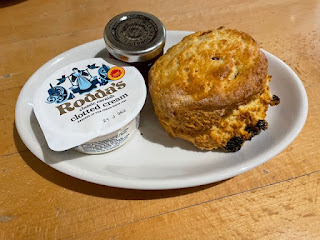
And that policy served me well today, viewers, because by the time we got back from our walk the tea room had been closed due to the high winds! Can you imagine if we'd waited? But Scone First it had been and so I'd already bagged this big, rugged and reassuring scone. It was also very fresh and delicious and got a unanimous 5 stars from the panel:

Ilam Park National Trust Scone

The panel today was made up of members of the Scone Blogger's family. This wasn't their first rodeo and their standards seem to have gone up during the COVID hiatus: there was a minor complaint from one member who claimed that all of her fruit was in the bottom half of her scone. This was overruled by everyone else. But we all agreed that the tea room itself was lovely with friendly, helpful staff. 

Ilam Park Tea Room

We then set off to see what Ilam Park, Dovedale and the White Peak had to offer. I was completing my Peak District trilogy today, having visited Kinder, Edale and the Dark Peak in June 2019 and Longshaw, Burbage and the Eastern Moors in January 2018. You'd probably assume that I would have been prepared, but no - I was still tottering around with a handbag and a pair of trainers while sturdy booted rucksackers strode past me. I think we have established that I will never learn.

So here's what we discovered:

  • This area of the Peak District National Park is known as the White Peak Estate
  • It's situated in the central and southern part of the Peak District, while the Dark Peak covers the north-east-west area
  • The White Peak Estate contains Ilam Park and the valley of Dovedale as well as other valleys
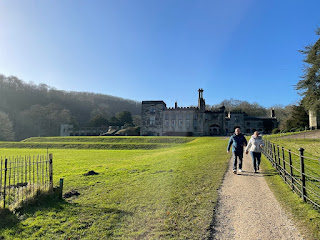
  • Ilam Park contains Ilam Hall, the Italian Gardens and the tea room
  • Ilam Hall was built between 1821-1826. It is currently a youth hostel and you can stay there for just £15 a night! Bargain!
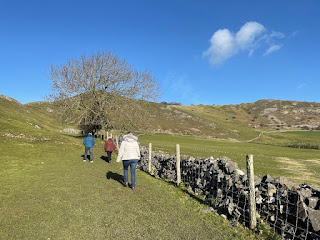
  • There's a very nice walk from Ilam to Dovedale - you can either walk across the fields and hop over one small stile, or head up a hill and go the long way. We won't dwell here on the option we chose. Let's just say that we came back the less arduous way.
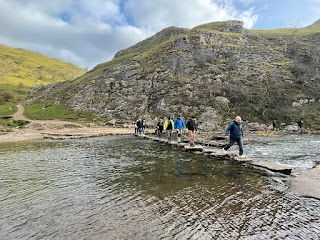
  • The stepping stones across the River Dove are quite easy to negotiate (I didn't negotiate them)

Stepping Stones in Dovedale

What you don't see in any of these pictures, of course, is the wind. It was almost unworldly - a huge swirling gust would suddenly build up and almost knock you off your feet.

This led to a first for Team Scone Blogger. As we walked along the river there was a sudden loud creaking sound and a tree on the other side was uprooted and fell away from the water. The smell of damp wood was incredible as the roots were exposed to the fresh air. Even the Scone Blogger's mother, who grew up in the countryside in Ireland, had never seen such a thing. We were very lucky it didn't fall on any passing walkers, as it was a very clear reminder of the sudden dangers of the weather. Plus it explained why the NT closed the car park and tea room as a safety precaution.

So that completes the first National Trust Scone Mission of 2022! Bring on the final 23! This is going to be our year!

Ilam Park, Dovedale and the White Peak: 5 out of 5
Scone: 5 out of 5
The wind: 5 out of 5 for being the wind but 0 out of 5 for stopping scone production
Saturday, 22 June 2019

Kinder, Edale, the Dark Peak

I've worked out that I've consumed around 113,900 calories so far on this National Trust Scone Odyssey (obviously I will be deleting this post before I ask BUPA to pay for the heart bypass).

So I was very excited to be heading for the great outdoors today for my visit to Kinder, Edale, and the Dark Peak. I had it roughly planned out as follows: walk up hill singing Valderee! Valdera!, eat scone on top of hill Heidi-style, return down hill in triumphant calorie credit.

Pennine Way Edale

I was half way to Derbyshire when I realised that Kinder Scout is actually a mountain and not a hill. The UK government decrees that a mountain is a summit of 600 metres or more and Kinder Scout is 636 metres high. 

I also realised that, as the name of the property suggests, I was actually visiting several different things:
  • The Dark Peak refers to a whole area of the Peak District, located in its more northern reaches 
  • Edale is the name of the village in the Dark Peak that sits at the start of the Pennine Way and is a gateway for walks onto Kinder
  • Kinder is the moorland that contains the Kinder Scout summit, the River Kinder, and the waterfall known as Kinder Downfall
When I got off the train at Edale, I discovered that the very lovely Pennypot Cafe, owned by the National Trust, was right next-door to the station. Kinder Scout, on the other hand, was not. 

It's about a 70 minute walk from Edale to Kinder Scout on the Pennine Way and I hadn't allowed enough time for a full circuit. So I did my best: I huffed and puffed up half a mile, took in the marvellous views, and then picked my way back down while being overtaken by 800 nine year-olds.

The Pennine Way at Edale

If I had been a bit more organised, I could have retraced the steps of the Kinder Trespass, which took place in 1932. I had heard of the Mass Trespass but I hadn't realised that five men went to prison for it. 

Luckily I had bought a book before my expedition called The Battle for Kinder Scout and that helpfully shed some light on events:
  • Six million acres of common land had been privately enclosed between 1600 and 1914, often given to landowners for sheep grazing and grouse shooting
  • The urbanisation of Manchester and Sheffield and other areas after the Industrial Revolution, along with affordable train travel, had created a great demand for access to the countryside at weekends and holidays
  • The limited public trails for rambling grew crowded, while whole swathes of land was visible to the ramblers but off limits
  • Kinder was a perfect example - the public could walk round it but not across it
  • Benny Rothman and his cohorts organised a Mass Trespass onto Kinder on Sunday April 24th 1932
  • Around 400 trespassers gathered and walked onto private land where there were altercations with gamekeepers - further trespassers also joined from other directions
  • Benny, along with four others, was arrested and ended up serving several months in prison for riotous assembly
  • Ewan MacColl, the folk singer then known as Jimmie Miller, was part of the Trespass and wrote The Manchester Rambler about it
There has always been debate about the Trespass - even at the time a lot of ramblers' associations disapproved of it - but it arguably led to the creation of our National Parks in 1949, after which the Pennine Way and other long-distance footpaths were established.

But let's go back to the beginning and my encounter with the Pennypot Cafe. The first thing you need to know about the Pennypot Cafe is that it offers the friendliest and most efficient service that I have ever come across at the NT. The guys that were running it today were brilliant. It also has very good music. 

The second thing you need to know is that the scones are very good. They had three types on offer: Apple & Walnut, Apple & Raspberry, and Cheese & Chive. 

I plumped for the Apple & Walnut and sat in the outdoor courtyard with a friendly little robin who accepted my offer to share the scone. It was very tasty (the scone, not the robin). I was convinced that the loose leaf tea was going to be a fail as it was a weird colour BUT NO - it was really refreshing and went down a treat.

Kinder, Edale National Trust Scone

Before my trip today I had decided to consider a future career as a hill/mountain walking fan when I finish the National Trust Scone Odyssey (don't pop the champagne corks just yet, folks; I still have 60-odd places to go) as it will offset six years of clotted cream. After today, I'm not sure it's going to be an easy transition.

(If you want further examples of previous Peak District failures, you can read about my trip to Longshaw, Burbage, and the Eastern Moors).

Kinder, Edale, the Dark Peak: 5 out of 5 for the views and the loveliness of Edale
Scone: 5 out of 5 (0.5 for the fantastic service and Tom Petty/Stevie Nicks soundtrack) 
Chance of seeing enough of the area in two hours: 0 out of 5

Saturday, 6 January 2018

Longshaw, Burbage and the Eastern Moors

Where do I even start with today's humiliations on my scone mission to the Longshaw Estate in the Peak District? If you're a regular reader, you'll know that the first scone mission of the year usually involves some sort of disaster and today I worked out why: footwear. Specifically, my choice of footwear for January scone missions.


Longshaw Peak District

I left London in what I considered to be a pair of sturdy, almost construction worker-type, boots. Two and a half hours later the boots seemed to have turned into ballet shoes, or that's how it felt as I tried to negotiate two miles of muddy rocks.


Muddy Longshaw

The alarm bells started when I got to Grindleford train station and asked a woman if I was on the right path. I knew it was a 1.5 mile walk but I was still expecting her to say "yes, it's not far". She didn't. She said "hmmm" and thought about it for 5 minutes.

I eventually thanked her and strode purposefully off, passing a group of what looked like elderly walkers getting kitted up. I then made my first mistake: I failed to notice the incline of the hill and tried to maintain my purposeful stride. It nearly killed me. Determined not to let the elderly walkers pass me, I got to the top and could hardly breathe. 

But it's not the hills you need to worry about with octogenarian walkers. It's the mud. Having got to the top of the hill I then had to negotiate a mile of really difficult terrain. Within minutes the elderly walkers had passed me, each one springing past like a mountain goat while I slid about the place like a new-born foal. I tried to keep up with them, so I could follow in their footsteps and take advantage of their insider knowledge, but did they wait for me? No they didn't.

I finally emerged, bedraggled and weary, to a a sign telling me it was another half a mile to the Visitor Centre. At this point the terrain became more National Trust - eg much flatter and only a bit muddy. On I trudged.


Longshaw

The Longshaw scone
I was starting to despair that I would ever find the Visitor Centre or a warming cup of tea or any sort of scone. But just as I was wondering whether I should give up, there it was. The scone itself looked nice enough but when I picked it up, I realised it was warm and my heart soared. And for good reason; it was an excellent, excellent scone. Light, fluffy, fresh and tasty. Totally worth the mud. 

Longshaw scone

If you're reading this thinking "what a city-dwelling imbecile" then you are, of course, completely right. I have a friend who doesn't like the National Trust much, as he thinks that it gives urbanites like me a false sense of what the countryside is. I always argue that he's wrong but today I realised he's probably right.

BUT. Imbecile urbanite or not, I do appreciate the Peak District. It was the first National Park in the UK (there are 15 of them today) and it offers so much; fresh air, exercise, and the opportunity to spend time in the beauty of the natural world. I highly recommend it (and its scones).

UPDATE: Turns out the mud wasn't to blame; I'm just useless at walking up hills, as my subsequent expedition to Kinder, Edale, and the Dark Peak proved. 

Longshaw Estate: 4 out of 5
Scone: 5 out of 5
Continued failure to dress appropriately for January scone missions: 0 out of 5

Saturday, 15 October 2016

Sudbury Hall

I don't know what I was expecting from Sudbury Hall and the National Trust Museum of Childhood in Derbyshire. I think I was expecting it to be the National Trust Museum of MY childhood, which would basically be the set of Saturday Superstore with Enid Blyton as the presenter and a cartoon sausage on a fork appearing out of nowhere every few minutes.

Sudbury Hall and the Museum of Childhood are in the same building, but they are separate entities so you can visit one or the other as you prefer.


Sudbury Hall
Can you just pretend the car is not there - it's cheaper than Photoshop 
We started off in the Museum. It begins with a really good replica of a chimney that little kids can actually climb into to see what life might have been like for them 170 years ago - quite handy if your offspring ever need reminding that a broken iPad is not the worst thing that ever happened to any child ever. 

Then there are loads of toys from olden times - I loved these cat skittles:


Cat nine-pins Steiff

And there were a few faces that I recognised from my own childhood days, although I don't remember Sooty looking this depressed:


Sooty at Sudbury
Poor old Sooty - maybe that rat stole his jumper
HOWEVER. I knew - I just knew - that there would be SOMETHING unexpected in that museum that would stop me dead in my tracks and throw me back to my younger days. 

And here it is. It wasn't Grange Hill, or Claire and Friends singing 'It's 'Orrible Being In Love When You're 8 and Half' in Search for a Superstar, - it was this orange Sindy bathroom suite, which I hadn't seen for at least 35 years. I can't recall which of my friends it belonged to, but I remembered every single bit of it, from the little white taps to the brown bath mat. I take my hat off to whoever got Sindy's hair into this Betty Draper do though - I remember her barnet just sticking up in the air and being impossible. 


Sindy Bathroom Sudbury
Proust had his madeleines to remind him of the past -
it's a little fringed brown bath mat that does it for me
ANYWAY. Once we'd looked round the museum we went next door to the actual house itself. This is a rear view of it:


Sudbury Hall rear view

A bit of history for you:

  • The Vernons arrived in Britain with the Norman Conquest
  • There are many branches of the Vernon clan, including the slightly mad lot at Hanbury Hall
  • However, the Sudbury branch inherited the Sudbury estate in 1513, when John Vernon married a local heiress
  • John left his property to his two sons - John Jnr inherited Sudbury and Henry got an estate in Staffordshire
  • The brothers appear to have been great pals, until Henry married a woman called Dorothy - John did not approve
  • John was a bachelor in his forties when Henry died in 1592, but he wanted to stop Dorothy getting her hands on all of the family estates - so he married a woman called Mary, the widow of his cousin, who handily already had a son called Edward Vernon
  • John died in 1600 without an heir of this own, and so Dorothy and Mary went into battle for the property
  • It was all sorted out in time-honoured fashion - Mary's son, Edward, and Dorothy's daughter, Margaret, were married off to each other (it's not known what they thought of this) and they were given a house at Sudbury
  • However, the house we see today was actually built by their grandson, George, after he inherited in 1660
  • The house was handed over to the National Trust by the 10th Lord Vernon in 1967, although he built himself a house on the estate and his family still live there apparently

The house has a Long Gallery, which was quite unusual for its time:


Long Gallery Sudbury Hall

In the Long Gallery there are a number of portraits, including these two. The first is Nell Gwyn, mistress of Charles II. The second is Barbara Villiers, mistress of Charles II. Do you get the feeling that he had a thing for shepherdesses whose clothes kept falling off?


Nell Gwynn Sudbury


Barbara Villiers at Sudbury

The Sudbury scone
Anyway, let's move on to more important matters. It took us a while to get to Sudbury today and we were both REALLY looking forward to our scones. I spotted a pile of them sitting on the counter as I walked past the tea room window - I think I may have broken into an actual sprint at that point. 

We were rewarded though, because the Sudbury Hall scone was fantastic. It looked perfect, it felt a tiny bit warm, and it was light and delicious. It even looked happy to see me. Definitely one of the best NT scones ever.

Sudbury scone
Maybe it's me, but I'm sure this scone was smiling for the camera

Sudbury Hall: 4 out of 5
Scones: 5 out of 5
Ability of 1980s children to be wildly jealous of anyone with an orange doll's toilet and a rubbish mirror: 5 out of 5 

Saturday, 6 August 2016

Kedleston Hall

I love the honesty of the National Trust. The fourth sentence of the Kedleston Hall guide book quotes Dr Johnson, of dictionary fame, who said; "It would do excellently for a town hall".

And I love them for quoting that so prominently, because he was right - the North Front of the house is undoubtedly imposing and striking, but it is also strangely functional:


Kedleston Hall

And the interiors are huge - grand rooms built for entertaining and showing off works of art, rather than providing space for a family home. 


Marble Hall Kedleston

But never mind any of that, because Kedleston is a fantastic property and you need to go and see it. Here's a bit of history:

1. Kedleston has been owned by Curzons for nearly 900 years!
The Curzon family arrived in the UK with the Norman Conquest. There have been Curzons at Kedleston for hundreds of years and they still live there today - the place was given to the National Trust in 1986 but there is still a family wing. 

2. The house we see today was begun in the mid 1700s!
Sir Nathaniel Curzon, 1st Lord Scarsdale, had a modest political career, like his ancestors. However as soon as he inherited Kedleston in 1758, he started to improve the place on a major scale.

3. Robert Adam was the architect!
Nathaniel had originally employed Matthew Brettingham to build his house in the Palladian style. James Paine, another Palladian architect, came along and contributed to parts of the house also. But Palladian architecture was falling out of fashion. In 1758, Sir Nat met Robert Adam, the architect known as 'Bob the Roman' because of his love of Roman buildings and the Neo-classical style. In 1760 Bob was given total responsibility for the build at Kedleston.

4. The South Front is stunning!
Robert Adam maintained much of what Brettingham had planned for the North Front, but he completely redesigned the South Front, which is indeed a much more pleasing facade I think:
Kedleston South Front

5. The interiors are also stunning!
The Marble Hall (above) is gigantic, as is the Saloon - huge rooms occasionally used for balls and other events. The showstopper room for me, however, was the Drawing Room and these huge sofas that were specially made in 1765.


6. George - the most famous of the Curzons!
I first came across the delightful George Curzon at Montacute House last year. I told the story of his affair with the novelist Elinor Glyn - she had been helping him to restore Montacute when she opened the newspaper at breakfast one day and discovered he had just got engaged to someone else.

Well, it turns out that he was indeed quite the character. Again, the guide book doesn't flinch from giving you the full story. They quote this poem written by A FRIEND at Oxford (God knows what his enemies were writing about him):


My name is George Nathaniel Curzon
I am a most superior person
My cheek is pink, my hair is sleek
I dine at Blenheim once a week

George only inherited Kedleston nine years before his death, but he adored the place. The guide book tells how George's ambition to become Viceroy of India was fuelled by his finding out that Government House in Calcutta had been designed to look like Kedleston.

He achieved his ambition, becoming Viceroy in 1899 aged just 39. He was very driven and did a lot to preserve historic buildings, both here and in the Far East, but he made a lot of enemies. He expected to be made Prime Minister in 1923 but Stanley Baldwin got the gig instead.

George collected various pieces during his time in India and his collection was divided between a museum at Kedleston and the V&A. 

My sister was with me today and I pointed out the howdah, below:


Howdah

Me: Look, there's an elephant saddle
Her: What does that mean?
Me: It's a saddle. For an elephant.
Her: They put that on an elephant?! With people in it?! The poor elephant!

7. There were Kedleston scones! Thank GOD!
The restaurant at Kedleston is quite unusual - it's in the house itself, which always brings a few understandable limitations in terms of layout. At Kedleston, you queue up at a till, give your order, and then wait at your table for your scones to arrive.

There were about 14 people ahead of me in the queue and just as I got to the front I had a heart-stopping moment - a waiter that had been searching for something on the desk triumphantly found what he had been looking for, just as I was about to be served; it was a sign saying "SOLD OUT - FRUIT SCONES". But they took the order and I went back to my seat, practising my calm face for when they came to tell me they had run out.

But it didn't happen. The scones arrived and they were huge - I couldn't have picked a better-looking scone. 

For some reason, however, the scone was really cold in the middle - not actually frozen, but very cold - and although it didn't really affect the overall taste, it completely confused me. I'm guessing it had been defrosted, but the rest of the scone wasn't warm so it couldn't have come directly from a microwave. ANYWAY - it was an OK scone, the tea was absolutely delicious, and the restaurant was nice and airy and light so we had a very pleasant time indeed.  


Kedleston Hall scone

I'm going to end with a final fascinating factoid that I discovered during my extensive research* into the Curzon clan. It turns out that the singer Harry Nilsson, the man who sang 'I can't liiiiive, if living is without yoo-ooo-oooou', once owned a flat on Curzon Street in Mayfair and both Keith Moon and Mama Cass met their untimely deaths in it within four years of each other! It is not the most cheery of stories, I grant you, but interesting all the same.

It has absolutely nothing to do with Kedleston, however, as Curzon Street in Mayfair is named after a man from a different branch of the family. But factoids are factoids!

Kedleston Hall: 5 out of 5
Scone: 4 out of 5
Elephant saddle: 5 out of 5, although probably not for the poor elephant

* reading Wikipedia

Saturday, 28 May 2016

Calke Abbey

I am not generally a fan of abbeys. I have had two bad abbey experiences; I visited Whitby Abbey about 6 years ago and am still paying off the entrance fee. And Westminster Abbey was guarded by the rudest doormen I have ever encountered, and I have been to some very questionable nightclubs in my time.

But I made an exception for Calke Abbey in Derbyshire for two reasons:
1. It's the 12th most popular National Trust property, with 314,000 visitors last year
2. It came in for some very high praise by Bill Bryson in his book, The Road to Little Dribbling. 


Calke Abbey

And from what I saw of Calke, it deserves the plaudits. However, I had a bit of a disastrous day and I didn't see much of it at all - more of that later. 

First, let me tell you what I learned about the slightly bonkers history of Calke Abbey: 

1. It was never actually an abbey
Calke was an Augustinian priory, founded sometime between 1115-1120 - the word abbey was only added in 1808 as a bit of vanity. The priory was dissolved in 1538 during the Dissolution of the Monasteries.  

2. It was owned by the same family for 360 years
The Harpur-Crewes owned Calke from 1622 until 1985, when it was given to the National Trust. It was Sir John Harpur, the 4th baronet, who built the house we see today between 1701-4.

3. It got a bit weird after 1789
From 1622 to 1789, the Harpurs sound like your usual well-to-do types - bit of politics, marrying into other local wealthy families, surviving the odd religious skirmish/being on the wrong side in the Civil War etc. 

But then Sir Henry came along. He was slightly odd, in that he hated having to communicate with other people and went to great lengths to avoid it - he wrote letters to his own staff, for example, and built a tunnel in the garden so he could go for a walk without having to see his gardeners. He didn't cut himself off entirely - it was he who added the 'Crewe' to the family name in a bid to get a peerage, and he managed to start a relationship with a lady's maid called Nanette, who he eventually married, to the outrage of everyone.

4. The "congenital unsociability" continued until 1981
Sir Henry was killed in 1819 in an accident. His son George was more sociable, but then his son, John, was "averse to public life" and rarely seen outside of Calke. And then came Vauncey who was even worse, often communicating with his own children by letter. His grandson, Charles, continued the theme and from 1949 to 1981 Calke was pretty much closed to the outside world.

5. The Trust has a policy of preservation, not restoration
As well as being unsociable, a lot of the Harpur-Crewes did very little to improve and maintain the house. Vauncey, for example, preferred to spend his money collecting stuffed birds and filled the house with them. When the Trust took over, they cleverly decided to maintain Calke as "an unstately home", showing what a decaying house looked like in the middle of the 20th century. 

This means that the Trust is preserving everything, without actually restoring it - nothing should decay any further, but it's not being polished and restored to its original brilliance. This dog is a good example of what 'preservation, not restoration' means. Apparently it was initially sent off to be fixed, but then the Trust changed their minds and decided to stick with the matchbox for a foot arrangement:


Calke Abbey dog

So what went wrong with my visit today? First, I made the mistake of trying to visit Calke using public transport. This turned out to be like Mission Impossible, if you replaced Tom Cruise on a high speed motorbike with a man called Ron driving an Arriva bus. My carefully crafted plans fell to pieces and I ended up having just 1.5 hours at Calke. Calke has 58 rooms. This was not going to work. 

And it breaks my heart to admit this, having ridiculed other people for the same mistake, but I also got the opening times wrong. In my defence, the website said 11am but I didn't read the small print, which explains that from 11-12.30 only 3 rooms are open. So that's all I saw. 

The day was saved though by Peter the guide. I think I was his first customer of the day, and he very enthusiastically offered to explain the conservation of metal to me. I'll be honest; my heart sank. I only had 45 minutes and I have very limited (ie no) interest in metal conservation. Plus the other guide rather ominously said "don't keep her long, Peter" in a way that suggested other visitors had been led away and only released 3 weeks later, dazed and requiring medical attention.

BUT! Peter was great. He showed me to the kitchen - a huge, damp cavern of a room - and pointed out a small metal pot that the NT has divided into sections and treated with different methods (eg wax and a buff, wax and no buff) so they can work out how to preserve everything. It was really interesting, and he was very amusing. 

And so onto the Calke Abbey scones.

I was feeling a bit harassed by the time I got to the cafeteria, but one glance cheered me up immensely; two big piles of generously sized scones awaited me. "Fruit or plain?" the woman asked. If I had taken just ONE second longer, I would have seen that the plain ones were bigger and more photogenic. "Fruit please," I said, and she handed me a plate containing the smallest, most misshapen scone in Derbyshire. 

I wanted to lift up my glasses and say "It is I! The National Trust Scone Blogger!" But I didn't do that, because a) she wouldn't have known what I was talking about and b) I wasn't wearing any glasses. 

So instead I carried my little scone to a table and cut into it. It looked dry. At this point, I felt like throwing the whole thing onto the floor. But I persevered and was amazed to discover that it was an excellent scone - crisp, tasty, perfectly baked. I am going to deduct half a point for its diminutive size though - at £5.20 for a cream tea, you have to expect a decent size scone. If Tom had been there, he'd have sorted it out.


Calke Abbey scone

So I'll be heading back to Calke Abbey for another look - it's a fascinating property and definitely worth a proper visit.  

Calke Abbey: 4 out of 5 this time - I'll be back though! 
Scone: 4.5 out of 5 

Saturday, 15 March 2014

Hardwick Hall

If the National Trust has taught me anything at all, it is that the Tudors and Stuarts totally kick ass when it comes to being the most interesting people in British history. The Victorians give them a run for their money, but having one moody monarch for so long denied them the edge. The Tudors and Stuarts lived in far more interesting times. If I had to go and live in another era I'd choose the 1500s any day of the week, as long as I could take the internet and a flushing toilet with me.

The National Trust owns a lot of Tudor buildings but it was Hardwick Hall in Derbyshire that I really wanted to see. It was built by Bess of Hardwick, who was a major player in Elizabethan society. 

Bess was an extraordinary woman. Here are my top five Bess facts, gleaned from Bess of Hardwick by Mary Lovell: 
1. She had four husbands. 
2. She built Hardwick Hall and Chatsworth.
3. Her brother-in-law once tried to kill her by poisoning her.  
4. She and her final husband were responsible for keeping Mary Queen of Scots under lock and key for 15 years before Mary eventually had her head cut off.  
5. She was a great friend of Lady Jane Grey before Jane also had her head cut off. 

When you hear that someone had four husbands you immediately think of a black widow type eating men for breakfast (well, I do anyway) but Bess wasn't like that. Her first husband, Robert Barlow, died when she was 16 - they'd only been married 15 months. She had 6 children with Sir William Cavendish, before he died after 10 years of marriage. Then William St Loe died after 6 years together - it was his brother who had tried to kill Bess, and the same brother was with William when he died, so it was all very suspicious, frankly. 

Her last husband was George Talbot, Earl of Shrewsbury. During their marriage, he was put in charge of keeping Mary Queen of Scots under house arrest so she couldn't stage any sort of coup against her cousin, Elizabeth I. The pressures of this led to Bess and George splitting up and having great big spats that Elizabeth sometimes had to step in and referee.

But although Bess loved her husbands, she was very canny. Her father had died when she was 7 months old and her mother had had a terrible time keeping hold of his assets, as his heir (Bess's brother) was not old enough to inherit, being only 2 at the time. Bess learned from this and as a result each marriage left her richer and richer until she was the second richest woman in Britain, after the Queen.

Hardwick Hall was built in 1590, after the Earl's death. Bess had been born at Hardwick, in the Old Hall, and she wanted to build something new and stupendous to show her wealth, power and status.

And the new Hardwick Hall is certainly stupendous. Bess's initials 'ES' feature on top of every turret, making it clear who built the place. It was designed by Robert Smythson and it was very unusual for its time:
1. It's symmetrical and most Tudor buildings were not
2. The private rooms are on the ground floor, with the public rooms up top
3. It contains a lot of windows. Glass was very expensive at the time and having a lot of windows was another statement of Bess's wealth. There was even a rhyme about it - "Hardwick Hall, more glass than wall". 


Hardwick Hall

It's a very large house and many of the rooms are true show-stoppers that make you gape. There are also tapestries that have been in the house since the 1590s - because Chatsworth was the main family residence, Hardwick wasn't modernised as much as it might have been.  

Hardwick also has a really distinct smell, which comes from the rush-matting that covers the floors. It was used back in Bess's time and is still used today. You can see it in this admittedly-not-great photo of the Long Gallery:


Hardwick Hall Long Gallery

The Hardwick scones
And the scones? There's a really nice modern restaurant to the side of the Hall itself where a cream tea consists of two whopping scones, fruit, plain or cherry. A bit of eavesdropping led me to conclude that everyone - EVERYONE - in the tea room was discussing either the enormity of the scones or the missing plane in Malaysia. But the scones were very tasty - raspberry jam is not really my thing and they looked a tad dry when I cut them but they were actually very soft and chewy.


Hardwick Hall National Trust Scones

But you know what? I also had two less-than-great things happen to me today and I am going to tell you about them. 

1. Visiting National Trust properties alone is not very enjoyable
This depresses me but I have to say it: I was on a solo mission today, as my other half was in Rome at the rugby, and it really wasn't much fun. I know that part of this is having no-one to talk to as you walk round and that's not the National Trust's fault - that applies wherever you are. However, why do NT staff have to say "Is it just you then?" when you're showing your pass at the entrance? It happened to me today at Hardwick and it happened at Lyme House last year (on three separate occasions in fact as I went round the house). Are they expecting me to suddenly remember that I left my husband and 3 children in the car? Or that I have secreted my mother under my coat? 

2. My taxi driver on the way there was like Fred West 
I am not an uncharitable person but he was horrible. My conversation with him went like this: 
Him: "I couldn't be doing with stately homes."
Me: "Oh?"
Him: "Do you know how much they charge you to get in here?"
Me: "No."
Him: "An arm and a leg. More than £10 anyway. And then a cup of tea is £3 and all it is is a tea bag and water."
Me: "Right."
Him: "Do you know the only stately home I would go to?"
Me: "No."
Him: "Blenheim. Do you know who lived there?"
Me: (lying) "No."
Him: "Winston Churchill. Or Obersalzburg. Do you know who lived there?"
Me: (warily) "No."
Him: "Hitler."
(At this point I start seriously assessing whether I would be irreparably injured if I threw myself out of the moving car.)
Him: "Or The Kremlin, where Stalin lived. These houses here were just owned by the second cousin of some toff. And we pay for it! I would rather see where war leaders lived, someone who had actually done summat."
Me: (trying not to cry) "Right."
Him: "Look at it, there's nothing here but a few trees. They've not even put any deer in it! Mind you, you could bring a bird up here for nookie I suppose."
Me: "OK! Here's all my money! Thankyoubye!"

But even Fred West and being made to feel like a no-mates couldn't ruin the amazing experience of Hardwick. I definitely recommend it.

Hardwick Hall: 4.5 out of 5
Scones: 4.5 out of 5