Showing posts with label Somerset. Show all posts

Saturday, 21 January 2023

Prior Park Revisited

It's funny how you always tend to remember the good bits of a day out. For example, I set off on my revisit to Prior Park Landscape Garden today remembering that it was easy to get there from Bath train station and that the centre of Bath itself is close by, with all the bonus loveliness of that.

What I had forgotten is that Prior Park is at the top of a steep hill. And when you get inside the park, you basically have to walk down the hill again before having to go all the way back up it again. And then when you leave, you have to walk down it again. In short: you basically spend a lot of time on a hill in Bath.

BUT! Don't let that put you off, because it's a lovely place and totally worth the Grand Old Duke of Yorking that you have to do. It was also very, very cold today so I was glad of the exercise, frankly.

I went back to Prior Park Landscape Garden today because they didn't have any scones the first time I visited in 2015 and I'm trying to give every property a fair go before I finally complete this project in February. The gardens were created by an exceptional man called Ralph Allen - you can read all about him in my first post about Prior Park so I won't repeat it here. 

Last week's revisit to Hindhead Commons and the Devil's Punch Bowl had been glorious - it was very cold but very sunny. Today I got the very cold bit:

Palladian Bridge

But it didn't matter. The Palladian Bridge seems to look lovely in all weathers. 

The Prior Park Scone

The main thing I remembered about the Prior Park scone from 2015 was that they didn't have any. What I hadn't remembered (but my original blog post helpfully reminded me) is that I'd taken solace that day in a huge lump of carrot cake. So I was hopeful of some sort of baked treat.  

The other thing I recalled was that the refreshments at Prior Park had been right at the bottom of the hill, about as far away from the entrance as you could get. I had steeled myself for this today, so I was overjoyed when the woman at reception told me they'd moved it and it was now just a few short metres away. 

I walked around the corner and found the promised Tea Shed:

Prior Park Tea Shed

It looked really lovely and inviting, despite the cold. However, I've been on this National Trust Scone Odyssey for a long time now and I can tell when scones are less likely to be on the menu. I prepared for the worst - and was delighted to be wrong. The Tea Shed offered a choice of fruit scone, plain scone or cheese scone. I plumped for fruit.

Prior Park scone

Clearing the frost off the table was a first for this project but it was worth it, because the scone was a triumph. It was very slightly warm and tasted delicious - I did waver very slightly on the score but in the end it had to be a 5 out of 5.

I have to tell you that the city of Bath has form for requiring revisits. My first visit to Bath Assembly Rooms in 2013 ended in scone failure, so the Scone Sidekick and I went back in 2014. On that occasion we had a Bath Bun as well as a scone. Today I decided to buy another Bath Bun for old time's sake - I knew the Assembly Rooms were closed but I thought every bakery in Bath would serve them. Turns out they don't. But Bath is always an excellent day out, so I recommend a visit if you've never been. 

Prior Park Landscape Garden: 4 out of 5
Scone: 5 out of 5
Prettiness of work of Jack Frost: 5 out of 5

Sunday, 14 August 2022

Barrington Court

I have a secret affection for National Trust properties where you approach the house saying things like "There it is! It's nice. Quite small and, er, I can't see any sign of the enormous multi-year roof repair project from here. Maybe they haven't started yet?" before you turn your head to the right and see the enormous Tudor house that you're meant to be looking at, rather than the random outbuilding you've been admiring for 10 minutes.


I'm not a heritage professional but if I was and someone told me that the building I was working in needed roof repairs, I would put my coat on and never, ever come back. I can't think of anything worse. Roof repairs take years and cost millions and cause total upheaval for something that 99% of visitors will never directly see or appreciate. It must be absolutely awful.


Anyway. You've probably gathered by now that we didn't get to go inside Barrington Court as it's closed. But it's a fascinating place so I'm going to share some details anyway:

It was restored by Arthur Lyle of sugar fame
It's an amazing story: Barrington Court was gifted to the National Trust in 1907 - it was actually one of its first acquisitions. But Barrington was a partial ruin and, with no endowment money, it threatened to become a huge drain on NT resources. Luckily, Colonel Arthur Lyle came to the rescue. He was the grandson of Abram Lyle, who invented Lyle's Golden Syrup. He took on a 99-year lease of Barrington and began the long process of restoring it with his architect, James Edwin Forbes.

Gertrude Jekyll worked on designs for the gardens
Jekyll was 74 when she worked on Barrington, with failing eyesight. She never actually visited the place and had to rely on drawings, biscuit tins of soil samples and visits from Colonel Lyle's wife, Elsie, who did much of the planting. I was pleased to read in the guidebook that Jekyll had a "dislike of rich people who gardened only through 'hirelings'", so she'd have approved of Elsie getting her hands dirty. (She would have approved of me too, as you won't find any hirelings in my garden. You won't find anything else either, but never mind.)

Barrington White Garden

The house was completed around 1560
A London merchant called Sir William Clifton actually built the house. His son John succeeded him but then it all went wrong - his son, Gervase, ended up in the Fleet Prison, where he killed himself. Gervase's son was mauled by a bear at a bear-baiting event and died of his injuries. The Strode family then acquired Barrington and extended it with an impressive stable block. 

It appeared in Wolf Hall
Barrington was in the BBC adaptation of Wolf Hall (as was Montacute, which isn't far away). It had a starring role as York Place/Whitehall, the home of Cardinal Wolsey.

The stables became Strode House
There are quite a lot of secondary buildings at Barrington. The impressive stable block built by the Strodes was restored by the Lyles so they could live there. It's a really striking building in its own right:

Strode House Barrington

There are Artisan Workshops
The Artisan Workshops are close to the house on the estate and they were very nice, with jewellery and chairs and other items on sale:


The Barrington Court Scone

Barrington was the final stop on a mini Somerset road trip. We'd started at Lytes Cary, which is a beautiful place but the scone wasn't the best. We then went to Knightshayes, which is a barnstormer of an NT property, where the scone was a bit better.

The Barrington scone didn't fill me with hope. It looked a bit over-baked and I was fearing the worst. But it was actually very nice. It was fresh and tasty and I ate all of it.

Barrington Court scone

I'll hopefully get to go back to Barrington when the roof is fixed, as the interiors look very impressive even if they are empty. In the meantime, I'm sending all my positive thoughts to the Barrington team - it can't be easy running a National Trust property that's actually shut.

Barrington Court: 3 out of 5 (I'm sure it would be a 5 when the house is open)
Scone: 4.5 out of 5
Gertrude Jekyll's approach to life: 5 out of 5

Saturday, 13 August 2022

Lytes Cary Manor

When I started this blog in 2013, it never occurred to me that I could write about anything other than scones. But this project could have been about a long list of subjects. I could have chosen National Trust cappuccinos or National Trust car parks. Even as I type, there's a man called NTByBike who is busy cycling around all 600+ National Trust properties to test out the bike facilities.

One thing I could have reviewed, although I may have got sued or beaten up in the process, is National Trust volunteer guides. I have met some absolutely brilliant National Trust volunteers over the past nine years of this project and the ones at Lytes Cary Manor today were exceptionally good.    

Lytes Cary Manor

You may be wondering "how do you know when you're in the presence of a five-star volunteer guide?". Luckily, I have the answer: you know they're brilliant when you have to drag yourself away from them. You want them to follow you around for the rest of your life, pointing things out to you, eg "This Tesco Express used to be a haberdashery. They once sold some buttons to Larry Grayson." or "There have been 114 marriage proposals in this restaurant. 112 were accepted, although of those was later rescinded."

Anyway. Lytes Cary today had not one but TWO five-star volunteer room guides. A man called Ian told us all about the Great Hall. Then we met Sue who pointed out all the quirky stuff in the Great Parlour. What I loved about them was the enthusiastic honesty, eg "These figures by the fireplace are made out of leather. They're quite ugly but everyone has their own tastes."

Lytes Cary Parlour

But let me tell you about the history of Lytes Cary:
  • The chapel is the oldest building at Lytes Carey. It was completed in 1348.
  • It was built by Peter Lyte, the grandson of William de Lyte who founded the family.
  • The Great Hall was built by Thomas Lyte in the 1460s, with the Great Parlour added in the 1530s.
  • One of the most notable Lytes was "Henry the Herbalist" as the guidebook calls him. In 1578 he published the Nieuw Herbal, an English translation of a Flemish book on plants and their medical and other uses.
  • But then it was all went a bit pear-shaped for the Lyte clan - they got into financial difficulties and had to sell up in 1755. However, they continued to make names for themselves. The Reverend Henry F Lyte wrote the hymn 'Abide with Me!' in 1847 while Colonel William Lyte was founder of the city of Adelaide in 1836.
  • The manor fell into disrepair.
  • In 1907, what was left of the manor was bought by Sir William Jenner and his wife. His dad had been Queen Victoria's doctor and had made a lot of money.
  • The Jenners set about restoring the place as faithfully as they could, salvaging panelling and other fittings and furnishings from other buildings.
  • The Jenners' daughter Esme died when she was 37 and so Sir William gave the place to the National Trust.
  • The West Wing of Lytes Cary is now a holiday 'cottage' that you can rent out - details here if you're interested!


The Lytes Cary Scone

I need to tell you that I went to Lytes Cary during a heatwave. This may have impacted on scone quality, as I can't imagine that it's much fun baking all day in a small kitchen when the temperatures outside are hitting 32 degrees and above. But - and it's genuinely paining me to say this - the Lytes Cary scone was a bit stale. 

The simple conclusion I have drawn after 9 years of eating National Trust scones is this: a fresh scone is 99% likely to be a good scone. If it's been baked in the last 2-3 hours, you almost cannot fail with it. The Lytes Cary scone was definitely a bit older than it should have been.

Lytes Cary scone

I also had two other scones that didn't quite hit the mark during this hot weekend - one at Knightshayes and one at Barrington Court. It's a long time since I've had a run of three scones without a five-star performer and I was feeling quite worried about it. 

So at last minute, I decided to add Montacute to the itinerary. I'd loved it there when I went in 2015 and they were brilliant again today; a top class scone. In the cafe they had a sign, though, which made me feel even more worried for all those people working so hard to keep things going in National Trust food and beverage outlets at the moment:


But let's not despair! We need to let the National Trust F&B teams know that we appreciate them and hopefully things will improve again soon.

In the meantime, I've decided that my next blog will be National Trust Holiday Cottages. I will selflessly offer my services as a kind of Judith Chalmers of the NT, going about reporting on bed quality and local cuisine (scones, obviously). Selfless, I know, but surely someone has to do it?

Lytes Cary: 5 out of 5
Scone: 3 out of 5
Lytes Cary volunteers: 500 out of 5

Friday, 15 April 2022

Brean Down

The most important piece of advice I can give anyone is simply this: never trust a bus timetable. There have been a few occasions during this National Trust Scone Odyssey when I have required the services of a bus and I can honestly say, hand on heart and without exception, that I have always been completely stunned when the bus actually turned up. And to be fair, they've turned up more often than they haven't. But I'm still always really surprised when they do.

And I will add to this, because there is one particular day of the year when you must NEVER trust a bus timetable and that is Good Friday. At least on Christmas Day you can be certain that there won't be a bus. But Good Friday? Just don't go there.

Anyway, today I went there, despite knowing the above. I checked the timetable for the bus service that goes to Brean Down from Weston-super-Mare and it clearly showed a service for public holidays. But there was no bus. Luckily, I knew the Brean Down Way provided an 8-mile walk from Brean to Weston. I'd been deliberating whether to attempt it, so the bus shortage made my mind up, while a taxi took me out there. 

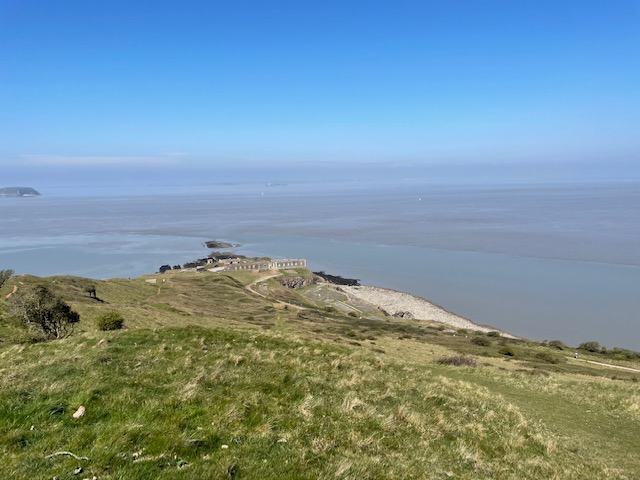
Brean Down Fort View

The slight snag with doing an 8 mile walk after a visit to Brean Down is that Brean Down itself requires a bit of effort. A nice amble on the beach it is not. As I dragged myself up the steps to reach the top of the promontory, I found myself thinking "is this fun? I'm not sure this is fun", before I reached the summit and was treated to the amazing views that make a climb worthwhile. 

Let me tell you a little bit about Brean Down:

  • Brean Down is a promontory stretching 1.2 miles into the Bristol Channel
  • People have used Brean Down for thousands of years - a possible long barrow mound suggests Neolithic occupation, while remains of an Iron Age hill fort and Roman temple have also been found
  • In the 19th century, plans were drawn up to turn Brean Down into a harbour that could act as a transatlantic port. The project was beset with problems and it didn't materialise.
  • Brean Fort was built at the far end of Brean Down between 1865-1872 as part of a chain of forts designed to protect against the French.
  • The main building we see today (below) was the barracks for 50 men
  • The fort was refortified in 1941 during World War II 


For some reason it reminded me of the Alamo. This isn't so strange - they're both forts after all. But I've never actually been to the Alamo, so I'm not sure why I made that connection. Maybe the sun was getting to me.

The walk along the promontory to the fort had been quite tricky - the steep steps, then an uphill incline followed by a steep downhill section that I wouldn't want to do on wet ground. I thought sadly of the people with mobility issues who wouldn't ever be able to see Brean Down. On my return walk, I discovered that I'd taken the high road route and an alternative was available -  a mostly flatter gravel path that was being enthusiastically used by highly determined folk powering themselves up the hill in all terrain mobility trampers. Never underestimate the National Trust or its members. 

The Brean Down Scone

It must be said that even the Brean Down cafe makes you work a little harder than your average NT property. I helped myself to a fruit scone and had paid for it when the assistant explained that I would find the jam and cream in the fridge and then I needed to pick up my drink from the counter in the other room. I ran around, collecting the constituent parts of my cream tea, feeling like I was on the Crystal Maze. It wasn't unpleasant - just different.

Brean Down Scone

It was worth it though, because the Brean Down scone was a lovely one - very big and even. It was fresh, full of fruit and very tasty, so it gets full marks from me.

And, despite the exertion, I can also recommend the walk back to Weston-super-Mare. The Brean Down Way is mostly flat and very well designed and maintained - once you get through Brean you don't encounter any cars for a few miles until you get to Weston itself. I did have the unexpected problem of sun (unexpected because it was April). I decided to buy myself a hat to prevent my face looking like a beetroot but the hat turned out to be a kid's baseball cap, so I had to walk along with a little hat perched on my head, looking like one of the Mr Men. 

As my weary legs carried me up the seafront in Weston, I was able to gape in awe at Brean Down in the distance. It looked like a sleeping crocodile about to glide down the Bristol Channel and I was inordinately proud of having walked all the way from the tip of its nose. 

Brean Down from Weston


Brean Down: 5 out of 5
Scone: 5 out of 5
Walking the Brean Down Way path to Weston-super-Mare: 5 out of 5

Thursday, 1 August 2019

Dunster Castle & Water Mill

If there was a sport called 'guess how old this castle is?' then I would be rubbish at it, just as I am rubbish at 99% of all other sports. (I'm saving the 1% for the as-yet-unknown one that I will master.) 

Dunster Castle near Minehead in Somerset is a perfect example. I saw a picture of it and decided it was the work of some 20th century madman who had made a pile of money out of toilet rolls and built himself a castle so he stood a chance of getting Queen Mary round for tea.
Dunster Castle

In fact, Dunster is very old. Here are the facts:

It was originally built by the de Mohuns after the Norman Conquest
William de Mohun was a knight who came over with William the Conquerer and built a castle on the site of a Saxon hill fort. However, not much is actually left of it - the gateway below is the only piece that dates from the 1200s. It's an impressive piece though:


Dunster Gateway

The Luttrells built what we see today
The de Mohuns sold up to the Luttrell family in 1376. The Luttrells built the gatehouse in 1420 and a new Jacobean castle in 1617. Henry Fownes Luttrell carried out a major landscaping project in 1755 and then in 1868 George Luttrell commissioned Anthony Salvin to redesign the castle to create a Victorian country home.

It was almost destroyed in the Civil War
Thomas and Jane Luttrell were Parliamentarians during the Civil War and were forced to defend the castle against Royalist troops. But they switched sides for some reason and then had to defend it against the Roundheads. Cromwell sent 200 men to destroy Dunster and the curtain walls were duly demolished but the order was revoked and the castle was left to stand.

It has a leather room
Every now and again you come across something that you've never seen before at the National Trust. Dunster has some leather hangings that were made in the Netherlands in the 1600s. They tell the story of Antony and Cleopatra but they were cut up to fit the room and so they're in the wrong order. Here she is killing herself with her snake:


I'm not sure why nobody looks terribly bothered that Cleopatra is
committing suicide in front of them - she doesn't look too fussed herself

It has a working water mill
The Domesday Book mentions that there was a mill on the site, although the current building dates from 1779. It was abandoned by the 1930s and then reopened during the Second World War. It is still working today and you can buy flour that has been milled on-site.

It has the Dunster Castle scone
And while we're on the subject of flour, let's move on to the scones. The tea room at the water mill is a lovely spot and my scone was very tasty indeed - maybe a little bit crumbly but it held together enough to be eaten without completely disintegrating.


If you want to have a go at this new and highly exciting sport of castle age guessing, then be my guest. Here are the other National Trust castles I've visited - see if you can pick out the oldest one:
- Bodiam Castle
- Chirk Castle
- Corfe Castle
- Croft Castle
- Lindisfarne Castle
- Penrhyn Castle
- Powis Castle
- Scotney Castle
- Sizergh Castle

Dunster was the second stop on my Grand Tour of North Devon - the day before I had fulfilled my ambition to visit the very awesome Watersmeet.

Dunster Castle: 5 out of 5
Scone: 5 out of 5
Chance of 'castle age guessing' making it to the Olympics: 0 out of 5

Holnicote Estate

The Holnicote Estate (pronounced Hunnicutt) is massive: 12,000 acres of land across Somerset and Exmoor National Park. It contains 5 villages, a nature reserve, and 150 miles of footpaths and bridleways. 

What it doesn't contain are any National Trust scones. There are several tenanted tea rooms in the various villages, but to give myself a fighting chance of ever finishing this quest I have decided not to make those mandatory.

However, I had seen a picture of the Periwinkle Tea Room in Selworthy and decided it was too pretty to miss, so I called in on my way from Dunster Castle.


Holnicote Periwinkle

I can honestly say that I thought I'd died and gone to heaven at the Periwinkle. It was a beautiful day and the tea room garden is the perfect peaceful little place for a cup of tea. 

The scone was also perfect - warm, tasty, and fresh: 


Holnicote Periwinkle Scone

So I definitely recommend a stop on the Holnicote Estate - there's lots of walking and scone eating to be done.

Holnicote: 4 out of 5
Scone: not strictly NT but an honorary 5 out of 5


Saturday, 18 August 2018

Coleridge Cottage

I think it was in May 1994 when a monumental realisation dawned on me; "Sarah, you are poor as a church mouse. You are clueless as to what you're going to do with your life. But look on the bright side; after this term at university, you will never, ever have to think about the Romantic Poets EVER AGAIN."

I love literature, I love reading, but I could never get my head around the Romantic Poets. Coleridge, Wordsworth, Keats...I just didn't get any of it. I'm sorry.

But the National Trust has a habit of making you face your educational demons and so I found myself at Coleridge Cottage in Somerset today.

I failed to take a picture of the outside of the cottage
so here's one from inside.
Here are some facts:

  • Samuel Taylor Coleridge was born in 1772, the youngest of nine brothers
  • He was precociously talented and a bit of a show-off but it sounds like he lacked self-confidence
  • He met Robert Southey and together they formed a plan of emigrating to America and setting up a utopian scheme called Pantisocracy 
  • In their planning for Pantisocracy, Coleridge ended up marrying Southey's sister-in-law, Sara Fricker. Pantisocracy never happened. Coleridge may have regretted the marriage.
  • In 1796, Coleridge moved his wife and young son to the cottage in Nether Stowey, where they could live among nature
  • He befriended William and Dorothy Wordsworth, who joined him in Somerset, and together they wrote their Lyrical Ballads - these included some of Coleridge's most famous works, including The Rime of the Ancient Mariner, Frost at Midnight, and Kubla Khan
  • After only two and a bit years, the Coleridges left the cottage - but it remains the place where he wrote his masterpieces
  • Best fact of all: Coleridge ended up in debt while he was studying at Cambridge and ran away to join the army under the pseudonym of 'Silas Tomkyn Comberbacke'.
  • Even better fact: there's a sign on the wall of the cottage explaining that Kubla Khan has inspired many artists, including Frankie Goes to Hollywood, whose song Welcome to the Pleasuredome references Coleridge's work
The cottage itself is lovely enough but the garden was the highlight. One of the guides apologised for it, explaining that it had suffered in the hot weather, but I absolutely loved it. Somehow I ended up being the only person out there for about 20 minutes - it has several listening posts that play snippets of Coleridge's poetry and it was truly lovely.


The Coleridge Cottage scone
But let us move on to the Rime of the Microwaved Scone. It all started so well - the tea room is actually part of the cottage building, which is always great. I ordered my scone and sat down and then 'PING!'. Unfortunately, I was the only person in there so that PING was definitely connected to my scone. It was nice enough - a bit salty maybe - but why microwave it? 


This isn't the first time that the National Trust has made me face my fears of the Romantic Poets; in April 2016 I went to Wordsworth House near the Lake District and I loved it there as well. Maybe I've been wrong all this time.

Coleridge Cottage: 4.5 out of 5
Scones: 4 out of 5 - nice but microwaved :(
Poems in the garden: 5 out of 5


Fyne Court

"Fyne Court was once owned by the electrician, Andrew Crosse," I learned during my research for this 170th scone mission. It cheered me up immensely - what hope to us all, that the National Trust might one day be interested in our homes! Electricians today - who knows, maybe even marketing managers will get a look-in eventually. I should probably start tidying up.

But of course the word electrician meant something very different in 1805 when Andrew Crosse inherited Fyne. He was known locally in Somerset as "The Thunder and Lightning Man" because of his experiments with the relatively unknown force of electricity...and eventually it all turned a bit nasty, with vicars doing exorcisms outside his house and what-not. Here's what I learned:

1. Fyne Court burnt down in 1894
...but before you jump to any conclusions, the fire had nothing to do with electrical experiments going wrong, or deranged arsonist vicars coming to stop the Devil's work - a housemaid's candle was to blame. I'm only mentioning it so early in my story because you're probably wondering what has happened to my usual stunning photograph of the house (I'm joking). Answer: there is no house at Fyne Court because it was engulfed in flames and pulled down. But here's a picture of the Boathouse which fell into disrepair: 

Fyne Court Boathouse

2. Fyne Court had been built in 1634
The Crosse family built Fyne Court in the 17th century. They were descended from a bloke called Odo de Santa Croce, who had sailed to England with William the Conqueror, and they had stayed close to the political action ever since; Andrew's own father had witnessed the Storming of the Bastille.


Fyne Court folly
This isn't the Bastille - it's the folly at Fyne Court
3. Andrew, the scientific wonderkid
Andrew Crosse was born in 1784 and became interested in electricity when he was around 12 - his father was a friend of Benjamin Franklin, which may or may not have influenced him. He continued his interest at Oxford and then set up his laboratory at Fyne when he returned to live there.

4. Was Andrew Crosse Frankenstein?
I bought a book about Andrew Crosse before my visit, called The Man Who Was Frankenstein. It argues that he inspired Mary Shelley to write her famous book. Further, it argues that the character of Dr Waldman in the book is based on Crosse. 

There is undoubtedly a connection - Crosse gave a lecture about his experiments in London in 1814 that Mary Shelley attended, and she started writing her famous novel in 1816. But much as I'm a sucker for a great story, I wasn't totally convinced, especially as the author bizarrely tries to support his claims by pointing out that a gargoyle in the churchyard looks like Boris Karloff in the 1931 film - don't they all??

However, I was happy to see the NT promoting the possible connection with a big display in the little information centre. I went to an NT property once that had an unsubstantiated link with the Gunpowder Plot and they didn't mention it anywhere. I took this as a sign that the NT is probably very risk averse when it came to rumours and conjecture. But no - turns out they like a good story as much as anybody.


Fyne Court information centre

5. What happened to Andrew Crosse?
Crosse's work benefitted experts and locals alike. He corresponded with some of the leading thinkers of the day, even though he preferred the quiet life at home in the Quantock Hills to hobnobbing in London. Locally, his electrical machine was used for curative purposes - a farmer who had been paralysed on one side was treated by Crosse and was much improved. 

However, it all got very difficult when he made a surprising discovery. During one of his experiments, he seemed to create living insects from a stone. Unable to explain it, he shared this news with a small group of people, one of whom, unfortunately, was the editor of a local newspaper. The good news was that the insects were named after him. The bad news was that it stirred up a tidal wave of vitriol and fear that Crosse was consorting with the Devil and meddling with nature/God's work. This is what brought Reverend Smith up to the estate to perform an exorcism.

6. Fyne Court today
There might not be a house at Fyne Court, but the estate covers 65 acres and there's lot of space for walking. 

Fyne Court walled garden
The Walled Garden - it is indeed walled
7. But what about the Fyne Court scone?
I really wanted a showstopper of a scone today - it was the 170th mission after all, AND it was also the 5th anniversary of me starting this National Trust scone blog project. But the Fyne Court scone turned out to rather suit its surroundings, in that they'd done their very best with limited resources. There's no proper kitchen at Fyne, so I assume the scones were bought in - mine was dry and didn't seem very fresh. But it did taste better than it looked.

Fyne Court Scone

I'm going to end on a sombre note because much as I enjoyed The Man Who Was Frankenstein, it is also sad. Crosse was prone to introspection and depression throughout his life, even before the world ganged up on him and vicars started waving crosses around outside his house. 

His final words to his wife before he died were: "My dear, the utmost extent of human knowledge is but comparative ignorance". Does that mean that when this odyssey is over, I'll still be none the wiser about scones??

Fyne Court: 4 out of 5
Scone: 3 out of 5
Andrew Crosse's choice of confidants: 0 out of 5


Saturday, 22 October 2016

Tyntesfield

I have now been to 149 National Trust properties. I've seen houses built from the profits of cotton, sugar, coal, banking, shipping, guns, and marriage but Tyntesfield (pronounced Tintsfield) near Bristol is the first place I have visited that was funded by bird poo.

Yes, you read that correctly. Bird poo. In 1842, the Gibbs family started importing guano (that's dried bird poo to you and me) from Peru of all places. It was sold as fertiliser and it revolutionised Victorian agriculture, making William Gibbs wealthy enough to create this place: 

Tyntesfield

  • The house at Tyntesfield had originally been Georgian
  • William Gibbs bought the place in 1844 as a country residence for his wife and seven children
  • In 1863, William commissioned architect John Norton to enlarge and remodel it in High Victorian Gothic style
  • His son, Antony, created the farm at Tyntesfield and modernised the place with electricity when he inherited it in 1887
  • Antony's son, George, inherited in 1907 - he later became 1st Baron Wraxall 
  • The Gibbs firm had left the guano trade in 1861 and diversified into other products
  • However, the 1929 Wall Street Crash and the Great Depression impacted on business and income gradually declined
  • George's son, Richard, inherited in 1949 - he never married and lived alone in the house while he ran the estate until he died in 2001 
  • In 2002, the National Trust acquired the house and the core of the estate

The house is undoubtedly beautiful, but the real show stopper at Tyntesfield is the chapel. It was the first part of the building that we saw and I was stunned by it- it's basically half a cathedral:


Tyntesfield chapel

The chapel is based on La Sainte Chapelle, a medieval royal chapel on the ÃŽle de la Cité in Paris. It had not been part of the original plan for Tyntesfield and was added a decade later, in 1875, by architect Arthur Blomfield. He managed to build it on sloping ground so that the family could access it from the first floor of the house. 

William was very religious. He was a Tractarian; in 1833, the Reverend John Keble had created the Oxford Movement, which called for a reform of the Church of England and a return to its Catholic roots. Supporters of the Oxford Movement were called Tractarians and they included William Gladstone as well as William and his wife, Blanche.

I'm now going to make myself sound like a right philistine by admitting that I was really disappointed not to see the chapel in its entirety. There's an art installation in there at the moment - it think it features people from different faiths praying - and it's enormous, covering up the whole altar. It's only there for two months, so we were just a bit unlucky with our timing, but it was really disappointing.


Art installation Tyntesfield chapel

And I hate myself for saying that, because I'm generally all for art installations at the NT - read about my love for the Singing Tree at Biddulph. I'm just not sure I'd have covered up one of the most important parts of the property - even the guide book says that the altar is the focal point of the chapel, so why obstruct it?  

Anyway. The same artist also has other pieces on display in the house itself. I have zero shame in saying that I thought they were horrible - a huge cast of a dead cow's head and two dead lambs would make most people feel uncomfortable. And they're supposed to do that - the website explains that they "will trigger us to consider mankind's complex relationship with breeding" - and I have no issue with that at all, but don't expect me to go home thinking it was lovely.


Emotional Archaeology Tyntesfield

More Emotional Archaeology Tyntesfield

The Tyntesfield scone
The art isn't the only thing at Tyntesfield that is challenging - the tea room is one of the most stressful places I have been to in a long time. I hasten to add that we were there at 1pm on a Saturday when they were having a Hallowe'en event, so I'm not complaining. I think the main issue is the building itself - there are limitations on what they can do with it and space isn't used very effectively.

But kudos to the mainly young staff - they were efficient and friendly and unflappable. The scone looked fantastic and it was fresh and tasty - a definite 5 out of 5.

Tyntesfield scone

I'm going to end with Marketing Idea for the National Trust Number 3,231. For the first time, I was struck by how all of the NT properties fit together - so William Gibbs was commissioning work at Tyntesfield in 1863, the exact same year that William Armstrong was buying land near Newcastle to build Cragside. A book explaining the chain of events and similarities/differences would be great. Or maybe just a big jigsaw. I'd buy it anyway.

Tyntesfield: 4 out of 5
Scones: 5 out of 5
Calmness and serenity: 0 out of 5


Sunday, 22 November 2015

Prior Park Landscape Garden

I love the city of Bath but let's be honest; it has not been kind to the National Trust scone blogger.

I set off for Prior Park Landscape Garden today knowing that this mission was make or break. If I found a phenomenal scone and a fascinating history at Prior I would be willing to forget the disastrous day of no scones and limited access at Bath Assembly Rooms. I would also overlook the fact that I couldn't even FIND Bath Skyline (although I will accept some culpability there on account of my inability to read a map). 


Prior Park

I have to admit, though, that I wasn't very hopeful. In my experience, landscape gardens are great for a nice walk but they don't tend to deliver the pet baboons called Bimbo or wives eloping with curates to Portugal that you get with some of the great NT houses. 

However, I did some reading and discovered that Prior Park was created by a man called Ralph Allen. I had never heard of Ralph Allen. I learned that he made his fortune by improving the postal system and buying some quarries, so I bought a book about him and prepared to be a bit bored. 

But Ralph Allen, Builder of Bath by Diana Winsor wasn't boring at all. In fact, I got so caught up in reading it that when I caught my first glimpse of the mansion I thought "that's Ralph's house!!", as if we were best pals and he himself was waiting for me with tea and scones and £1000 that he wanted to donate to my next novel or political campaign. 

Anyway, here are a few fascinating facts about Ralph and Prior Park. 

1. He made his first fortune in the post service
Ralph was born in Cornwall where it is believed he helped his grandparents with their inn/post office. He moved to Bath and soon scooted up the ladder to become Deputy Postmaster. It sounds like he was an honest sort who stamped out (ha!) any dodgy dealings and greatly improved the profitability of the post service. He retained the contract for over 40 years. 

2. He made his second fortune from Bath stone
Ralph believed in the qualities of Bath stone as excellent building material and was soon buying up the local quarries. He befriended John Wood the Elder, who had visions of turning Bath into the beautiful city that we recognise today. They worked together to create Prior Park as a showcase for Bath stone, although it sounds like they fell out a fair bit. The mansion is now a school so you can only admire it from afar.

3. He created tourist attractions
His first attraction was a bit of an accident. He commissioned a type of railway to bring his stone down to the canal so it could be shipped to London. People were fascinated by the mechanism, coming from miles around to marvel at it. In Prior Park itself he built a Palladian bridge that was soon attracting sightseers, as it still is today - it's one of only four Palladian bridges in the world (one is at Stowe, one at Wilton House, one in St Petersburg).


Palladian Bridge Prior Park

4. He was a man of the arts 
Ralph loved Bath and was its mayor from 1742-1769, but he wasn't very keen on all the gambling and frivolity that went on. He was far more interested in literature and was friends with many writers - Henry Fielding based the character of Squire Allworthy in his novel Tom Jones on Ralph. 


View from Prior Park to Bath
The view of Bath from Prior Park. It's a bit wasted on the cows.
But was Prior Park able to deliver on the all-important scone front? The short answer is no. However, the 'tea shed' was an outdoor cafe and it had a) carrot cake and b) a brazier for warmth, so I decided not to be a misery about it and enjoy the lovely view.


Carrot Cake Prior Park

But it doesn't alter the fact that I've now had two scone fails on the trot - last week's mission to Woolsthorpe Manor only delivered apple shortcake. This unnerves me. I will have to sack myself if it goes on much longer. Luckily the Scone Sidekick has agreed to join me on what I hope will be a sconestravaganza next week, so stay tuned. 

Prior Park Landscape Garden: 4 out of 5
Scones: 0 out of 5 (there weren't any)
Ralph Allen as man I would choose as my ancestor over baboon owners and scandalous elopers any day of the week: 5 out of 5

UPDATE: I went back to Prior Park Landscape Garden in 2023 to see if any scones would be available on the second time of asking! And guess what - they were!