Showing posts with label Lincolnshire. Show all posts

Saturday, 12 November 2022

Sandilands

I was scrolling through social media a few weeks ago when I saw the words "baristas" "training" "National Trust" and "exciting news next week". I don't want to say that I went into a panic but I went into a panic.

I discovered that Sandilands, a former golf course near Mablethorpe that the National Trust acquired in 2020, was opening a temporary tea facility. I went into Sherlock Holmes mode, examining the photos for any signs of scones. 

I couldn't see any. Surely a temporary tea kiosk wouldn't serve scones? The Rules of the National Trust Scone Blog clearly state that if there are no scones, I don't need to include the property in this quest.

But I was wrong. The ever-helpful Sconepals did some slightly more in-depth investigating and let me know that scones were indeed on the menu. There was only one thing for it - I had to go to Mablethorpe.
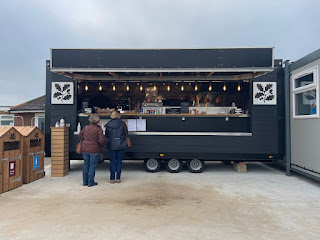
Sandilands Tea Kiosk
A National Trust tea room on wheels. A potential game-changer.
The National Trust is turning Sandilands into a nature reserve. It will cover 74 acres and will take years to complete. I have to say that although there wasn't much to see, it was interesting to see it in its formative state and know that in a few years it'll look totally different.

Sandilands

However, it does mean that there isn't a huge amount I can tell you about the place today. I can tell you that it was a links golf course with a par of 70 and a standard scratch of 69. I don't know what that latter part means but it might mean something to you.

It's a sad story though, as the golf club had almost reached its 125th year anniversary when it ran into financial difficulties and had to close. It's in a lovely spot though and it's good to know that the National Trust will be looking after it.

The Sandilands Scone

I decided to throw myself on the mercy of my family for this outing. They live in Northamptonshire, which was a blessing - Mablethorpe is one of their 'local' seaside resorts, even though it's over 2 hours away. 

Even so, I broached the subject with a heavy heart, wondering a) how I was going to sell a trip to the seaside in November and b) what I was going to do if they said no. 

But I was in luck, thanks to a very bizarre coincidence. It turned out that my sister's partner had had a dream many years ago that he went to Mablethorpe and journeyed around it on a monorail. He'd been looking for a reason to visit the place ever since and now I was giving him that reason. 

Sadly, I couldn't give him his monorail, as there wasn't one. But we did have the beach, 2p slot machines, a seal sanctuary, fish and chips and a lot more besides. 

Scone Blogger

The main event though was the Sandilands scone. It wasn't fresh but it was big and tasty. For the first time ever though, I found myself paying more attention to the toasted sandwiches that were on offer. In my defence, it was chilly and scones are not known for warming you up on a cold day. 

Sandilands scone

What I am worried about is that, in theory, the National Trust could drag this portable tea room around the UK, parking up near every parcel of land they own, and say "exciting news next week!" and I'd have to go there. I'll spend the rest of my life like one of those tornado chasers in Oklahoma, except with scones. I will never finish.

But let's think positive! With the curveball of Sandilands volleyed into the stands of success, I'm back to just TWO more National Trust properties to go! 

Sandilands: 3 out of 5 today 
Scone: 4 out of 5
Lure of the cheese toasties: 5 out of 5

Saturday, 29 June 2019

Gunby Hall and Gardens

I don't want to be disrespectful to the Massingberd family who built Gunby Hall and got up to all sorts of escapades in their colourful history, but to be brutally honest I set off today looking forward to two things:
  • The Gunby celebrity cats
  • Skegness
But Gunby Hall turned out to be a lovely surprise. It's a bit like Trerice in Cornwall, in that there's a massive resort just down the road (Newquay, in Trerice's case) but the property is peaceful beyond all reasonable expectations - quiet, serene, and tranquil, as though dodgems and doughnuts are a thousand miles away, not ten. 

Gunby Hall

Here's a bit of history:
  • Gunby Hall was built by Sir William Massingberd, the second baronet - his father had been baronetted (not a word) by Oliver Cromwell
  • The pond is apparently haunted by the ghost of a servant that tried to elope with Sir William's daughter - Sir William shot him and dumped his body in there
  • The family trend for female succession started right away - Sir William's daughter Elizabeth inherited after her brother died
  • When Elizabeth's grandson died, HIS daughter Elizabeth also succeeded with her husband, Peregrine. They hated each other - when he tried to make garden improvements she would dig them up again.
  • Their grandson, Algernon, was known as 'Naughty Algernon' as a child and he did his best to live up to the name in adulthood - he got into massive debt and went missing in Peru
  • His uncle Charles managed to claim his right to inherit, paid off Naughty's debts, and passed the property to his daughter, Emily
  • Emily was a teetotal political activist who dressed like a man and played the violin
  • Her son Stephen died childless so his sister, Diana, inherited. She and her husband, Field Marshal Sir Archibald, had to fight to stop Gunby from being demolished in 1943 by the Air Ministry who wanted to land bombers at a nearby airfield
  • Gunby Hall was saved and Diana and Sir Archie gave the place to the National Trust in thanks
  • It was tenanted until 2010 when the NT decided to open it completely
Gunby Garden

If you want to know what it's like to inherit a property that has been given to the National Trust, you can read Daydream Believer by Hugh Massingberd. He was obituaries editor at the Daily Telegraph and Diana was his great-aunt.

The book offers some very funny anecdotes about Hugh's use of Gunby as a weekend place to impress his friends in the early 1960s. The caretaker, Rogers, had once been a warden at Crumlin Prison: "He longed to parade about the premises with an Alsatian on a leash. Visitors on open days were liable to be referred to as 'Cons' and frequently upbraided for shifty behaviour. 'I've got my eye on you, feller-me-lad,' I once heard him admonish a blameless National Trust punter who was making a close study of the Stuart miniatures in the music room." 

The Gunby cats
But sorry as I am to say this, Massingberds, there's no escaping it: the main attraction at Gunby these days are two social media star cats who appear regularly on Gunby's Instagram feed and also feature in the official Cats of the National Trust book. 

There's Committee, whose full name seems to be 'Committee, So-called Because She Looks Like She Was Designed By One', the explanation presumably having to be included on every tweet and Instagram post to preempt the inevitable question. And then there's black and white Craig, who is 15 and diabetic.


Photos taken from Gunby's Facebook page. Hopefully they won't get on to their lawyers.
And hopefully the people at Gunby won't mind either.
You'll notice that these photos are too good to have been taken by me. And the reason for that is simple: I forgot to look for the cats. Yes, you read that right. I spent a whole week reading up on them and looking forward to spotting them and then I got there and got distracted. It's not *all* my fault: Craig and Committee SCBSLLSWDBO could have done the decent thing and made a voluntary appearance to spare me weeks (probably years) of regret. But no. They stayed away.

Skegness
I did have more luck with Skegness. There is a solid connection between Gunby and Skeggy: to pay off Naughty Algernon's debts, a load of Gunby land was sold off to the Earl of Scarborough. He used it to turn the fishing village of Skegness into a holiday resort, taking advantage of the railway as a means of people accessing a seaside break.

But for me, and anyone hailing from my Northamptonshire home town, Skeggy remains an almost mythical place - in childhood it meant a day at the seaside and the chance to put 2ps into slot machines. In your teenage years/20s, it was cheaper than Torremolinos.

The reason for factoring Skeggy in to my Gunby outing was this: I had persuaded a young scone apprentice to accompany me on my trip. Her mum is one of my oldest friends - the fact that she was following the National Trust Scone Blog before she knew I was the one writing it confirms my decision to befriend her at primary school was correct.

Anyway - we had agreed to complete a scone mission together and I was looking around for somewhere to go when I realised Gunby was near the coast. And so the proposal was put to 10-year old Lara; come for a scone and we'll throw in a trip to the beach and an overnight stay in a resort that has a swimming pool in case it's tipping it down. She accepted the proposal. So there you have it, folks: to those of you who struggle to get your nearest and dearest to accompany you to the National Trust - Gunby offers a lot of extras.

The Gunby scone
The Scone Apprentice admitted that she had a date with a tray of doughnuts on the beach later and was saving herself for that, but she tried the Gunby scone and gave it her approval. I, on the other hand, was worried; it looked small and not home-made. 

Gunby Hall scone

But while the kitchen at Gunby is tiny, the courtyard was a perfect place to sit in the sun drinking tea and eating scones and discussing the Fleetwood Mac-esque dramas of Lara's band, Fire Cucumbers (merchandise available). And the scone was very enjoyable indeed.

Gunby courtyard
The guitar-playin', rabbit-ownin', doughnut-lovin' Scone Apprentice and her mother.
After Gunby we carried on to Skeg and a great time was had by all. A lovely weekend trip that offers a bit of everything and is highly recommended.

I'll end with this - my favourite Insta picture of Committee SCBSLLSWDBO. Maybe she was too busy doing watercolours to come out and grant us an audience today.

Gunby Hall: 5 out of 5
Scone: 4 out of 5
Sightings of ghost servants or social media star cats: 0 out of 5

Saturday, 27 August 2016

Belton House

I have discovered the secret of making a National Trust property EXTREMELY popular. Yes indeedy, if I was put in charge of an NT house I would simply write a best-selling book about the place and get the BBC to make a TV series about it. Job done.

It certainly seems to have worked wonders for Belton House near Grantham. The children's book, Moondial, was set there, as was the BBC TV series of the same name:


Moondial TV show

And now Belton is the 5th most popular National Trust property, with over 400,000 visitors a year! Amazing.

Sadly, the Scone Sidekick had never seen the TV series, so he had absolutely no idea what he was looking at today. He was even more confused when I explained that it was actually a sundial. The two figures represent Eros (for love) and Chronos (for time). I thought it was great - I can see why Helen Cresswell, the author, was so inspired by it.


The Scone Sidekick - unsure of what he was looking at
I must admit though; I was expecting to find hundreds of people gathered transfixed around the moondial/sundial, but there was only me, the Sidekick, and one other woman of a similar age to me. Maybe the 399,997 other visitors just like Belton.

And that's very possible because Belton is LOVELY. Here are 5 things I learned today:

1. Belton was owned by Brownlows and Custs from 1609 to 1984
Richard Brownlow, a very successful lawyer, bought the Belton estate in 1609. Various Brounlows followed until Sir John Brounlow, Viscount Tyrconnel, had no children and passed the estate to his sister's son, Sir John Cust, in 1754. It remained in the family until 1984, when Edward Cust, 7th Baron Brounlow, gave it to the National Trust.

2. The house was built from 1684
'Young' Sir John Brounlow inherited Belton in 1679 and work started on a new house in 1684. It was built around four central rooms that are still there today, although the property has undergone a lot of change since those days. The very impressive Chapel and the adjacent Drawing Room are the least altered of the 17th century interiors.

3. It played a part in the Abdication crisis!
Peregrine Adelbert Cust, the 6th Baron Brounlow, inherited Belton in 1927. He was a close pal of Edward, Prince of Wales, and became his Lord in Waiting in 1936 when Edward became king.

It all went a bit wrong after that, however. 'Perry' accompanied Wallis Simpson to France to try and extract her from the media storm in 1936. He persuaded her to release a statement on 7 December saying that she would withdraw from the unhappy situation, but by 10 December Edward had decided to abdicate. Many people, including the Archbishop of Canterbury, blamed Perry for the whole sorry mess. He withdrew from public life and died in 1978, after which his son (named Edward) gave Belton to the National Trust.

This is Perry and his wife, Kitty. They even look a bit Eddy-and-Wallisy, don't they?


Perry and Kitty

4. It has a lovely Boathouse
A path takes you from the house through the Pleasure Grounds to the Boathouse, which was designed by Anthony Salvin in 1821. It's a lovely little spot - the Brownlows used it for fishing and picnics.


Belton boathouse

5. It was also in Pride & Prejudice!
It's not just Belton itself that has benefitted from some TV glory. In 1995, this beautifully crafted bureau decided to get a piece of the action by sharing a scene with Colin Firth in the TV series of Pride & Prejudice. 

Belton stood in as Rosings, home of Lady Catherine de Bourgh, and this is where Mr Darcy wrote his letter to Elizabeth Bennet:


Here it is, having its moment of fame and waving to its mum:


Anyway, twenty years on and the bureau needs some conservation work, so they are reminding people of the hugely important role it played in bringing Darcy and Lizzie together.

But let's talk about scones. I had always known that the Moondial TV series was filmed at Belton, but I hadn't realised until recently that the original book was actually set there too. There's even a little promo for the NT in there:


Moondial mention of National Trust

There's also a mention of scones in the book, which therefore makes it my favourite book of all time (soon to be replaced by Around England in 50 Scones). Sadly the scones that get mentioned in Moondial are not strictly NT scones - they were made by Aunt Mary - but still.

The Belton scone
Belton House in the real world has a smashing tea room, with a very impressive display of cakery. The scones themselves were great - very fresh and light. 


Belton scone

Anyway, I highly recommend Belton House. And now I need to get a wriggle on, as I've got 565 best-selling books to write. 

Belton House: 5 out of 5
Scones: 5 out of 5
Successful TV career of both house and items of furniture: 5 out of 5

Saturday, 14 November 2015

Woolsthorpe Manor

If ever there was a book title to make me run for the hills screaming "PLEASE GOD NO" it is The Mathematical Principles of Natural Philosophy.

In fact, if I hadn't seen said book at Woolsthorpe Manor, birthplace of Sir Isaac Newton, and if I hadn't been reminded that he was a fan of things like gravity and light, then I wouldn't even have been able to guess what mathematical principles of natural philosophy were.

Woolsthorpe Manor

BUT! Before you start writing a letter to Tim Berners-Lee asking him to uninvent the Internet so that people like me can't be so completely stupid in public, I must stress that science has never really been my thing. 

So props to Woolsthorpe Manor, because today's visit taught me a great deal:

1. Woolsthorpe played a big part in Sir Isaac Newton's life and works
Sir Isaac Newton, one of the greatest scientists of all time, was born at Woolsthorpe Manor near Grantham on Christmas Day in 1642. 

Our tour guide explained that Isaac's father, who was lord of the manor, died before Isaac was born. His mother then spent a few pregnant months wondering what was going to happen to her: if she had a boy, he would also eventually become lord of the manor and they could remain at Woolsthorpe. If she had a girl, the two of them would be packed off back to her relatives and the house would pass to someone else. So she was presumably extra delighted to see Isaac, although it's a miracle that he survived, having been born premature during a very cold winter.

Anyway. The Woolsthorpe connection doesn't end there. Isaac was a precocious lad who failed to show the slightest interest in farming, so he was sent off to school followed by university. When the Plague struck Cambridge in 1665, Isaac returned to Woolsthorpe and did some of his greatest work at the manor. 

2. Sir Isaac Newton - one of the most influential scientists of all time
It's very easy to align one person with one discovery - Alexander Fleming and penicillin for example, or the extremely useful one that has stuck in my brain for 25 years since my History GCSE; Joseph Glidden and barbed wire.

But Sir Isaac Newton's thinking went far beyond the subject of gravity, which is what I always connect him with. When he returned to Woolsthorpe in 1665, he spent his 'annus mirabilis' producing some of his most important scientific thinking, covering motion, light and gravitation. 

He didn't publish his theories until 1687, when Philosophiæ Naturalis Principia Mathematica appeared in print. It contained three books; the first and second books explore his laws of motion. The third contains his theory of gravity. 


Principia Mathematica

3. He didn't get hit on the head with an apple
It's a myth that he came up with his theory of gravity when he was hit on the head by an apple. He was a safe distance away when he saw the apple fall from the tree at Woolsthorpe, prompting him to wonder why it dropped straight downwards and not in a random direction. (He wasn't always so health and safety conscious - the short film that you can watch in the education centre tells how he once looked into the sun for as long as he could bear and went blind for three days.)

His apple tree is still there though, right outside the house. It fell over in 1816 but re-rooted and continues to grow. It now has offshoots all over the world, ensuring that Newton's legacy lives on at MIT and other places of learning. Bizarrely, the tree doesn't get a mention in the guide book.


Isaac Newton apple tree
A rare sighting of my sister, aka Doctor Watscone, being incredibly original
and holding an apple in front of the famous tree. 
We later realised that 
every single person that visits Woolsthorpe does this.
4. It's probably only right to stick to apple-related items in the tea room
Woolsthorpe Manor was the 40th National Trust scone mission of 2015. The year started badly - there were no scones at Leith Hill in January, followed by a similar failure at Aberdulais Tin Works. But since then I've struck scone gold everywhere. 

Until today. The tea room at Woolsthorpe Manor is very small - they should definitely try and extend it a bit, as it was full the whole time we were there. This was November, so God knows how they cope in poor weather in June and July.

The nice lady told me that they were waiting for some scones, but it wasn't clear whether she meant waiting five minutes or until next week so I opted for the last two slices of apple shortcake. And let's face it, apple shortcake is highly appropriate for Sir Isaac's birthplace, AND it was delicious, so I'll overlook the scone scarcity. 


Woolsthorpe Manor apple shortcake

Anyway. I highly recommend Woolsthorpe - it's a lovely spot with an impressive history that is very well told.

Woolsthorpe Manor: 5 out of 5
Scones: 0 out of 5 (there weren't any)
Highly appropriate apple shortcake: 5 out of 5