Saturday, 22 July 2017

The Book of Scones - Tried and Tested - Part Three

I'm on a roll with this project to bake every recipe in the National Trust Book of Scones. I want to prove that ANYONE can produce scone glory - ANYONE, even me.

I already shared my first five scones with you - including the dark horsedly-good Earl Grey scone - and then last week I shared scones 6-10, which included the world-famous Chocolate Orange scone.

So here we go with scones 11-15! 

The Cherry & Almond Scones
I am not really one for wasting spending time making things look nice - just ask anyone who has received a present wrapped by me, or anyone who has read my hand-writing. And if I had known in advance that the flaked almonds were for decoration only, I wouldn't have bought them. But I did, and I had to use them, so here you have probably the prettiest scones I've ever produced. They tasted fantastic too:
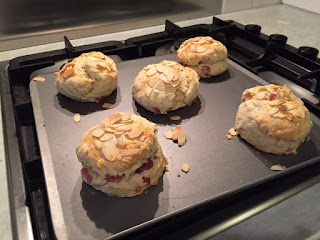

Cherry and almond scone

The Triple Chocolate Scones 
You HAVE to try these. You just have to. They are astonishingly good. They are even worth the pain of baking with cocoa - I had forgotten that the simple act of opening a tub of cocoa sends a spray of fine brown powder up into the air and and down onto every available surface in your kitchen. Wear an apron and you'll be fine.
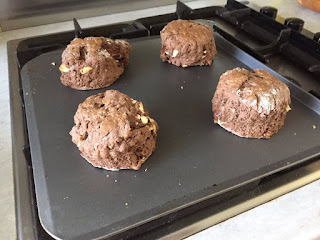

triple chocolate scones

The Honey, Sunflower Seed, & Ginger
If you said to me, "Scone Blogger, I bet you £20 that you could not get Gwyneth Paltrow to eat a scone," I would probably agree with you. But if I was going to persuade Gwynnie to consume more calories in one bite than she probably does in a week, I would ply her with these ones. Honey! Sunflower Seeds! Ginger! Nature's bounty in a very tasty scone.


Honey, sunflower, ginger scone

The Chocolate & Hazelnut Scones
I'm not going to say much about these, as you're going to scroll down in a moment and see the same scones baked by someone with more of an eye for detail - but these tasted absolutely delicious.


Chocolate and hazelnut scones

The Chocolate & Marshmallow Scones
I had a catastrophe with these ones. And before you say "yeah, look at the state of them! How did they end up that shape?", it's not the mishapenness I'm talking about, nor the enormous hunks of chocolate that look like they're trying to escape because I failed to chop them up properly. I forgot to put the cocoa in. Maybe the experience of baking the Triple Chocolate scones did affect me after all. They still tasted lovely.


chocolate and marshmallow scone

I'm now going to humiliate myself by showing you an example of a Sconepal bake. These are the Chocolate Hazelnut as baked by Sconepal Emma Jayne. Now look back at my Chocolate Hazelnuts above. I think I need to work on my aesthetics.


I love seeing photos of your scone bakes, so keep sending them!

Saturday, 15 July 2017

The Book of Scones - Tried and Tested - Part Two

I'm like a woman possessed these days - a woman possessed by scones. For four years I have been trotting around the country eating them for this blog, which does require a certain devotion to the cause. 

But once the Book of Scones was published, I decided I had to bake all 50 recipes. I am not an expert baker. If I can do it, anyone can.

I've already reported on the results of my first five scone bakes, including the astoundingly delicious Earl Grey scone.

So eyes down for recipes 6-10:

The Chocolate Orange
Where would the world be without the Terry's Chocolate Orange? Sad and diminished, that's where we'd be. And the very excellent NT property, Goddard's up near York, probably wouldn't exist, as it was built by Noel Goddard Terry. You possibly need to chop the Chocolate Orange into smaller pieces than I did before adding them to the scone mixture - I was eating the Chocolate Orange faster than I was chopping it, so I had to speed things up - but they taste divine.


The Wet Nelly
If you're in a hurry, then the Wet Nelly scone from Speke Hall is probably not for you. This is because you have to make the Wet Nelly (a type of bread pudding) before you put it in the scone mixture - unless you have loads of Wet Nelly lying around, in which case work away. My friend Kathy came to my house as I took these out of the oven and once she got over the shock of seeing me baking, she was genuinely shocked again by how absolutely delicious these scones were. Well worth the effort.


Wet Nelly scone

The Rhubarb & Ginger
I'm not the world's biggest fan of rhubarb - as you know if you read about my trip to Clumber Park - but the rhubarb and ginger scones were fantastic.

Rhubarb Ginger Scone

The Ulster scones
These were amazing - they taste like Irish soda bread in a scone. The cherries were optional; I would probably leave them out next time as I think the scones taste good enough without them.


Ulster scone

The Raspberry & White Chocolate
It was very late when I baked these scones, it was hot and the raspberries were turning to mush, and I'd eaten most of the Milky Bar Buttons. But somehow these still turned out to be absolutely delicious. It's the magic of the scone.


So there you have it - 10 scones done, 40 to go. Remember to send me your pictures of your scone bakes - I've seen some absolute corkers that put my efforts to shame.

Saturday, 8 July 2017

Peckover House and Garden

Peckover House in Wisbech was built in 1722. Sometime after 1794, it was purchased by Jonathan Peckover. How amazingly lucky he was, I thought to myself, to find a house with the same name as him. But don't worry, folks; the penny dropped before I said that out loud - I'm sharing it here as we're all friends and you won't tell anyone. 

In fact, Peckover House only became Peckover House when the National Trust took it over in 1948. Before that it was known as Bank House, for reasons that will become apparent.


Peckover House rear view

Here's what I learnt today at Peckover:

1. The Peckovers were Quakers
Jonathan Peckover was descended from Edmund Peckover, a soldier in Oliver Cromwell's army. Edmund became a follower of George Fox in 1655; Fox had established a Nonconformist religion, the Religious Society of Friends, otherwise known as Quakers.

Quakers believe that religious faith is a personal matter between the individual and God, rejecting the need for clergy or rituals. Known for their commitment to social justice, their teetotalism, and for fighting the fight against slavery and war, many well-known businesses were set up by Quakers, including Cadbury, Rowntree, Barclays, Lloyds, and Clarks shoes.

2. The Peckovers were bankers
Jonathan started out as a grocer but soon began holding onto his customers' cash for safe-keeping (at their request, I hasten to add). His bank had just seven accounts in its ledger in 1782 but it grew and survived many financial booms and busts until it was subsumed into Barclays Bank in 1896.

Peckover House was home to the bank until 1879, when it moved to new premises nearby - and that building is still the Wisbech branch of Barclays Bank today.

3. Banking was a heavy old game
This is one of the ledgers from the bank. I'll never complain about Microsoft Excel again.


Peckover bank ledger
A rare sighting of my sister, aka Dr Watscone,
marvelling at the office admin tools of yesteryear.
4. Banking was also a bit of a dangerous old game
The man-trap shown below is also on display at Peckover. It would have been positioned in the gardens outside the house during its days as a bank. If a would-be robber tried to gain access, the trap would have grabbed them. There was also a blunderbuss that would have been used to fend off highwaymen who attacked the bank's staff and funds. Banking was not for the faint-hearted.

Believe it or not, this is a humane man-trap - as Quakers, the Peckovers would not have condoned the use of a device that maimed or even killed a burglar that walked into it. Not sure if/how they got around using the blunderbuss.

Peckover Mantrap

5. I want to live in Peckover House 
Like Rob in the book Hi-Fidelity by Nick Hornby, I spend a lot of my time making lists of my top-fives. Naturally my top-fives all relate to the National Trust and not to music. But one of my top-fives is "Top Five National Trust Houses I Would Move Into Tomorrow If the National Trust Would Let Me". 

Peckover House goes straight into that Top Five. It feels so homely and comfortable with a huge amount of light. I'll start packing.

Peckover Morning Room
The Morning Room at Peckover
(If you'd like to know the other four properties in the Top Five National Trust Houses I Would Move Into Tomorrow If the National Trust Would Let Me: Hughenden, Sunnycroft, and at joint number one: Goddards and Bateman's. Let me know yours - when I finally get round to setting up a Sconepal AGM, this will be the subject of the first debate.)

6. Peckover scones are bloomin' excellent
My sister has now done several scone expeditions with me and so she has picked up my dread that the scones will have run out by the time we get there. And it was a very really fear today; we didn't get to the tea-room until 4pm. 

But we needn't have worried; there were plenty of scones AND THEY WERE WARM. They were light and fluffy inside and slightly crisp on the outside - a complete triumph and worthy of a unanimous 5 stars.


I'll end by praising the surprising loveliness of the town of Wisbech. I grew up in the Midlands, but for some reason we had to watch Look East and other East Anglian news programmes. Wisbech was always getting a mention, along with Felixstowe and other places that might as well have been on the moon for all I knew of them, so I took against them a bit and have harboured that irrational dislike for about 40 years. And now I go and visit them and think "THIS IS A LOVELY PLACE! Why was I not told about this? Pah!"

ALSO, for all you National Trust fact-fans, Wisbech was the birthplace of Octavia Hill, one of the founders of the National Trust! So there you have it. 

Peckover House: 5 out of 5
Scones: 5 out of 5
Surprising loveliness of Wisbech: 5 out of 5

Friday, 7 July 2017

The Book of Scones - Tried and Tested

I'd like to say a massive, massive, heartfelt THANK YOU to all of you that have bought a copy of the Book of Scones. I am so very grateful to you. 

I can honestly say, though, that you have made a canny investment. 

The Book of Scones is more than just a book containing 50 scone recipes and some crumbs of history. It's like that scene towards the end of Harry Potter where his mum and dad and Sirius and Remus all appear to him in a wood and say "WE ARE WITH YOU - TO THE END". That's how I see the Book of Scones - whenever you pick it up, 20-odd National Trust scone bakers appear in your kitchen speaking words of wisdom, such as "work quickly - scones prefer it that way" and "don't twist as you cut - it stops them rising". Unfortunately the bakers do not hang around to clean up your kitchen.

I decided to put my money where my mouth is and bake all of the scones in the book. Here are my first five bakes. They were all, without exception, absolutely delicious. 

Ginger & Treacle scone:


Ginger and Treacle scones

There was an extra ingredient in the G&T scone: beginner's luck. The scones rose beautifully and I've yet to see it happen again. They tasted like a warm and cosy armchair on a cold night. Even though it was June.

Earl Grey scone:


The surprise package of the Book of Scones. They were absolutely stunning. I think my dough was a bit too soggy, hence they look like buns, but the fruit and the tea are an incredible combination. I urge you to try this one.

Singing Hinnies


THESE ARE MEANT TO BE FLAT! Stop sniggering! Trying to find some lard in West London was harder than I expected, but I'm glad I persevered - these were a revelation. 

Walnut & Maple scone:


Look, it was very late and I was tired. I had diligently chopped up loads of walnuts, sending walnut knobbles all over the kitchen, but then I absent-mindedly plomped the lot into the mixture and didn't save any for the tops. I couldn't face more chopping. So big chunk o' walnut for decoration it was. They were absolutely lovely.

Apple & Salted Caramel scone:


I recommend that you make double the amount of caramel sauce for the topping, because if you're anything like me then you'll need to test the caramel fifty several times before you deploy it. They tasted incredibly appley. Delicious.

So there you have it - the first five bakes to prove to you all that anyone can bake a scone. Look out for the next five attempts and remember to send me your scone bake pictures!

Saturday, 3 June 2017

Clumber Park

Did you know that 1,200 country houses have been demolished in England since 1900? I don't know exactly how many historic homes the National Trust owns - I'll guess at 200, which means that for every house the NT has saved, another 6* have been bulldozed.

Take Clumber Park near Worksop as an example. If you look at this photograph you'll see trees, daisies, geese, and some steps. What you won't see is Clumber House. It used to sit on this very spot but it was demolished in 1938.


Clumber Park house site

This is what it looked like:

Clumber Park aerial

Clumber Park had been created in 1707 by the Duke of Newcastle when he enclosed a 300 acre piece of Sherwood Forest.

In the 1760s, his descendent built a Palladian house at Clumber. It was destroyed by fire in 1879 and replaced with an Italianate house. That was then partially damaged by another fire in 1912. After the 7th Duke died in 1928, the family spent little time at Clumber and were facing a massive tax bill, so they sold it all off, stonework, drainpipes and all.

BUT if I was expecting Clumber Park to be a sad old ruin surrounded by a load of fields, then I was wrong. The National Trust took over Clumber in 1946 and have restored and maintained the surrounding estate.                                         

Here's a list of what there is to marvel at:

1. A lake that's two miles long!
The lake is undoubtedly the highlight of Clumber Park. It took 15 years to build - it was started in the 1770s with the damming of the River Poulter. It was extended in 1817 and again in 1885 until it covered 87 acres. 

The 5th Duke actually had a mini gun battery by the lake so he could stage battles with his miniature boat. You had to be there, presumably.

And the lake keeps growing; old coal mines below Clumber caused it to sink by several feet in the late 1980s and early 1990s, so it expanded to 104 acres. Amazing.


Clumber Park

2. An 18th century walled garden!
I keep walled gardens in a folder called "Things I will appreciate one day, but not just now" (also in the folder: porcelain). But without a house to visit today, I did have a wander around the walled garden at Clumber and very nice it was too:


In fact, it's one of the grandest surviving walled gardens from the 18th century. In its day it supplied asparagus, pineapples, and even strawberries at Christmas from its glasshouses.

3. 130 varieties of rhubarb!
I was doing my usual forensic pre-mission research (ie reading Wikipedia) when I saw that Clumber offers 135 varieties of rhubarb. I decided it had to be a joke - rhubarb is hideous stuff if you ask me and there surely can't be so many types of hideousness in the world - BUT NO! There in the Walled Garden was a sign explaining that Clumber is home of the National Rhubarb Collection, which is the second largest collection of culinary rhubarbs in the world! Admittedly the sign said 130 varieties, so Wikipedia was five out, but what's five rhubarb varieties amongst friends.

Clumber Park rhubarb
I can't promise that there are 135 varieties of rhubarb in this picture,
but there is quite a lot of rhubarb, I think you will agree.

4. 1,296 lime trees!
Clumber has the longest double row avenue of lime trees in Europe, with 1,296 trees! You can't see in the picture below but they all have black bands around their trunks, like they're in mourning. This is to stop the pesky winter moth; apparently hungry winter moths can strip a whole tree, but the female winter moth can't fly. She has to walk up the tree to lay her eggs - when she tries to walk up a Clumber Park lime tree, she gets stuck on the sticky black bands and probably wishes she hadn't bothered. 

Clumber Park lime avenue

5. One giant Clumber Park scone!
It's quite ironic that one of the reasons I started this blog was to help me fight off some small irritating anxieties. Let me tell you now that the first few minutes of me entering a National Trust tea room are among the most stressful of my life. 

My inner monologue (which becomes an externalised dialogue if the Sidekick is with me) goes something like this:

ARE THERE SCONES? Are there? I CAN'T SEE ANY, I CAN'T SEE ANY...wait, wait, wait, THERE ARE SCONES!...ARE THEY CHEESE THOUGH, ARE THEY CHEESE...no, they're not cheese...HOW BIG ARE THEY THOUGH, ARE THEY BIG ENOUGH, WILL IT BE LIKE CLIVEDEN WHERE I NEEDED A MICROSCOPE TO SEE THE SCONE, LET ME SEE...etc

I'd make a rubbish food critic, because I just can't stand it when things go wrong - I want every scone to be brilliant. 

So I can't tell you how delighted I was to see this GIANT of a scone today. As soon as I cut into it, I knew it was going to be good and it was DIVINE. One of the best scones I've had in ages.

Clumber Park scone

And there's other stuff at Clumber Park - there's a kids playground, a bike hire place, and more besides. Like Tatton Park, it has become a spot for local people to get their daily exercise or walk their dogs, which always makes a place feel loved.

I thought today I would get to see what the world would be like without the National Trust, but that didn't pan out. The work of the NT is very much in evidence at Clumber, even without a house - and not just in the brilliant scones but in their care of the gardens and the surroundings. A lovely place.

Clumber Park; 5 out of 5
Scone: 5 out of 5
130 varieties of rhubarb - who knew?: 5 out of 5

*This has been altered since it was first published, as my maths was a bit dodgy

Monday, 1 May 2017

Greyfriars House and Garden

I think I was in my late 20s when I developed an unexpected passion for Countryfile. It's not the rare breeds of sheep that I love, nor the farmers finding a lucrative sideline in making crisps out of turnips. It's the people they interview - the people that have devoted their ENTIRE LIVES to protecting a certain species of moss, or a specific type of bat that I've never even heard of.

And I know what you're thinking. You're thinking: "But Scone Blogger! You yourself have selflessly devoted your ENTIRE LIFE to a noble cause - the noble cause of scones!" To which I reply: "This is undoubtedly true, and at times it is very challenging, but sitting in tea rooms eating jam is not the same as standing in a freezing barn with a torch, looking for a colony of greater horseshoes that might not be there". 

ANYWAY. I mention this because Greyfriars House and Garden in Worcester would 100% be a car park today if a group of extremely determined individuals had not devoted their lives to opposing the council and saving it from destruction.

Greyfriars House

Greyfriars - the happier history:
  • Greyfriars House was originally built in the 1480s for a Thomas Grene
  • He was High Bailiff of Worcester and wanted to show off his wealth
  • After Grene died, it was passed through various owners and tenants
  • It was acquired by Francis Street who sold it to the council for £100 and rented it back for £5 a year
  • The Streets were staunch Royalists, as was most of Worcester - the Streets ended up leaving Greyfriars during Cromwell's rule
  • The house was subsequently divided up with various residents and tenants moving in - it was used as a pub, and was home to a greengrocer, a milliner, a book dealer, an umbrella maker, a tinsmith, and even a fish fryer
But then came tough times:
  • By 1912 Greyfriars was in a poor state and by the 1930s it was derelict
  • The Worcestershire Archaelogical Society tried to rescue the building but no deal could be reached with the owner
  • In 1936 the council ordered its demolition
  • However, the archaelogical society was not deterred and fought on
  • In 1939, all demolition work was stopped because of the outbreak of war
  • In 1943, a man called William John Thompson bought the property and carried out emergency repairs but he couldn't continue to fund it long-term
The Moores to the rescue:
  • Matley and Elsie Moore were siblings who offered to restore Greyfriars at their own expense as long as they could live it in
  • They collected the contents of the house that we see today
  • They were interesting characters - Alan the guide told us that they often held tea parties and if you didn't show up or send a thank you letter afterwards, you didn't get invited back
  • They were very frugal, so the house was bitterly cold in winter
  • Matley didn't like televisions or radios or anything that made a noise - Elsie had to keep her radio in her bedroom
  • They had a controlling mother - after she died in 1953, Elsie used her money to buy three shops opposite Greyfriars to save them from demolition
  • The Moores left the contents to the NT in their wills, with the stipulation that no ropes or barriers would be used and visitors could roam freely
Parlour at Greyfriars
The Parlour, where Matley and Elsie Moore used to sit.
No TV = no Countryfile, which is very sad

Other things I learned today that I didn't know:
  • In the 1400s, all men were required by law to practice archery every Sunday
  • Worcester is a really, really lovely little city - why didn't I know this?
But onto the bad news. I'm afraid I let you all down on this scone mission. Greyfriars did have a little tea room and they probably had scones, but I didn't stop for any. They were short-staffed and not really supposed to be open on a Monday and, well, I just couldn't face being the only one dinging a little bell for service and demanding that someone come running to bring me tea. I know. Pathetic.


Greyfriars Garden
The garden at Greyfriars - you can sit and drink your tea on the patio
when it's not pouring down, as it was when I went

So I basically need you all to go to Greyfriars and do my job for me - let me know how you get on?

Greyfriars House: 5 out of 5
Scones: 0 out of 5 because I didn't ask for any. I'm so sorry, everyone. 
Chances of me being sacked as Scone Blogger: 5 out of 5


STOP PRESS! Greyfriars House Revisited!

OK, maybe "STOP PRESS!" doesn't quite work when 6 years have passed but anyway: today, March 23rd 2023, I went back to Greyfriars. My aim was to right the wrongs of my first visit, when I failed to ding a little bell and find out if they had any scones. 

This time I was very much in luck: the lovely woman in the cafe told me that the scones were fresh out of the oven, which cheered me up immensely. I think I've said the words "it's hard to ruin a fresh scone" to every journalist in the universe over the past three weeks, since I finished the National Trust Scone Quest at the Giant's Causeway.

I'm pleased to tell you that the Greyfriars scone proved me right: it was a fantastic scone. Slightly warm, fluffy, a good amount of fruit, and baked to perfection. A triumph.

Greyfriars scone

I ate my scone in the Greyfriars garden, which I highly recommend. It's a lovely little tranquil spot.

Greyfriars Cream Tea

I then went for a wander around Worcester cathedral. It contains the tombs of King John and Prince Arthur among others, so that was very interesting.

King John tomb
King John's tomb in Worcester cathedral

Scones: 5 out of 5!

Friday, 14 April 2017

Bodnant Garden

I went to Cardiff a few years ago for a meeting. I got chatting to the receptionist about the FA Cup, which was being played the following day at the Millenium Stadium, as Wembley was being rebuilt. I apologised, saying that it must be a total hassle for the people of Cardiff, as the stadium is right in the city centre. "OH NO!" she said (you need to adopt a Welsh accent to get the full effect of this story) "We don't mind at all. We love it. Everyone should come and have a good time." 

And that sums up the Welsh for me. If things had been reversed and Twickenham was hosting an Eistedfodd, we'd all be moaning about it for weeks: "The A316 is going to be a total NIGHTMARE! And it'll be IMPOSSIBLE to get on or off a train at Richmond station that day! Luckily I don't live anywhere near Richmond or require any train services. Why can't they just hold it in Newport?"

What has this got to do with Bodnant Garden near Llandudno, I hear you ask? The answer is that they have a huge laburnum arch that bursts into beautiful bloom every year. And the Bodnant team go ALL OUT to encourage people to come and see it. They have 'Laburnum Archers' guiding visitors around, they stay open until 8pm - they even have Wag Wednesdays so dogs don't miss out. Apparently 50,000 people visit Bodnant in 3 short laburnumy weeks to see it. The staff don't get worked up that so many visitors might traumatise the laburnum, they don't worry that articles will appear in the Daily Mail screaming 'HAS THE NATIONAL TRUST LOST THE PLOT?' They just say 'it's marvellous - everyone should come and enjoy it'. I love them for it. 

Now I've shared all of that, you might be asking why I went to Bodnant Garden in April when the laburnum is not in bloom. The answer is: I'm not sure. This was the laburnum arch today:


Bodnant laburnam arch in April

And this is what it will look like in a few weeks' time:


To paraphrase Sir Alex Ferguson: Mother Nature. Bloody hell.

ANYWAY. The good news for me is that the laburnum arch is just one of many highlights of Bodnant. In fact, Bodnant Garden was not what I was expecting at all. 

My route began as I expected, with prettily ordered flower beds and a house you're not allowed into (it still belongs to the McLaren family, the gardening-mad descendants of Henry Pochin, the industrialist that bought Bodnant in 1874).


Bodnant tulips

Then you come to the five terraces, which continue the orderly theme, albeit with the backdrop of wild Snowdonia.

This is the Canal Terrace, with its long pond. The building on the left is the Pin Mill. It originated in Gloucestershire, where it was used as a pin mill and a tannery before it fell into disrepair. Henry McLaren bought it and had it moved brick-by-brick to Bodnant.


But then you descend into a whole different landscape. The dells and water gardens are amazing - you can follow little paths hither and thither:


There's also an old mill:


And a waterfall bridge:


...as well as a boathouse and and a little church-like building called The Poem, where Henry Pochin and his wife Agnes are buried along with their children, including the four that died in infancy. 

I also learned about champion trees today. I had absolutely no idea that the concept of champion trees even existed, or that there that is a database of champion trees. A champion tree is basically the tallest or widest of its kind in the British Isles, and Bodnant has several champions.

I know nothing about trees but I do love to bump into a sequoia, or Californian Redwood, on my scone travels - I explain why I love them in my post about Sunnycroft

The sequoia at Bodnant is 49 metres high and the tallest in Britain. It was planted in 1886 though, which was bad news for the Scone Sidekick who is currently attempting to grow a sequoia from a seed:


The sequoia at Bodnant - planted 1886, now 49 metres high

The Sidekick's sequoia - planted 2015, not 49 metres high
The Bodnant scone
Anyway. Let's move on to the all-important scone. The scone at Bodnant was very good - it was a little bit soft for my liking, but it was tasty and I ate every crumb.


Bodnant Garden scone

The one good thing about me missing the laburnum's big moment is that I'm giving you a few weeks' notice to go and see it for yourselves. If you can get there in May, I highly recommend it - Bodnant Garden is lovely anyway but with the laburnum as well, it's a fantastic place.

Bodnant Garden: 5 out of 5
Scone: 4.5 out of 5
Sidekick's dreams of one day seeing his sequoia towering above him: squashed to 0 out of 5.

Other properties we've been to in Wales: Aberdulais Tin Works, Chirk Castle, Dyffryn Gardens, Erddig, Penrhyn Castle, Plas Newydd, Powis Castle, Tredegar House