Friday, 2 August 2019

Baggy Point

In the 22 years since I graduated and joined the world of work, there have been something like 1,120 Fridays. There have been some very good Fridays - most of them involving at least one pub, it must be said - and some very sad Fridays and some please-God-can-it-just-be-the-weekend-already Fridays.

But I'd be willing to bet that the day I spent at Baggy Point near Croyde in North Devon would be up there in the Top 20 Fridays of my life.

It involved an early start. My world tour of North Devon National Trust scones was drawing to a close and I had a lot to fit in, so I headed to Croyde Beach to take in the morning air and hopefully find a cup of tea before I continued my nerve-jangling drive around the roads of the Devon coast. 

I was immediately reminded that there are few nicer things in the world than a path leading to a beach. So simple yet so full of promise, whether you're four or forty-four or ninety-four. 
Croyde beach path

But this particular path led me through a campsite, which presented me with a problem. Friends, I am not a camper. I am renowned, although pretty much unique, among my acquaintances for my antipathy towards camping, but as I stood at the entrance to that campsite I knew the moment of truth had arrived. "OK," I thought. "This is where I realise I've been wrong for 30 years and I'm going to immediately ring everyone up and beg them to lend me a tent and take me to the Pooh Cottage Holiday Park in Budleigh Salterton." 

I needn't have worried; the sight of two lads trying to pack their belongings into a car with nothing but a very limited amount of common sense and a very liberal use of the F-word left me in no doubt that I had made the right call all along. Thanks boys. 

Anyway - I continued down onto the beach, which was empty apart from some surfers and one family whose kids had clearly decided that 7am was the correct time to start a day by the sea. It was just glorious:


Admittedly, the weather was on my side but even on a cloudy windy day I'd have loved it; I sat there for over an hour listening to the sea and the birds.


But time was ticking and so I headed up to Baggy Point, the headland above Croyde. It was a gorgeous walk - hardly anyone else was around and all the cares of the world felt like they belonged far, far away.
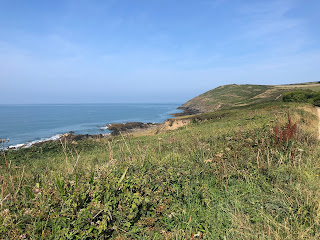

Baggy Point

I eventually returned to Croyde and to the Sandleigh Tea Room, which was recently taken over by the National Trust, for my Baggy Point scone. It was risky - I can't imagine they get many people requesting a cream tea at 10.30am - but time was running short.

The scone looked fantastic but it tasted soggy, in that way that scones tend to taste soggy after they've been kept in an air-tight container. It was a shame but I suppose you can't be good at everything.

Baggy Point scone

Regardless of that, I cannot recommend Croyde and Baggy Point enough. Go early to the beach and at a reasonable afternoon hour for the scone.

Baggy Point: 5 out of 5
Scone: 4 out of 5
Bonus points for fresh strawberries: 5 out of 5

Thursday, 1 August 2019

Dunster Castle & Water Mill

If there was a sport called 'guess how old this castle is?' then I would be rubbish at it, just as I am rubbish at 99% of all other sports. (I'm saving the 1% for the as-yet-unknown one that I will master.) 

Dunster Castle near Minehead in Somerset is a perfect example. I saw a picture of it and decided it was the work of some 20th century madman who had made a pile of money out of toilet rolls and built himself a castle so he stood a chance of getting Queen Mary round for tea.
Dunster Castle

In fact, Dunster is very old. Here are the facts:

It was originally built by the de Mohuns after the Norman Conquest
William de Mohun was a knight who came over with William the Conquerer and built a castle on the site of a Saxon hill fort. However, not much is actually left of it - the gateway below is the only piece that dates from the 1200s. It's an impressive piece though:


Dunster Gateway

The Luttrells built what we see today
The de Mohuns sold up to the Luttrell family in 1376. The Luttrells built the gatehouse in 1420 and a new Jacobean castle in 1617. Henry Fownes Luttrell carried out a major landscaping project in 1755 and then in 1868 George Luttrell commissioned Anthony Salvin to redesign the castle to create a Victorian country home.

It was almost destroyed in the Civil War
Thomas and Jane Luttrell were Parliamentarians during the Civil War and were forced to defend the castle against Royalist troops. But they switched sides for some reason and then had to defend it against the Roundheads. Cromwell sent 200 men to destroy Dunster and the curtain walls were duly demolished but the order was revoked and the castle was left to stand.

It has a leather room
Every now and again you come across something that you've never seen before at the National Trust. Dunster has some leather hangings that were made in the Netherlands in the 1600s. They tell the story of Antony and Cleopatra but they were cut up to fit the room and so they're in the wrong order. Here she is killing herself with her snake:


I'm not sure why nobody looks terribly bothered that Cleopatra is
committing suicide in front of them - she doesn't look too fussed herself

It has a working water mill
The Domesday Book mentions that there was a mill on the site, although the current building dates from 1779. It was abandoned by the 1930s and then reopened during the Second World War. It is still working today and you can buy flour that has been milled on-site.

It has the Dunster Castle scone
And while we're on the subject of flour, let's move on to the scones. The tea room at the water mill is a lovely spot and my scone was very tasty indeed - maybe a little bit crumbly but it held together enough to be eaten without completely disintegrating.


If you want to have a go at this new and highly exciting sport of castle age guessing, then be my guest. Here are the other National Trust castles I've visited - see if you can pick out the oldest one:
- Bodiam Castle
- Chirk Castle
- Corfe Castle
- Croft Castle
- Lindisfarne Castle
- Penrhyn Castle
- Powis Castle
- Scotney Castle
Sizergh Castle

Dunster was the second stop on my Grand Tour of North Devon - the day before I had fulfilled my ambition to visit the very awesome Watersmeet.

Dunster Castle: 5 out of 5
Scone: 5 out of 5
Chance of 'castle age guessing' making it to the Olympics: 0 out of 5

Holnicote Estate

The Holnicote Estate (pronounced Hunnicutt) is massive: 12,000 acres of land across Somerset and Exmoor National Park. It contains 5 villages, a nature reserve, and 150 miles of footpaths and bridleways. 

What it doesn't contain are any National Trust scones. There are several tenanted tea rooms in the various villages, but to give myself a fighting chance of ever finishing this quest I have decided not to make those mandatory.

However, I had seen a picture of the Periwinkle Tea Room in Selworthy and decided it was too pretty to miss, so I called in on my way from Dunster Castle.


Holnicote Periwinkle

I can honestly say that I thought I'd died and gone to heaven at the Periwinkle. It was a beautiful day and the tea room garden is the perfect peaceful little place for a cup of tea. 

The scone was also perfect - warm, tasty, and fresh: 


Holnicote Periwinkle Scone

So I definitely recommend a stop on the Holnicote Estate - there's lots of walking and scone eating to be done.

Holnicote: 4 out of 5
Scone: not strictly NT but an honorary 5 out of 5


Wednesday, 31 July 2019

Watersmeet

John Craven has been a very important influence in my life. He was also a major influence on this blog - in fact, I would go as far as to state that John Craven saved the National Trust Scone Blog. 

We began our connection, John and I, as presenter and viewer (respectively) of Newsround, where he educated me on space shuttles and giant pandas. We later moved on to otters and turnip farms when he took up the reins at Countryfile. 

But back in 2013, I was going through a crisis of confidence with this National Trust Scone project. I had only just started out with it, but was almost thwarted by a) a temporary lack of internet connection in my home, which meant that I had to go to my local pub to upload my posts (thanks The Swan) b) the fact that the very first place I went to had no scones in the restaurant and c) a general feeling that it was going to be a complete waste of time.

And then, that fateful Sunday evening as I contemplated quitting, I turned on Countryfile and what did I find? John Craven was baking National Trust scones! It was like a sign from the heavens - there he was, at Watersmeet in Devon, making a right mess of Fiona the resident baker's scones. All of my doubts fell away and I have never looked back. 


Ever since, Watersmeet has stood like a place of pilgrimage in my mind. Unfortunately, it was a tricky one to reach, being in North Devon. But today I finally made it there for the 180th mission on this scone quest.


Watersmeet bridge

As it's a momentous occasion, I will break with tradition and start with the scones. I have had numerous moments of panic over the six years of this project, usually when I've travelled 250 miles and the only baked goods in sight are shortbread and flapjacks. Today's panic was off the scale. I was late getting to Watersmeet so I almost skidded the car into a parking space and abandoned it, running down the path in the wrong shoes saying "EXCUSE ME" to bemused holidaymakers as if I was exiting Holborn Tube station at 8.45am on a Monday morning.

And then total disaster loomed: no sign of any scones in the tea room. I started to panic-formulate the sentence in my mind - "Can you put the oven back on please? I'll explain later." - when suddenly it was my turn so I just blithely asked for a cream tea. "Strawberry jam or whortleberry jam?" the woman asked. I later discovered that whortleberry is the local name for bilberry and I probably should have opted for that but at this point it was all too much for me so I played it safe.


Watersmeet scones

And what a treat it was: two big plain scones, fresh as fresh could be, served with a big pot of cream. The jam always has to do more of the heavy lifting in a Devon cream tea, as neither the scone nor the cream is overly sweet. But it was divine. I could only manage one scone but it was one divine scone. I will never forget it.

And I got to eat it here - what a stunning place to eat scones:


By the rivers of Watersmeet/We ate our scones
I had given myself a pass with this blog post - I decided not to worry about the history of the place and instead just focus on lapping up the sights and sounds. But I can never resist a factoid. So here goes:
  • Watersmeet stands at the bottom of a deep gorge where the East Lyn river meets Hoar Oak Water
  • The tea room has been there since 1901! 
  • The National Trust took over in 1936
  • The ancient oak woodland around Watersmeet contains a local species of tree called the 'No Parking Whitebeam' - that's its real name, folks. The first one of its kind was found in a layby near Watersmeet with a no parking sign nailed to it. Amazing.
There are numerous walks that you can do around the area - and I highly recommend that you spend a good few hours there.


I'm going to close by going all John Peel on you. I also discovered a lovely song on Spotify called The Meeting of the Waters by Fionn Regan and it fits Watersmeet perfectly (or at least my experience of it - you might prefer Motorhead.) 

In keeping with the mini surprises that Watersmeet has thrown at me since I started writing this blog post, I just looked for the video on YouTube to share it with you and it features Cillian Murphy. From John Craven to Cillian Murphy - that's the beauty of the National Trust Scone Blog. Thank God I didn't abandon it.

Watersmeet: 5 out of 5
Scones: 5 out of 5
My willingness to vote for John Craven for Prime Minister: 5 out of 5

Sunday, 21 July 2019

Mottistone Gardens

FACT: every National Trust property has a story. Every single one. Sometimes you have to work a little bit harder to find that story, and so it was with Mottistone Gardens on the Isle of Wight. My usual extensive pre-visit research (ie reading the National Trust website) was giving me nothing, so I was overjoyed when I finally found something on a random CELEBRITY NEWZ OMG site; Benedict Cumberbatch had his wedding reception there.


His choice of venue wasn't random, however; his wife, Sophie Hunter, is the great-great-grand-daughter of Jack Seely, 1st Baron Mottistone, who once owned the place. More tireless investigation by me (ie a bit of Googling) revealed that his nickname had been "Galloper" Jack and he was also the grandfather of Brough Scott, the horse racing journalist, who had written a biography about him. So I read that and ended up with about 8,000 stories.

But let me tell you a bit about the property itself. The first thing you need to know is that the manor house is tenanted and closed to the general public. The second thing is that the gardens are not open on Fridays and Saturdays. And so, with the bad news out of the way, here are the highlights of what you can actually see:

1. The Shack
It doesn't exactly oversell itself - I expected it to be an ice cream kiosk or an information centre for bored kids on school trips - but it's an amazing little building.

The story behind it is as follows: John Seely, son of Galloper Jack, was an architect. He built The Shack in 1936 as a country retreat and working office 
for himself and his business partner, Paul Paget:


The Shack Mottistone
The outside of The Shack - those aren't real mushrooms,
just in case you're wondering
Seely & Paget restored Mottistone Manor, but the firm also took on a lot of ecclesiastical work - as well as building new churches they also helped to restore St Mary's Islington and others that had been damaged by the Blitz.

But it's the interior of The Shack that is really surprising. It has nearly everything - two beds, kitchen, toilet, desks, even a letterbox - and all with high quality finishing. It's quite something:


The Shack Interior Mottistone
I thought I was quite committed to my job but
actually building a bed above your desk is a whole new level
The Gardens
There's plenty to see in the gardens. There's a huge double herbaceous border, a rose garden, a kitchen garden, a turf maze, even a scarecrow that looks like Jeff Lynne of the Electric Light Orchestra:


"The sun is shining in the sky/There ain't a cloud in sight" -
yeah but are there any scones, Jeff?
The View from the Grassed Terraces
It takes about five minutes to walk up to the terraces above the gardens - it's well worth it for a lovely view over the Manor and out to sea:


The View Mottistone
It's OK - I know these people. They weren't
just following me around, photobombing
But let's return to Galloper Jack. There are about 8,000 quotable stories about him in the biography - he was a great friend of Winston Churchill and shared a similar life history of military and political derring-do - but here are the five key things you need to know:
  • He had more near-death experiences than any other human - his first happened when he was nine years old and he felt 70 feet from a cliff 
  • He didn't exactly try to avoid death after that lucky escape - he manned the lifeboat on the Isle of Wight from a relatively young age, he fought in the Boer War, and he survived four years on the battlefields of France and Belgium during World War One
  • His horse, Warrior, was his spirit animal - it was a true life war horse, somehow surviving the full four years of battle that did for 8 million other horses. At one point Warrior was stabled in a house that was hit by a shell - Galloper Jack turned to his companion and said "that's the end of Warrior" only to see that one corner of the house was still standing. Inside was Warrior, holding up a joist. The men tried to free him but the horse decided to take decisive action himself and jumped free, at which point the rest of the building collapsed. There are many, many stories like this.
  • He also fitted in a career as an MP and was Secretary of State for War at one point (Jack, not Warrior)
  • It all ended a bit sadly for Jack - having been a hero for so much of his life, he backed the wrong horse completely in the 1930s and became an appeaser. He met with Hitler and Mussolini and appears to have been hoodwinked by them both, although especially by Hitler who persuaded him that the Hitler Youth was just like the Scouts.
It's an interesting book about a very colourful man of his time. He died in 1947 and his architect son became the 2nd Baron Mottistone. (Jack's eldest son, Frank, fought with him in France and died at Arras.) John gave the estate to the National Trust when he died in 1963.

The Mottistone scone
But let's move on. Sadly there is no Scone Horse to accompany me on my expeditions, although I'm not sure they'd have let one on the Isle of Wight ferry anyway. Instead, I recruited my in-laws for the voyage. It wasn't their first rodeo - two of them had accompanied me to Lamb House in Rye last year, where they had stunned me with a stinging critique of the scone. At Croft Castle the scones were so good that nobody had a bad word to say. So how would Mottistone fare?


In-laws at Mottistone

The short answer is that we found scone perfection. They were fresh and light and tasty and got a unanimous thumbs up from the panel. The service was great, and the outdoor tea room by The Shack was a beautiful place to sit on a sunny Sunday morning.  

Mottistone Scone

So that means that the Isle of Wight has ended up with an enviable 100% record for National Trust scones. You can read about our earlier trip to The Needles Old Battery, which not only scooped 5 scone stars but were my Scone of the Year for 2017.

Mottistone: 4 out of 5
Scone: 5 out of 5
Levels of derring-do by Mottisfont owners and their horses: 5 out of 5

Saturday, 29 June 2019

Gunby Hall and Gardens

I don't want to be disrespectful to the Massingberd family who built Gunby Hall and got up to all sorts of escapades in their colourful history, but to be brutally honest I set off today looking forward to two things:
  • The Gunby celebrity cats
  • Skegness
But Gunby Hall turned out to be a lovely surprise. It's a bit like Trerice in Cornwall, in that there's a massive resort just down the road (Newquay, in Trerice's case) but the property is peaceful beyond all reasonable expectations - quiet, serene, and tranquil, as though dodgems and doughnuts are a thousand miles away, not ten. 

Gunby Hall

Here's a bit of history:
  • Gunby Hall was built by Sir William Massingberd, the second baronet - his father had been baronetted (not a word) by Oliver Cromwell
  • The pond is apparently haunted by the ghost of a servant that tried to elope with Sir William's daughter - Sir William shot him and dumped his body in there
  • The family trend for female succession started right away - Sir William's daughter Elizabeth inherited after her brother died
  • When Elizabeth's grandson died, HIS daughter Elizabeth also succeeded with her husband, Peregrine. They hated each other - when he tried to make garden improvements she would dig them up again.
  • Their grandson, Algernon, was known as 'Naughty Algernon' as a child and he did his best to live up to the name in adulthood - he got into massive debt and went missing in Peru
  • His uncle Charles managed to claim his right to inherit, paid off Naughty's debts, and passed the property to his daughter, Emily
  • Emily was a teetotal political activist who dressed like a man and played the violin
  • Her son Stephen died childless so his sister, Diana, inherited. She and her husband, Field Marshal Sir Archibald, had to fight to stop Gunby from being demolished in 1943 by the Air Ministry who wanted to land bombers at a nearby airfield
  • Gunby Hall was saved and Diana and Sir Archie gave the place to the National Trust in thanks
  • It was tenanted until 2010 when the NT decided to open it completely
Gunby Garden

If you want to know what it's like to inherit a property that has been given to the National Trust, you can read Daydream Believer by Hugh Massingberd. He was obituaries editor at the Daily Telegraph and Diana was his great-aunt.

The book offers some very funny anecdotes about Hugh's use of Gunby as a weekend place to impress his friends in the early 1960s. The caretaker, Rogers, had once been a warden at Crumlin Prison: "He longed to parade about the premises with an Alsatian on a leash. Visitors on open days were liable to be referred to as 'Cons' and frequently upbraided for shifty behaviour. 'I've got my eye on you, feller-me-lad,' I once heard him admonish a blameless National Trust punter who was making a close study of the Stuart miniatures in the music room." 

The Gunby cats
But sorry as I am to say this, Massingberds, there's no escaping it: the main attraction at Gunby these days are two social media star cats who appear regularly on Gunby's Instagram feed and also feature in the official Cats of the National Trust book

There's Committee, whose full name seems to be 'Committee, So-called Because She Looks Like She Was Designed By One', the explanation presumably having to be included on every tweet and Instagram post to preempt the inevitable question. And then there's black and white Craig, who is 15 and diabetic.


Photos taken from Gunby's Facebook page. Hopefully they won't get on to their lawyers.
And hopefully the people at Gunby won't mind either.
You'll notice that these photos are too good to have been taken by me. And the reason for that is simple: I forgot to look for the cats. Yes, you read that right. I spent a whole week reading up on them and looking forward to spotting them and then I got there and got distracted. It's not *all* my fault: Craig and Committee SCBSLLSWDBO could have done the decent thing and made a voluntary appearance to spare me weeks (probably years) of regret. But no. They stayed away.

Skegness
I did have more luck with Skegness. There is a solid connection between Gunby and Skeggy: to pay off Naughty Algernon's debts, a load of Gunby land was sold off to the Earl of Scarborough. He used it to turn the fishing village of Skegness into a holiday resort, taking advantage of the railway as a means of people accessing a seaside break.

But for me, and anyone hailing from my Northamptonshire home town, Skeggy remains an almost mythical place - in childhood it meant a day at the seaside and the chance to put 2ps into slot machines. In your teenage years/20s, it was cheaper than Torremolinos.

The reason for factoring Skeggy in to my Gunby outing was this: I had persuaded a young scone apprentice to accompany me on my trip. Her mum is one of my oldest friends - the fact that she was following the National Trust Scone Blog before she knew I was the one writing it confirms my decision to befriend her at primary school was correct.

Anyway - we had agreed to complete a scone mission together and I was looking around for somewhere to go when I realised Gunby was near the coast. And so the proposal was put to 10-year old Lara; come for a scone and we'll throw in a trip to the beach and an overnight stay in a resort that has a swimming pool in case it's tipping it down. She accepted the proposal. So there you have it, folks: to those of you who struggle to get your nearest and dearest to accompany you to the National Trust - Gunby offers a lot of extras.

The Gunby scone
The Scone Apprentice admitted that she had a date with a tray of doughnuts on the beach later and was saving herself for that, but she tried the Gunby scone and gave it her approval. I, on the other hand, was worried; it looked small and not home-made. 

Gunby Hall scone

But while the kitchen at Gunby is tiny, the courtyard was a perfect place to sit in the sun drinking tea and eating scones and discussing the Fleetwood Mac-esque dramas of Lara's band, Fire Cucumbers (merchandise available). And the scone was very enjoyable indeed.

Gunby courtyard
The guitar-playin', rabbit-ownin', doughnut-lovin' Scone Apprentice and her mother.
After Gunby we carried on to Skeg and a great time was had by all. A lovely weekend trip that offers a bit of everything and is highly recommended.

I'll end with this - my favourite Insta picture of Committee SCBSLLSWDBO. Maybe she was too busy doing watercolours to come out and grant us an audience today.

Gunby Hall: 5 out of 5
Scone: 4 out of 5
Sightings of ghost servants or social media star cats: 0 out of 5

Saturday, 22 June 2019

Kinder, Edale, the Dark Peak

I've worked out that I've consumed around 113,900 calories so far on this National Trust Scone Odyssey (obviously I will be deleting this post before I ask BUPA to pay for the heart bypass).

So I was very excited to be heading for the great outdoors today for my visit to Kinder, Edale, and the Dark Peak. I had it roughly planned out as follows: walk up hill singing Valderee! Valdera!, eat scone on top of hill Heidi-style, return down hill in triumphant calorie credit.

Pennine Way Edale

I was half way to Derbyshire when I realised that Kinder Scout is actually a mountain and not a hill. The UK government decrees that a mountain is a summit of 600 metres or more and Kinder Scout is 636 metres high. 

I also realised that, as the name of the property suggests, I was actually visiting several different things:
  • The Dark Peak refers to a whole area of the Peak District, located in its more northern reaches 
  • Edale is the name of the village in the Dark Peak that sits at the start of the Pennine Way and is a gateway for walks onto Kinder
  • Kinder is the moorland that contains the Kinder Scout summit, the River Kinder, and the waterfall known as Kinder Downfall
When I got off the train at Edale, I discovered that the very lovely Pennypot Cafe, owned by the National Trust, was right next-door to the station. Kinder Scout, on the other hand, was not. 

It's about a 70 minute walk from Edale to Kinder Scout on the Pennine Way and I hadn't allowed enough time for a full circuit. So I did my best: I huffed and puffed up half a mile, took in the marvellous views, and then picked my way back down while being overtaken by 800 nine year-olds.

The Pennine Way at Edale

If I had been a bit more organised, I could have retraced the steps of the Kinder Trespass, which took place in 1932. I had heard of the Mass Trespass but I hadn't realised that five men went to prison for it. 

Luckily I had bought a book before my expedition called The Battle for Kinder Scout and that helpfully shed some light on events:
  • Six million acres of common land had been privately enclosed between 1600 and 1914, often given to landowners for sheep grazing and grouse shooting
  • The urbanisation of Manchester and Sheffield and other areas after the Industrial Revolution, along with affordable train travel, had created a great demand for access to the countryside at weekends and holidays
  • The limited public trails for rambling grew crowded, while whole swathes of land was visible to the ramblers but off limits
  • Kinder was a perfect example - the public could walk round it but not across it
  • Benny Rothman and his cohorts organised a Mass Trespass onto Kinder on Sunday April 24th 1932
  • Around 400 trespassers gathered and walked onto private land where there were altercations with gamekeepers - further trespassers also joined from other directions
  • Benny, along with four others, was arrested and ended up serving several months in prison for riotous assembly
  • Ewan MacColl, the folk singer then known as Jimmie Miller, was part of the Trespass and wrote The Manchester Rambler about it
There has always been debate about the Trespass - even at the time a lot of ramblers' associations disapproved of it - but it arguably led to the creation of our National Parks in 1949, after which the Pennine Way and other long-distance footpaths were established.

But let's go back to the beginning and my encounter with the Pennypot Cafe. The first thing you need to know about the Pennypot Cafe is that it offers the friendliest and most efficient service that I have ever come across at the NT. The guys that were running it today were brilliant. It also has very good music. 

The second thing you need to know is that the scones are very good. They had three types on offer: Apple & Walnut, Apple & Raspberry, and Cheese & Chive. 

I plumped for the Apple & Walnut and sat in the outdoor courtyard with a friendly little robin who accepted my offer to share the scone. It was very tasty (the scone, not the robin). I was convinced that the loose leaf tea was going to be a fail as it was a weird colour BUT NO - it was really refreshing and went down a treat.

Kinder, Edale National Trust Scone

Before my trip today I had decided to consider a future career as a hill/mountain walking fan when I finish the National Trust Scone Odyssey (don't pop the champagne corks just yet, folks; I still have 60-odd places to go) as it will offset six years of clotted cream. After today, I'm not sure it's going to be an easy transition.

(If you want further examples of previous Peak District failures, you can read about my trip to Longshaw, Burbage, and the Eastern Moors).

Kinder, Edale, the Dark Peak: 5 out of 5 for the views and the loveliness of Edale
Scone: 5 out of 5 (0.5 for the fantastic service and Tom Petty/Stevie Nicks soundtrack) 
Chance of seeing enough of the area in two hours: 0 out of 5