Friday, 15 April 2022

Brean Down

The most important piece of advice I can give anyone is simply this: never trust a bus timetable. There have been a few occasions during this National Trust Scone Odyssey when I have required the services of a bus and I can honestly say, hand on heart and without exception, that I have always been completely stunned when the bus actually turned up. And to be fair, they've turned up more often than they haven't. But I'm still always really surprised when they do.

And I will add to this, because there is one particular day of the year when you must NEVER trust a bus timetable and that is Good Friday. At least on Christmas Day you can be certain that there won't be a bus. But Good Friday? Just don't go there.

Anyway, today I went there, despite knowing the above. I checked the timetable for the bus service that goes to Brean Down from Weston-super-Mare and it clearly showed a service for public holidays. But there was no bus. Luckily, I knew the Brean Down Way provided an 8-mile walk from Brean to Weston. I'd been deliberating whether to attempt it, so the bus shortage made my mind up, while a taxi took me out there. 

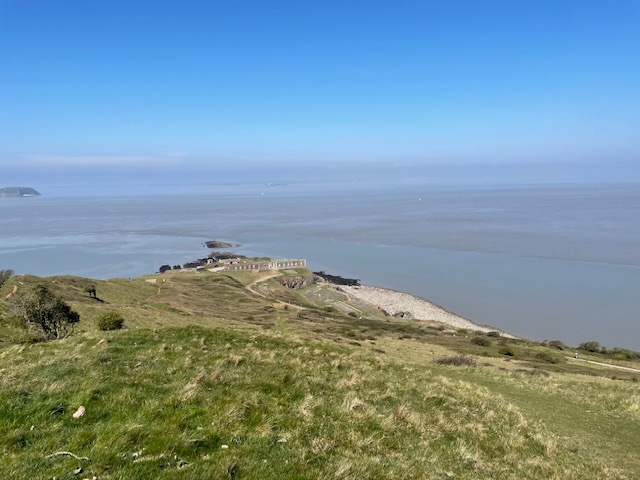
Brean Down Fort View

The slight snag with doing an 8 mile walk after a visit to Brean Down is that Brean Down itself requires a bit of effort. A nice amble on the beach it is not. As I dragged myself up the steps to reach the top of the promontory, I found myself thinking "is this fun? I'm not sure this is fun", before I reached the summit and was treated to the amazing views that make a climb worthwhile. 

Let me tell you a little bit about Brean Down:

  • Brean Down is a promontory stretching 1.2 miles into the Bristol Channel
  • People have used Brean Down for thousands of years - a possible long barrow mound suggests Neolithic occupation, while remains of an Iron Age hill fort and Roman temple have also been found
  • In the 19th century, plans were drawn up to turn Brean Down into a harbour that could act as a transatlantic port. The project was beset with problems and it didn't materialise.
  • Brean Fort was built at the far end of Brean Down between 1865-1872 as part of a chain of forts designed to protect against the French.
  • The main building we see today (below) was the barracks for 50 men
  • The fort was refortified in 1941 during World War II 


For some reason it reminded me of the Alamo. This isn't so strange - they're both forts after all. But I've never actually been to the Alamo, so I'm not sure why I made that connection. Maybe the sun was getting to me.

The walk along the promontory to the fort had been quite tricky - the steep steps, then an uphill incline followed by a steep downhill section that I wouldn't want to do on wet ground. I thought sadly of the people with mobility issues who wouldn't ever be able to see Brean Down. On my return walk, I discovered that I'd taken the high road route and an alternative was available -  a mostly flatter gravel path that was being enthusiastically used by highly determined folk powering themselves up the hill in all terrain mobility trampers. Never underestimate the National Trust or its members. 

The Brean Down Scone

It must be said that even the Brean Down cafe makes you work a little harder than your average NT property. I helped myself to a fruit scone and had paid for it when the assistant explained that I would find the jam and cream in the fridge and then I needed to pick up my drink from the counter in the other room. I ran around, collecting the constituent parts of my cream tea, feeling like I was on the Crystal Maze. It wasn't unpleasant - just different.

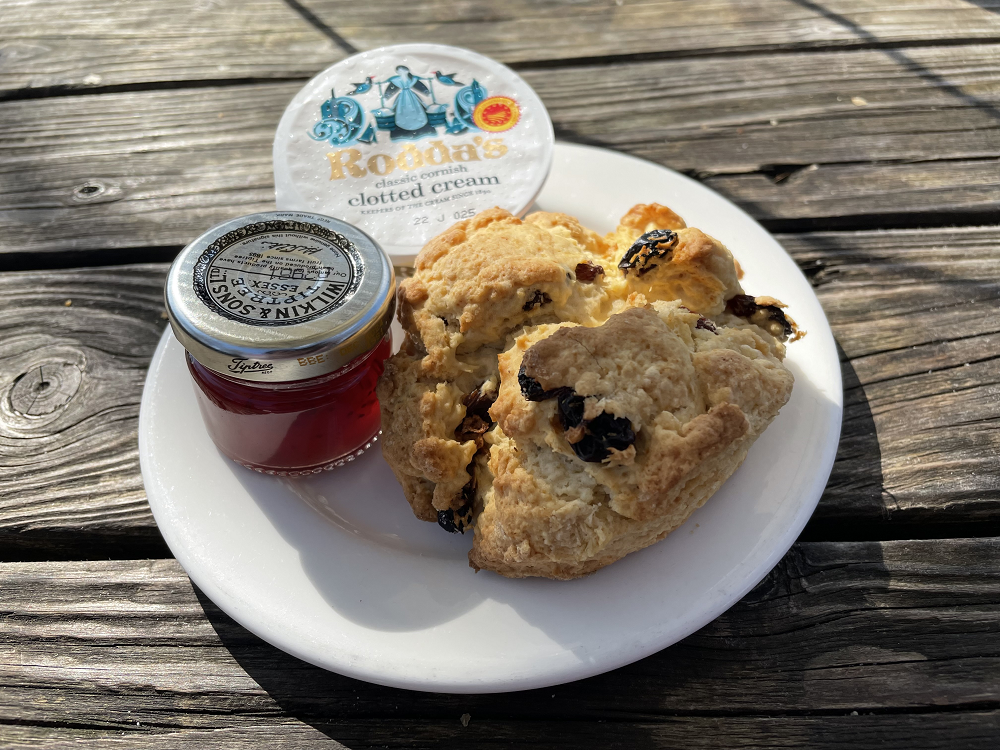
Brean Down Scone

It was worth it though, because the Brean Down scone was a lovely one - very big and even. It was fresh, full of fruit and very tasty, so it gets full marks from me.

And, despite the exertion, I can also recommend the walk back to Weston-super-Mare. The Brean Down Way is mostly flat and very well designed and maintained - once you get through Brean you don't encounter any cars for a few miles until you get to Weston itself. I did have the unexpected problem of sun (unexpected because it was April). I decided to buy myself a hat to prevent my face looking like a beetroot but the hat turned out to be a kid's baseball cap, so I had to walk along with a little hat perched on my head, looking like one of the Mr Men. 

As my weary legs carried me up the seafront in Weston, I was able to gape in awe at Brean Down in the distance. It looked like a sleeping crocodile about to glide down the Bristol Channel and I was inordinately proud of having walked all the way from the tip of its nose. 

Brean Down from Weston


Brean Down: 5 out of 5
Scone: 5 out of 5
Walking the Brean Down Way path to Weston-super-Mare: 5 out of 5

Saturday, 26 March 2022

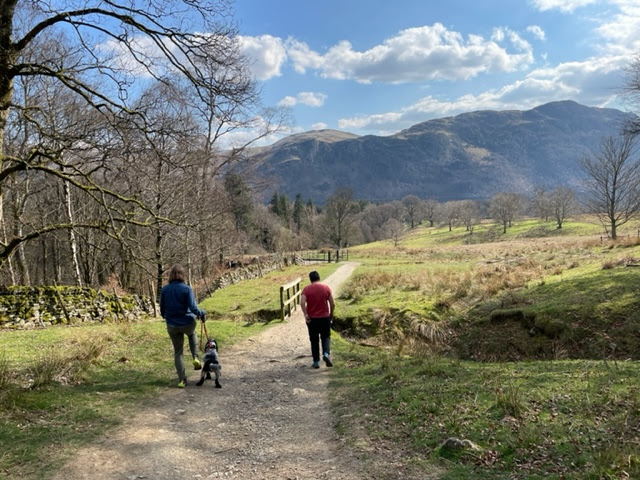
Aira Force and Ullswater

Maybe it's the law that every waterfall has to be described as 'dramatic' and 'thundering' but I will be very, very honest with you, viewers: having read a bit about the place in advance, I was expecting Aira Force to be a bit more of a force? 

Aira Force waterfall

Due to a fallen tree, you can't access the viewing platform so you have to admire the falls from afar and then walk over them. This does diminish the impact a bit. BUT. It is very beautiful and the walks around the area are absolutely lovely.
  
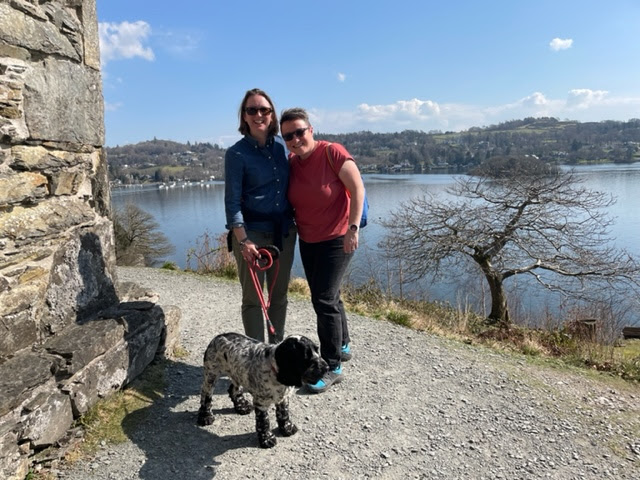
Ullswater

William Wordsworth even wrote a poem about Airey-Force Valley (as he called it): 

—Not a breath of air
Ruffles the bosom of this leafy glen.
From the brook's margin, wide around, the trees
Are stedfast as the rocks; the brook itself,
Old as the hills that feed it from afar,
Doth rather deepen than disturb the calm
Where all things else are still and motionless.
And yet, even now, a little breeze, perchance
Escaped from boisterous winds that rage without,
Has entered, by the sturdy oaks unfelt,
But to its gentle touch how sensitive
Is the light ash! that, pendent from the brow
Of yon dim cave, in seeming silence makes
A soft eye-music of slow-waving boughs,
Powerful almost as vocal harmony
To stay the wanderer's steps and soothe his thoughts.

The Aira Force Scone

I certainly needed to soothe my thoughts as I approached the cafeteria at Aira Force. I have to tell you that I could write a very lengthy thesis on the art and science of purchasing National Trust scones. People think it is easy. It is not. 

The Aira Force scone is a great example of this. It was my second scone of the day, as we'd already stopped off at Claife Viewing Station. This means that two completely opposing things occurred at the same time: on the one hand, my stress levels were reduced because one scone was already safely in the bag, so the trip wasn't going to be a complete disaster. 

But! Because it was the second stop of the day, it was LATER in the day. I was now veering into mid-afternoon territory and that's a scary place for a Scone Blogger. It was also the warmest day of the year so far and the place was packed.

I joined the queue with a sense of foreboding and did a quick, subtle recce of the scone situation. In normal circumstances, the person with me is usually oblivious that we have now entered the critical moments of the scone mission. My friend Steph, however, is a very, very observant person. Within 3.5 seconds she had clocked the situation and turned to me and said "There are only two scones left".  

The queue was long. The person at the front asked for a cream tea. Steph looked at me. The next person in the queue was querying out loud whether she whether wanted a cream tea or not....did she? Didn't she? She did. Steph looked at me.

We finally made it to the front. "Two cream teas please!" I chirped confidently, as if by not even acknowledging that no scones was possible, I could stop it happening. "You're lucky," said the very nice man. "These are the last two."

Aira Force Scone

(I'd like to point out that Steph doesn't eat scones and there was no other food left so while I was gambolling triumphantly off across the patio with my baked items, she was making do with coffee. I probably wasn't empathetic enough about that, so sorry Steph.)

Anyway. It was a delicious scone and well worthy of 5 stars.

Aira Force and Ullswater: 5 out of 5
Scone: 5 out of 5
Food that wasn't a scone: 0 out of 5 (it was a very busy day)

Claife Viewing Station

Nobody can ever accuse the National Trust of turning Claife Viewing Station into a tourist attraction, because it always was a tourist attraction. It was built in the 1790s to wow visitors when they came to Lake Windermere in the Lake District, a two storey octagonal tower that looked like a mini castle. 

Claife Viewing Station

It's hard to believe now, but until the 18th century the Lake District wasn't troubled by tourists. It was largely was seen as an unattractive wilderness. This changed for a number of reasons: firstly the Picturesque movement encouraged people to appreciate landscapes, while the French Revolution and Napoleonic Wars made it harder for people to travel on the continent. The Lake District became a destination and - as 19 million annual visitors can now confirm - it never looked back.

It was one Reverend William Braithwaite who commissioned the original summer house, which was built in a Greek/Roman style. It was then extended by John Curwen after he purchased it in 1801, giving it a more Gothic look. By the 19th century it was hosting dinners and other events, with visitors often arriving by boat and making their way through a landscape garden to the big reveal of the spectacular views over Windermere.

The building also used coloured glass to provide filters on the views - yellow gave the visitor a summer perspective, for example, while light green was used to provide a spring theme and so on. There's still a hint of this in the building today:

Claife windows

By the end of the 19th century, Claife Viewing Station had fallen out of favour and into disrepair. It eventually passed to the National Trust in 1962.

The Claife Scone

To be honest, I wasn't sure if the cafe at Claife was actually run by the National Trust. As per the Rules of the National Trust Scone Project, I don't need to include properties with tenanted or 'NT approved' scone facilities. 

However, I decided to go for two reasons. Firstly, at this late stage of the scone quest I am taking absolutely no chances of missing one out. Secondly, my very brilliant friend SJ had seen my map of remaining properties and had sorted out the itinerary for the day to help me get two more places covered. I have had a lot of help with this project over the years but SJ and Steph have gone above and beyond - they've done about 450 miles with me and Steph doesn't even eat scones.

The triangular shape of the fruit scones finally convinced me that the place wasn't NT run, but frankly it didn't matter because it was an absolute barnstormer. There was no jam or cream but SJ and I agreed they weren't needed. Fresh, warm, fluffy and full of fruit - it might not strictly qualify as a National Trust scone but I'm including it anyway. 


Our luck was also in: one of my fellow scone fans visited Claife the following day and reported that there were no scones at all.  

SJ, Steph and Cooper - if you also ever decide to visit 240 National Trust properties,
I can recommend them as an exemplary support team.

Claife Viewing Station: 5 out of 5
Scone: 5 out of 5

Friday, 25 March 2022

Beatles' Childhood Homes

I'll cut to the chase here: there aren't any scones at the Beatles' Childhood Homes. But seeing as Paul McCartney and John Lennon gave us the most influential pop band of all time, as well as 180-odd Beatles songs, as well as all the other music they did, I'm going to let them off.

There are two properties that you get to visit as part of your pre-booked tour: 

  • 20 Forthlin Road in Allerton in Liverpool, where Paul McCartney lived from the age of 13 until his dad had to move when Paul became too famous
  • Mendips on Menlove Avenue in the nearby Woolton area of Liverpool, where John Lennon lived with his Aunt Mimi from the age of 5

Pre-booking is essential and you meet your driver at a designated pick-up point (in our case, Liverpool South Parkway station). They then drive you to the first property, drop you off, and then pick you up and drop you off again. The reason for this becomes very clear: both houses are on normal residential streets. Even the most tolerant of neighbours probably have a limit on how many people and how much traffic they're willing to put up with.

Our first stop was Mendips. I had heard that John had grown up with his aunt and uncle in quite well-to-do surroundings, after it became clear that his parents weren't able to look after him. It wasn't quite the case - his Uncle George died very suddenly when John was 14 and Mimi took in student lodgers to make ends meet.

Beatles Houses Mendips

In yet more tragedy, John's mother Julia was hit by a car and killed in 1958. What I didn't know was that she had been visiting Mimi and the accident took place only a few yards from Mendips.  

Colin, the tour guide at Mendips, was great. He was a local boy who remembered the very church fete where John Lennon met Paul McCartney for the first time. Unfortunately for Colin he doesn't remember The Quarrymen playing their set at all - he did remember the police dog display though and said it was amazing.

We then hopped back on the bus and zipped off to Forthlin Road. Colin had told us that Mimi was a bit sniffy about John having friends from the council estate but as Paul dressed smartly and didn't "talk Scouse" she let him in the house.

Paul also had tragedy in his life. The family moved to Forthlin Road in 1955 but his mother died shortly afterwards, when he was 14. Music was a big thing for Paul, his brother Michael and his dad. Jim had formed an outfit called Jim Mac's Jazz Band, and Paul's brother Michael later formed The Scaffold (of Lily the Pink fame) with Roger McGough and John Gorman. Lots of Beatles songs were composed in the living room at Forthlin Road.

Beatles House Forthlin Road

Paul's brother Mike was a keen photographer and so there are loads of great shots of the family - Paul getting ready to to The Cavern and so on. It really helps to bring the place to life, as do the recordings of both Paul and Mike that get played as you move around the house. 

The National Trust has done a great job of restoring the place. The tour guide explained that the NT had acquired the windows from a house across the road, for example, while the original Belfast sink was found in the garden being used as a flower pot. My favourite story was the front door: when new owners replaced the original, the next-door neighbour retrieved it from the skip knowing that it might be a worth a bob or two one day. 

Unlike Mendips, there's no blue plaque on Paul McCartney's house. This is because English Heritage only give you a plaque when you've been dead for at least 20 years. I can understand that it helps give a bit of perspective but come on: I hardly think we'll forget Paul McCartney. 

Anyway - I highly recommend a visit to the Beatles' Childhood Homes. The tour guides are fantastic and it's a really unique insight into the history of music and the lives of Lennon and McCartney.

Beatles' Childhood Homes: 5 out of 5, 8 days a week
Scones: there weren't any but we knew that
Tour guides: 5 out of 5

Saturday, 5 March 2022

Ormesby Hall

I don't suppose there are many people in the world who would attempt a day trip to Middlesbrough from London, apart from football fans and scone bloggers. But that's what I did today: a 480 mile round-trip for a National Trust scone. 

Back in January, I'd looked at the list of places I needed to visit in order to finish the National Trust Scone Quest and two thoughts came to mind:

1. I only have 24 properties to go - I will SURELY complete the task this year
2. Those 24 properties include one in North Yorkshire, one in Snowdonia, one in Essex and three in Cornwall. How did I let this happen? 

What made it even more troublesome was that Ormesby Hall near Middlesbrough seemed like an understated kind of place. It didn't claim to be involved in any major historical event, like Moseley Old Hall, or have a scandalous past like Seaton Delaval

But if I've learned one thing over the past 9 years of this project, it's never underestimate a National Trust property.

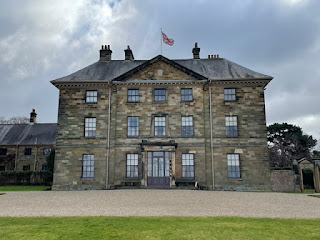
Ormesby Hall

To summarise: I absolutely loved Ormesby Hall. There are many reasons for this: the homeliness of the place, Ruth Pennyman and her headscarf, the tea-room inside the house, the surprise model railway, all of which you can read about below.

But before I get onto the history, I'm going to give a mention to the volunteer guides. There are some properties where you just strike lucky with entertaining, informed, passionate guides and the ones at Ormesby were brilliant. There was no guide book, so I had to try and learn as much as I could from them and they didn't let me down.

Ormesby - owned by the Pennyman family

The Pennyman family lived at Ormesby for over 400 years, although the present house was built in the 1740s. They sound like an interesting bunch, always on the wrong side of things: Robert Pennyman had been executed in 1569 for his part in the Pilgrimage of Grace against Henry VIII. They were Royalists in the 17th century, with William Pennyman (the 1st Baronet) fighting for the King at the Battle of Edgehill in 1628. 

The 'Wicked' Pennyman bankrupts the place

James, the 'Wicked' 6th baronet, was a gambler who landed the family in bankruptcy. The guide told me that he had inherited £25m in today's money but it was soon gone. The contents of the house were sold off and the place was shut for almost 20 years. His son William managed to get it back on its feet - when he died without children the estate passed to his aunt and her family, while the baronetcy became extinct.

Jim and Ruth - the final Pennyman residents

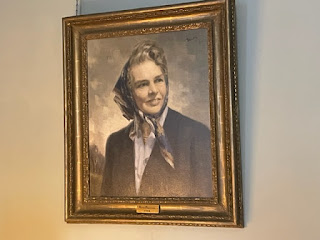
The last Pennyman to inherit Ormesby was James Beaumont Pennyman. His first wife died in childbirth and in 1926 he married a woman called Ruth Knight. I knew I liked Ruth from the minute I saw her portrait:

Ruth Pennyman

How many women would choose to sit for a portrait in a head scarf and blazer? She was obviously brilliant. I knew she was the kind of woman who got things done and I wasn't wrong - there were notices everywhere explaining how the couple had very different interests and political viewpoints but together they had set up schemes for unemployed miners. She was also very fond of the arts - visitors to the house included everyone from Sybil Thorndike to Ewan MacColl.

The Ormesby Model Railway

Before I move on to the all-important scone, I have to tell you that Ormesby Hall had a final flourish up its sleeve. It doesn't happen very often but occasionally you wander into the last room of a house thinking 'well, that was all very nice', expecting nothing more than a basket for your visitor surveys and an exit door with a handle that needs twisting a bit.

At Ormesby, I wandered into a final room to find an enormous model railway. In the middle of the railway was the nicest man in the world. He told me that Ormesby had decided to use the space to offer something to younger visitors and that a man had donated a fantastic model railway that had taken him 35 years to create. "To be honest, this ended up being something the adults love," he added. "So we put Thomas the Tank Engine next door." He pointed out the bits of the railway that were particularly relevant to the NT - Corfe Castle is in it, for example.

At that point, some other visitors wandered into the room so I thanked him and turned to leave. "Are you not going to see Thomas?" he said, sounding disappointed. I will admit that my heart sank a bit. I didn't want to be rude but I imagined that the room would contain a toddlers' table with some colouring pencils and books. But he had been so very lovely - I decided I would go and admire the crayons for him.

Reader, I was wrong. I have never been more surprised at the contents of a National Trust room. There in front of me was another model railway containing four trains, of Thomas and his friends. You could choose which button you pressed to set each in motion. My mind was blown, so a real fan of Thomas the Tank would probably have exploded with excitement. 


It was so good, I just spent 30 minutes working out how to upload a video onto the National Trust Scone Blog so I could share it with you. 

The Ormesby Hall Scone

But let's move on to the scone. I have to tell you that I've never met a National Trust tea room I didn't like. Team rooms fitted into stables or other out-buildings? Love the quirkiness. Large new-build cafeterias? Love the space and modern conveniences. Tea rooms located inside the house, thus allowing you to pretend you live there? Saddle up my second-best horse, Jeeves, I want to inspect the ha-ha after tea. 

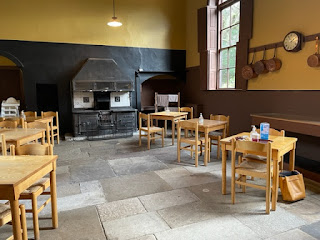
Ormesby falls into the latter category. It has been fitted into the kitchen area of the house and the service area is relatively small. Having been to two large modern tea spaces this year, I started to worry. I worried even more when they charged me £6.20 for a cream tea - ie the same as East Riddlesden the week before, where they seemed to have better facilities. What if this turned out to be a 'good effort with limited resources' type of scone?  

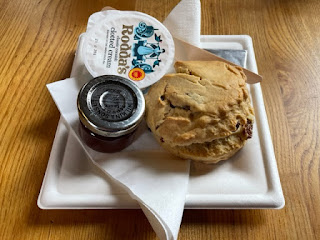
The worrying was for nothing. The scone was absolutely first-rate - very fresh, slightly warm and delicious. I ate every last crumb of it.

Ormesby Hall scone

I don't award points for tea room decor but I'd like to compliment Ormesby on providing a tea room that matched my bag:

Ormesby Hall tea room

The Scone Blogger has a Walk of Fame called "Houses I Would Live In Tomorrow If The National Trust Would Let Me, And Also Paid The Heating Bills". Ormesby Hall goes straight onto that list, along with Croft CastlePeckover, Goddards, Sunnycroft, Batemans, Arlington and Hughenden.

I will end by saying that every time I tweet about scones at the moment I feel a bit uneasy. Like everyone, I spend a lot of time reading and worrying about Ukraine. I know that scones are trivial compared with being bombed, killed, forced from your home. But all I can do (apart from donating to the Disasters Emergency Committee, which supports 15 UK charities in getting aid to the Ukrainian people) is to keep going. During those 14 hours on the road yesterday, all I could think about was how I had the freedom to travel from one end of a much loved country to the other and how one day the Ukrainian people will once again be able to do the same. Let's make sure that day comes soon.

Ormesby Hall: 5 out of 5
Scone: 5 out of 5
Thomas the Tank: 5 out of 5

Saturday, 19 February 2022

East Riddlesden Hall

I think East Riddlesden Hall will go down in scone blog history as the hardest-fought scone of all time. I've had my travel battles before but this one took the biscuit, thanks to Storm Eunice.

I have to tell you that I don't normally ignore travel advice. I'm usually the batten-down-the-hatches type, but I knew that if I timed it right I could get ahead of the bad weather and batten my hatches down in West Yorkshire.

I won't go into it, except to say my journey took nine hours instead of four.

Instead, let's get straight into the history of East Riddlesden Hall, which is located just a mile from Keighley station!

  • There have been inhabitants on the site since the 7th century
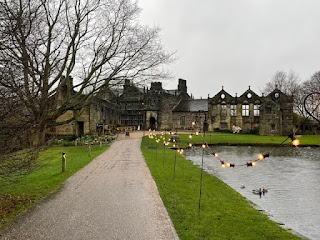
  • In the early 14th century a hall was constructed on the site where the facade on the right in the picture below now stands:
East Riddlesden Hall
  • In 1638, a rich wool merchant called James Murgatroyd bought the estate and built most of the house you see on the left in the above picture
  • This included a Great Hall that sits between both wings but he died before it could be finished
  • A man called Edmund Starkie completed the acquisition of the estate in 1708. He built the Starkie Wing, although all that's left of that is the facade, as it was demolished in 1905.
  • The estate was eventually inherited by Starkie daughters who had married Suffolk men - they became absentee landlords and pieces of the estate were sold off 
  • The Brigg brothers saved the house from demolition in 1933 and gave it to the National Trust

East Riddlesden reminded me of Cotehele in that it was a) very dark and b) one of those labyrinthine houses where you can never quite work out where you are or why there are so many rooms in a relatively small building. Or at least I couldn't.

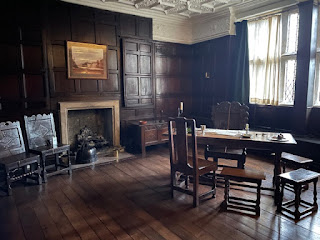
The Drawing Room,
known as 'His Own Parlour' in James Murgatroyd's time

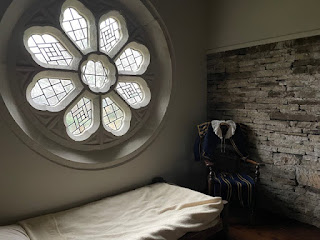
The interior of the house was chopped up and remodelled several times during its history, as different tenants moved in and out. As a result, it has some oddities, like this very tiny bedroom with an enormous rose window:

Surely the most incongruous
bedroom window in Britain

The Airedale Heifer

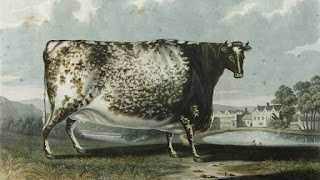
My favourite line in the guidebook was without doubt this one: "During the 1820s East Riddlesden enjoyed the reflected glory of the celebrated Airedale Heifer" who was apparently "fattened on the estate". I was instantly fascinated by this Airedale Heifer and did some more research: "It was said to have been 3.5 metres (over 11 feet) long and weighed more than a ton and became a much-visited local animal celebrity until its slaughter following a serious injury in 1830."

I'm not sure I've encountered a "local animal celebrity" before. I was quite sad that she wasn't mentioned in the house (although I just checked the book and there's a picture of her in the kitchen that I must have missed). There wasn't any Heifer merchandise in the shop either. I'd have paid good money for a "I got fattened at East Riddlesden Hall!" mug or fridge magnet. 

The impressively huge Airedale Heifer with the Hall
in the background - she was 170 years too early for 'Pets Win Prizes'

The East Riddlesden Scone

I don't want to worry any of the remaining places on my list, but I seem to have become the angel of doom for National Trust properties. An hour after I left East Riddlesden, they closed the place early because of snow. Ilam Park also closed early, an hour after I had eaten my scone there in January.

Or maybe I'm the National Trust scone ninja, using great skill and agility to grab my scone in the very nick of time before the weather catches me. To be honest, it's all quite stressful whichever way you look at it. But such is life for us hardy National Trust members venturing out before Easter.

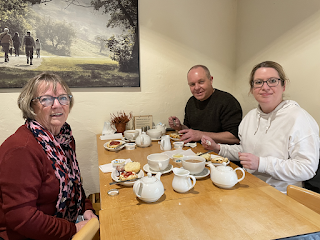
Anyway. The tea room at East Riddlesden was really lovely. I was the only person in there, presumably because a) it was the first day of their season and b) it had literally opened about 20 minutes earlier. This in itself carries risk - is it fair to judge the first scone of a property's entire season?

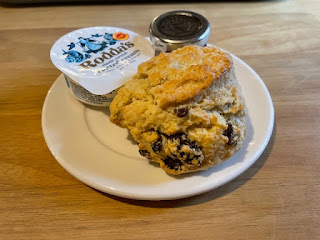
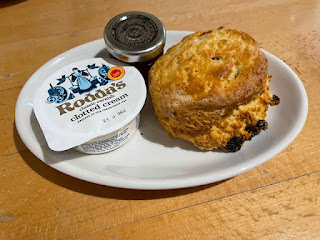
East Riddlesden scone

This was National Trust scone #194. As you can imagine, I've learned a few things from the previous 193 specimens. One of those things is that a perfect scone often dances on the precipice of disaster. Take the East Riddlesden scone today: it was still warm, which is always an encouraging sign (although not entirely surprising at 11am). However, fresh and warm can sometimes suggest that a scone is under-baked and I had to deliberate a lot on this today before adjudicating that it was, in fact, perfectly done. 

I've also had to establish a Crumbleometer. According to me, if a scone disintegrates into more than six pieces during preparation or consumption, then it must be marked down. The East Riddlesden scone tottered on the edge today but remained intact enough for a top five star rating. Bravo!

Haworth and the Brontë Parsonage Museum

By now, you have probably realised that I am ruthlessly single-minded in my pursuit of a National Trust scone. I don't really like distractions. I can count on the fingers of...well, three fingers the number of occasions when I've combined my scone missions with a visit to another heritage location. 

(For the record, they are: Tintagel Castle when I visited Tintagel Old Post Office; Hever Castle when I went back to Knole; and finally York Minster and the York City Walls when I went to Treasurers House for the third time and decided I needed to add a bit of  'value', so I wrote The Christmas Pudding Scone Tour of York.) 

But I decided to make an exception on this trip, because just five miles down the road from East Riddlesden Hall is a village that I have wanted to visit for a long, long time. 

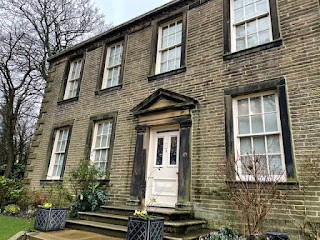
Haworth was home to the Brontë sisters, and their former residence is now a museum dedicated to their lives:

Bronte Parsonage Museum

The museum was about to close for the day by the time I turned up, bedraggled and cold like a true Brontë heroine, although I'm not sure Brontë heroines typically wore a Brentford FC bobble hat that was, in retrospect, an unwise decision in Leeds United territory. Anyway, my lateness is the reason for the poor quality photographs. However, it was absolutely worth nine hours of train pain. 

Below is the room where the sisters wrote their celebrated novels, Jane Eyre, Wuthering Heights and The Tenant of Wildfell Hall. If you've seen To Walk Invisible, the excellent BBC film about the family, you'll recognise it - although the parsonage is much smaller in real life than it seemed to be in the film.

I then headed to the Old White Lion pub/hotel where I was staying and watched the Michael Fassbender version of Jane Eyre while Storm Eunice raged outside. (There have been 24 films of Jane Eyre! 24! And that doesn't even include the TV versions! I recommend the Fassbender one. Let me know which one you prefer, in the Comments.)

Keighley & Worth Valley Railway

But I STILL wasn't done. I decided to throw caution to the (very strong) wind and add a third heritage stop to my trip. During my preparations, I had discovered that The Railway Children was filmed near Haworth on the Keighley & Worth Valley Railway. 

It's an amazing thing: the Keighley & Worth Valley Railway originally opened in 1867 and ran for 95 years before the line was closed in 1962. However, a group of determined and dedicated enthusiasts worked to reopen the line in 1968 and restore it to its past glory, leading to its appearance in the 1970 film. The station at Oakworth is the one that appears in the movie and you can stop there during the five mile ride from Keighley to Oxenhope (you can go back and forth all day if you like).

And that's it! A miraculous feat, considering I'd attempted three heritage visits during a very bad storm and managed to successfully achieve all three! This really could be my year! Who wants me to come and force them to close their property early next?? 
  

East Riddlesden Hall: 5 out of 5
Scone: 5 out of 5
Brontë Bonus: 5 out of 5  - I'd give it more if I could

Saturday, 29 January 2022

Ilam Park, Dovedale and the White Peak

Consider this: in the first seven years of the National Trust scone project, I visited an average of 32 National Trust properties per year. That's thirty-two different places visited (and scone purchases attempted) annually.

Last year, I managed one - ONE National Trust property with ONE single National Trust scone. As it happens, that one visit to Winchester City Mill was great: I was joined by one of the Sconepals, so I got to meet her after years of following her on social media, plus the volunteer guides in the Mill were brilliantly entertaining and knowledgeable.

But the scone situation was just too stressful. It was takeaway only (due to COVID), it was absolutely pouring with rain (due to England), so at one point our only recommended option was to take the scones and eat them in Winchester Bus Station. (We didn't do this, obviously: we just stood outside eating a cream tea in a downpour next to a river, because that's what you do when you're British.) 

For this reason, I decided to sit it out last year and wait. It didn't feel right to be highlighting missing scones or closed tea rooms caused by staff shortages. And as Johnny Logan said; "What's another year, when it's already taken seven?" (He didn't say that last bit.)

What I had forgotten is that visiting the National Trust always contains an element of risk, because COVID isn't the only thing that can shut a tea room. Power cuts, weather...you never know when your plans might need to change. As Steven Tyler from Aerosmith said; "We're living on the edge in the National Trust." (He didn't say that last bit.)  

It probably helps to manage the risk with some planning and weather awareness skills but I don't have any, so I was halfway to Ilam Park, Dovedale and the White Peak today before I was even aware of Storm Malik. I hastily looked at the Twitter feeds of some NT properties and saw that a few were closing their doors for safety reasons. But we continued on and made it to the Manifold tea room, which is named after the nearby river and valley. 

I'm going to start with the scone, having made you wait 223 days for it. As you know, I have a 'Scone First' policy whenever I visit a new property because otherwise I walk around mentally accusing all the other visitors of having just eaten the last scone of the day.

And that policy served me well today, viewers, because by the time we got back from our walk the tea room had been closed due to the high winds! Can you imagine if we'd waited? But Scone First it had been and so I'd already bagged this big, rugged and reassuring scone. It was also very fresh and delicious and got a unanimous 5 stars from the panel:

Ilam Park National Trust Scone

The panel today was made up of members of the Scone Blogger's family. This wasn't their first rodeo and their standards seem to have gone up during the COVID hiatus: there was a minor complaint from one member who claimed that all of her fruit was in the bottom half of her scone. This was overruled by everyone else. But we all agreed that the tea room itself was lovely with friendly, helpful staff. 

Ilam Park Tea Room

We then set off to see what Ilam Park, Dovedale and the White Peak had to offer. I was completing my Peak District trilogy today, having visited Kinder, Edale and the Dark Peak in June 2019 and Longshaw, Burbage and the Eastern Moors in January 2018. You'd probably assume that I would have been prepared, but no - I was still tottering around with a handbag and a pair of trainers while sturdy booted rucksackers strode past me. I think we have established that I will never learn.

So here's what we discovered:

  • This area of the Peak District National Park is known as the White Peak Estate
  • It's situated in the central and southern part of the Peak District, while the Dark Peak covers the north-east-west area
  • The White Peak Estate contains Ilam Park and the valley of Dovedale as well as other valleys
  • Ilam Park contains Ilam Hall, the Italian Gardens and the tea room
  • Ilam Hall was built between 1821-1826. It is currently a youth hostel and you can stay there for just £15 a night! Bargain!
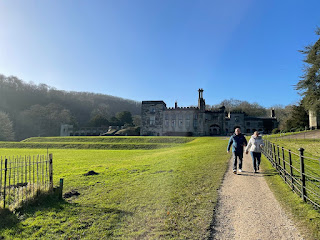
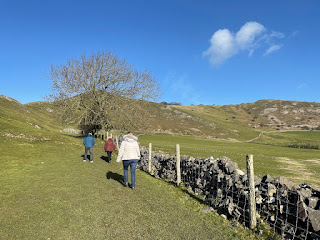
  • There's a very nice walk from Ilam to Dovedale - you can either walk across the fields and hop over one small stile, or head up a hill and go the long way. We won't dwell here on the option we chose. Let's just say that we came back the less arduous way.
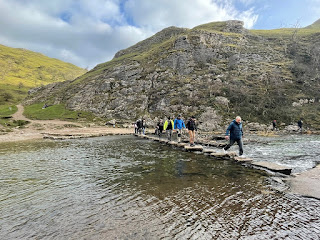
  • The stepping stones across the River Dove are quite easy to negotiate (I didn't negotiate them)

Stepping Stones in Dovedale

What you don't see in any of these pictures, of course, is the wind. It was almost unworldly - a huge swirling gust would suddenly build up and almost knock you off your feet.

This led to a first for Team Scone Blogger. As we walked along the river there was a sudden loud creaking sound and a tree on the other side was uprooted and fell away from the water. The smell of damp wood was incredible as the roots were exposed to the fresh air. Even the Scone Blogger's mother, who grew up in the countryside in Ireland, had never seen such a thing. We were very lucky it didn't fall on any passing walkers, as it was a very clear reminder of the sudden dangers of the weather. Plus it explained why the NT closed the car park and tea room as a safety precaution.

So that completes the first National Trust Scone Mission of 2022! Bring on the final 23! This is going to be our year!

Ilam Park, Dovedale and the White Peak: 5 out of 5
Scone: 5 out of 5
The wind: 5 out of 5 for being the wind but 0 out of 5 for stopping scone production